





































Real estate data management boils down to a critical choice: RESO Standards or custom formats. RESO Standards, like the Data Dictionary and Web API, simplify integrations with standardized fields and modern JSON-based APIs. Custom formats, on the other hand, cater to specific regional or organizational needs but often lead to higher costs and integration issues.
Key Takeaways:
- RESO Standards: Offer consistency, faster integrations (2–16 hours per feed), and scalability across markets. They reduce errors by eliminating manual data mapping and support modern tech like OData querying.
- Custom Formats: Provide flexibility for niche or local needs but require more time (25+ hours per feed), higher costs, and ongoing maintenance.
Quick Comparison:
| Attribute | RESO Standards | Custom Formats |
|---|---|---|
| Integration Time | 2–16 hours per feed | 25+ hours per feed |
| Data Consistency | High; standardized fields | Low; fragmented naming |
| Scalability | High; repeatable pipeline | Low; custom work per market |
| Maintenance | Streamlined; standardized updates | Complex; manual remapping |
| Cost | Lower; reduced development time | Higher; resource-intensive |
For national scaling or multi-market needs, RESO Standards are the clear choice. For localized operations with specific requirements, custom formats may work but come with higher costs and complexity.
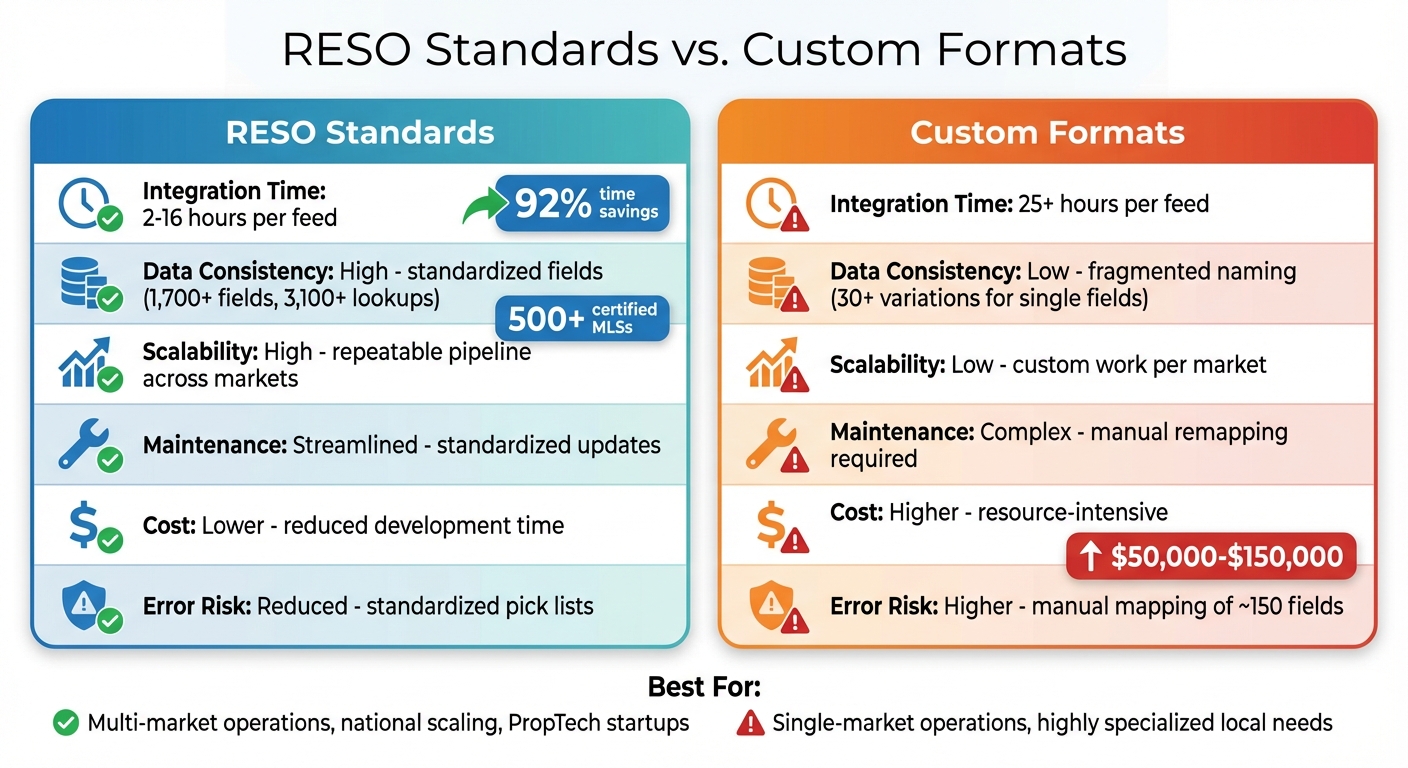
RESO Standards vs Custom Formats: Integration Time, Cost, and Scalability Comparison
How RESO Is Transforming Global Real Estate with Data Standards – Sam DeBord, CEO of RESO
What RESO Standards Offer
RESO Standards simplify real estate data exchange by creating a unified framework. At the heart of this system is the RESO Data Dictionary, which organizes data into three main components: Resources (broad categories like Property, Member, Office, and Media), Fields (specific data points), and Lookups (standardized lists of options). This ensures that a field like "ListPrice" has the same meaning, whether you’re accessing data from an MLS in California or Florida.
The RESO Web API replaces the outdated RETS protocol with a modern, RESTful design built on current web technologies. Most organizations transition from RETS to the Web API within six to nine months. Thanks to its JSON-based formatting, the data is easier for both humans and machines to process, speeding up development and reducing errors when building web or mobile integrations.
"The RESO Web API is the modern way to transport data in the real estate industry. It is built on well-known, open technology standards so that any organization can use it to deliver or receive data quickly and efficiently." – RESO
This standardized approach lays the foundation for the integration benefits discussed below.
Standardized Field Names and Values
One of the biggest advantages of RESO Standards is the elimination of custom mapping. By standardizing field names and lookups, RESO ensures consistency across platforms. For example, instead of reconciling multiple variations like "Bedrooms", "Beds", or "BR" from different MLSs, developers work with a single, unified field name. Similarly, Lookups ensure that terms like "Active" status mean the same thing across systems. With over 1,700 fields and 3,100 lookups, the RESO Data Dictionary covers nearly all data points needed for real estate transactions.
Beyond the Web API, the RESO Common Format (RCF) extends this standardization. This API-agnostic JSON format allows organizations to share data in a consistent structure, even when they’re not using the Web API. This flexibility opens the door for RESO Standards to be applied in areas like appraisals, showings, and even global markets.
RESO Web API and JSON-Based Integration
The Web API simplifies integration further by combining authentication and authorization into a single step using OAuth. It also supports payloads, which are pre-defined data structures like the "IDX Payload" that ensure developers can access complete, ready-to-use datasets for building real estate websites.
Interoperability and OData Querying
RESO Standards don’t just standardize data – they also improve how that data is accessed. OData querying enhances integration by offering a clear set of rules for API interactions and data transfers. With OData V4, developers can request exactly the data they need through live queries, instead of downloading entire datasets. This approach significantly boosts performance for web and mobile applications compared to older batch-processing methods.
"RESO uses open standards and off-the-shelf tools that are supported across industries. By ensuring standards and protocols like OData at the core of the Web API’s functionality, industry incumbents and newcomers can be assured that they are building well-supported technology." – RESO
Additionally, metadata – essentially "data about the data" – provides developers with a clear understanding of what information is available and how it’s structured. This upfront transparency minimizes development time and reduces the risk of costly errors from misinterpreting the data layout.
What Custom Formats Offer
Custom formats provide the adaptability needed to address specialized workflows and regional requirements, especially in areas where legacy systems and universal standards fall short. They bridge gaps by accommodating local nuances and ensuring data structures align with specific market needs.
Tailored Data Schemas
Custom formats allow organizations to create data schemas that reflect unique regional characteristics and requirements often missed by universal standards. For instance, certain markets may have distinct ways of categorizing property types, managing water rights, or documenting homeowner association rules – details that standardized fields might overlook. These local intricacies highlight the complexity of regional real estate markets.
By incorporating unique local data elements, custom formats ensure that critical information is captured accurately. To support this, RESO includes the "LocalData" field, which enables MLSs and brokerages to handle these unique elements in a structured and predictable way alongside standardized fields.
"Local data nuances can be effectively preserved." – RESO Staff
Legacy Systems and RETS-Like Approaches
Despite advancements in data transport protocols, many organizations continue to rely on the Real Estate Transaction Standard (RETS), which was the industry’s go-to solution for over 20 years. Although RESO now considers RETS "Deprecated" and "Historical", it remains integral to many legacy systems.
"RETS (Real Estate Transaction Standard) is a deprecated, unsupported data transport protocol created over 20 years ago." – Sam DeBord, CEO, RESO
Before standardization efforts gained momentum, platforms had to manage hundreds of MLS feeds with unique quirks. This required extensive custom mapping and format translation, driving up integration costs. While resource-intensive, these custom formats enabled organizations to operate across diverse markets before modern solutions became widespread.
Custom Field Mappings and Business Rules
Custom formats go beyond addressing legacy challenges – they also enable advanced business rules and support specialized processes.
For example, they accommodate data types beyond standard listings, such as transaction records, appraisals, tours, and showing services. This flexibility is particularly useful in markets with unique requirements, like specific methods for storing photos or enforcing record access limits.
Technology companies often use custom data mapping to translate various MLS formats into their internal schemas, ensuring operational consistency. While this approach allows for integration across multiple formats, it requires significant development effort, which can limit scalability.
RESO Standards vs. Custom Formats: Side-by-Side Comparison
Comparison Table of Key Attributes
The differences between RESO Standards and custom formats stand out when you look at how they affect day-to-day operations. Custom formats often lead to fragmentation. For instance, the field "MLS Number" can appear in almost 30 different variations across various non-standardized feeds.
| Attribute | RESO Standards | Custom Formats |
|---|---|---|
| Data Consistency | High; relies on a universal Data Dictionary with 1,700+ fields and 3,100+ lookups | Low; fragmented naming (e.g., 30+ names for a single field) |
| Integration Time | 2–16 hours per feed | 25+ hours per feed |
| Scalability | High; enables a repeatable pipeline across markets | Low; requires custom work for every market |
| Maintenance | Streamlined; standardized updates and webhooks | Complex; involves manual remapping and polling |
| Cost | Lower; modern web technology cuts development time | Higher; manual mapping consumes significant resources |
| Error Risk | Reduced; standardized pick lists minimize mapping errors | Higher; manual mapping of ~150 fields increases errors |
This table clearly outlines how operational differences impact development timelines and error rates in practical scenarios.
Development Time and Error Reduction
The practical benefits of using RESO Standards are substantial. Real-world examples highlight time savings and reduced errors. In May 2025, Homes.com slashed integration times from over 25 hours per MLS feed to just 2 hours by adopting the RESO Data Dictionary and Web API – a 92% time savings. Similarly, myTheo, a startup, shortened their market launch timelines from nearly two months to just a few weeks, accelerating their ability to scale by 30–40%.
"At one point, a few years ago, we identified nearly 30 different ways this single field [MLS number] was named in the feeds we used. For a software company… that meant the code needed to be written to account for each of those ways." – Cass Herrin, Director of Data Services, MoxiWorks
Custom formats demand manual mapping of around 150 data points per feed, which not only increases the workload but also introduces more opportunities for errors. On the other hand, RESO’s standardized framework eliminates repetitive mapping tasks. Developers can build their code once and deploy it across multiple markets with minimal modifications.
"Surely, data duplication carries more risk for inaccuracy and error than a single feed with rules that support multiple applications?" – Cass Herrin, Director of Data Services, MoxiWorks
sbb-itb-8058745
Pros and Cons of RESO Standards
Benefits of RESO Standards
RESO Standards bring much-needed efficiency to real estate data management. The RESO Data Dictionary creates a common language for property data, addressing the long-standing issue of inconsistency – fields like "MLS number" used to have nearly 30 different variations across data feeds.
These standards go beyond just naming conventions. They enable seamless interoperability, with over 500 MLSs achieving RESO certification and support from more than 800 member organizations. Together, they serve nearly two million real estate professionals. This widespread adoption means developers can create integrations once and use them across multiple markets, skipping the hassle of rewriting code for each new data source.
Organizations that have adopted RESO Standards report big wins in terms of time and cost savings. By reducing integration times, businesses can cut development expenses and bring products to market faster.
Another major plus is the flexibility offered by RESO Standards. Features like standardized custom fields and a JSON format that works independently of any specific API allow companies to meet unique market needs without losing compatibility.
Still, transitioning to RESO Standards isn’t without its hurdles.
Challenges of RESO Standards
While the advantages are clear, implementing RESO Standards does come with challenges. As mentioned earlier, moving from legacy systems to standardized models demands a significant technical effort. For instance, preparing for updates like Data Dictionary 2.0 has required years of work from software vendors, highlighting the level of expertise needed. Organizations must also familiarize themselves with both the Data Dictionary and the RESO Web API, as certification hinges on Web API compliance.
The initial setup involves aligning legacy data with over 1,700 standardized fields, which takes careful planning and resources. Although organizations don’t need to adopt every field for certification, deciding which fields to prioritize still requires strategic thought.
There’s also the issue of niche data needs. While extensibility features cover many local requirements, some highly specific cases might fall outside the core dictionary, requiring additional custom solutions. Transitioning from RETS (Real Estate Transaction Standard) to RESO specifications also means leaving behind proprietary data models, which have historically created vendor lock-in.
Here’s a quick comparison of the benefits and challenges:
| Aspect | Benefit | Challenge |
|---|---|---|
| Setup Time | 2–16 hours per feed versus 25+ hours with custom formats | Requires technical expertise in Web API and OData querying |
| Data Mapping | Eliminates manual remapping of ~150 fields per feed | Initial conversion of legacy data to 1,700+ fields can be complex |
| Scalability | Repeatable pipeline across 500+ certified MLSs | Full adoption varies; not all organizations implement every field |
| Maintenance | Standardized updates reduce ongoing work | Transition from deprecated RETS requires investment |
Pros and Cons of Custom Formats
Advantages of Custom Formats
Custom formats provide the flexibility to design data schemas that align perfectly with specific workflows. This level of precision is particularly valuable in specialized fields, like maritime property valuation or niche compliance processes.
For companies, creating custom formats can mean delivering insights that competitors using off-the-shelf tools simply can’t match. Alex Yudin from GroupBWT highlights this advantage:
"The more specific the use case – niche models, legal triggers, multilingual sentiment – the more relevance matters".
Custom formats also allow for tailored security measures to protect sensitive data and offer adaptability to changing needs. For instance, businesses can quickly integrate features like virtual tours or remote document signing in response to shifting market conditions.
Another key benefit is scalability. Custom solutions grow alongside a business, preventing revenue losses that can range from 8% to 28% due to non-scalable software. They also ensure high-quality, schema-aligned data, which is essential for regulatory compliance and deploying complex models – something generic datasets often struggle to provide.
However, these benefits come with some trade-offs.
Drawbacks of Custom Formats
One of the biggest hurdles with custom formats is the high upfront cost. Building a custom real estate automation solution, for example, can cost anywhere from $50,000 to $150,000, with deployment taking 4–6 weeks or more. In contrast, pre-built solutions are often ready in just 1–5 days. As North South Tech aptly puts it:
"Custom software is like having a tailored suit versus an off-the-rack outfit".
While the fit is ideal, the price tag reflects that level of personalization.
Another challenge is maintenance. Custom systems, due to their lack of standardization, often require constant upkeep, which can strain engineering teams and lead to burnout. For example, The Trade Desk managed to reduce its server footprint by over 80% and scale from 15 billion to 90 billion auctions per day after transitioning away from custom architectures. Engineering teams working on custom systems may spend the majority of their time on maintenance, compared to less than 10% when using standardized infrastructure.
Scaling custom formats can also be tricky. Complex data structures may lead to interoperability issues and inconsistencies. Add to that the evolving landscape of privacy regulations – like California’s CPRA, Texas-specific rules, and GDPR – and the need for manual updates becomes a recurring headache. Dakota Kelley, Senior Solutions Architect at phData, emphasizes:
"Lack of standardization makes it difficult to collaborate, track progress, and ensure the quality of data outputs".
While custom formats offer unmatched control and precision, they come with steep costs, higher complexity, and ongoing technical challenges.
| Aspect | Advantage | Drawback |
|---|---|---|
| Initial Cost | Perfect fit for unique workflows | $50,000–$150,000 upfront investment |
| Deployment | Tailored to exact business needs | 4–6+ weeks to build and validate |
| Data Quality | Schema-aligned, labeled data | High error potential due to inconsistent field mappings |
| Maintenance | Low overhead when well-integrated | Brittle systems require constant monitoring |
| Scalability | Designed to scale without major overhauls | Infrastructure costs can dominate burn rate |
| Compliance | Purpose-built auditability | Manual updates required for varying jurisdictions |
When to Use RESO Standards vs. Custom Formats
When to Choose RESO Standards
RESO Standards are a smart choice for businesses managing multi-market integrations. For example, PropTech companies expanding nationally have seen massive time savings by adopting these standards. Homes.com, for instance, cut its development time per feed from 25 hours to just 2 hours – an impressive 92% reduction. Similarly, myTheo reduced its market launch time from nearly two months to just a few weeks after implementing RESO standards. With over 90% of MLSs now offering RESO-certified Web API services, the framework is well-suited for rapid scaling.
Another advantage of RESO Standards is their ability to ensure interoperability across different technology stacks. Take Doorify MLS (formerly Triangle MLS) in North Carolina as an example. By using RESO, they built a modular system that allows brokers to choose their preferred front-end tools and switch vendors without disrupting operations. This kind of flexibility is invaluable for businesses needing seamless integration across multiple platforms.
In contrast, operations that rely on highly specialized data structures may find RESO Standards less suitable.
When to Choose Custom Formats
In scenarios where single-market operations dominate, custom formats often shine. These formats are particularly useful when dealing with unique local data needs that the RESO Data Dictionary may not fully address. If your business operates in a specific geographic area with distinct legal or geographical requirements, the adaptability of custom schemas can outweigh the benefits of strict standardization.
That said, RESO’s extensibility allows for "local fields" within its framework. This hybrid approach offers the best of both worlds: interoperability through RESO standards while still accommodating unique market-specific demands.
| Scenario | Best Choice | Key Reason |
|---|---|---|
| Multi-MLS/nationwide integration | RESO Standards | Reduced development time and repeatable integration pipeline |
| Single-market legacy operations | Custom Formats | Maintains existing business rules |
| Rapid PropTech scaling | RESO Standards | Faster onboarding and lower barrier to entry |
| Highly specialized local data | Custom Formats / Local Fields | Flexibility for unique market requirements |
| Non-API data exchange | RESO Common Format (RCF) | Standardized JSON without API requirements |
Conclusion
Deciding between RESO Standards and custom formats hinges on your business goals and the scale of your operations. RESO Standards offer a shared framework that eliminates the need to map dozens of variations for fields like "MLS number" – a common pain point in real estate data integration. This streamlined approach not only speeds up market entry but also cuts integration costs, freeing up resources to focus on developing new features rather than grappling with data challenges. However, there are cases where custom formats may still be the better fit.
For businesses operating in niche or single-market environments, custom formats can address specific local needs that might fall outside the scope of standard frameworks. That said, RESO’s flexibility allows for the addition of local fields, meaning you don’t have to choose between standardization and customization.
"Standards lower the barrier for entry into this market and increase competition, which should result in brokers having access to a growing variety of innovative products".
This quote highlights how adopting standards fosters innovation while still allowing for market-specific adjustments.
For companies managing multiple MLS integrations or planning to scale nationally, RESO Standards provide a clear roadmap. On the other hand, if your business relies heavily on legacy systems in a localized market, custom formats might still work – but be mindful of potential long-term costs and the risk of being tied to specific vendors. The trend in real estate technology is leaning heavily toward standardization. Whether you’re a growing PropTech company or a well-established brokerage, weighing these factors will help you make informed decisions that align with both your immediate needs and future ambitions. For those looking to combine standardized data with tailored local solutions, BatchData offers tools to simplify integration and enhance your data strategy.
FAQs
What advantages do RESO Standards offer compared to custom formats for managing real estate data?
Using RESO Standards in real estate data management offers several standout advantages compared to custom formats. For starters, these standards make data sharing seamless across MLSs, platforms, and applications. By standardizing the process, they eliminate the headaches of complex data conversions, resulting in faster integrations, fewer errors, and more consistent results.
Another big plus? Scalability and security. RESO Standards are regularly updated to incorporate modern tools like OAuth and RESTful APIs. These technologies allow for real-time data access while ensuring strong security protocols are in place.
By adopting these standards, businesses can simplify their data workflows, enhance accuracy, and set themselves up for long-term success in the evolving world of real estate technology.
How do RESO Standards support scalability and seamless integration across different markets?
RESO Standards make growth and integration easier by providing a consistent data format and well-defined guidelines. This uniformity ensures systems can exchange data smoothly and work together effortlessly, even when adapting to specific regional needs.
By aligning property data formats, RESO Standards help businesses simplify their processes, cut down on integration headaches, and improve teamwork across various markets. This approach not only supports scaling but also helps maintain accurate and reliable data.
What are the challenges of switching from custom data formats to RESO Standards?
Switching from custom data formats to RESO Standards comes with its share of hurdles, often requiring both technical upgrades and organizational shifts. For companies with heavily customized legacy systems, aligning with RESO’s standardized structure can mean overhauling or even replacing existing systems. This process can be both time-intensive and expensive.
On top of that, staff training becomes a priority. Teams need to fully grasp the new standards to implement them correctly, which can take time and resources. Bringing stakeholders – like brokers, MLSs, and developers – on board can also be tricky. Resistance to change is common, and getting everyone aligned might slow down the adoption process. Careful data mapping and validation are essential to avoid inconsistencies, which adds another layer of complexity.
Another challenge lies in adapting to RESO’s secure, real-time data-sharing methods, such as RESTful APIs. These modern systems can feel like a big leap for companies used to older batch processing methods. Still, while the transition may seem daunting, the long-term benefits – like improved data scalability, stronger security, and seamless interoperability – make the effort worthwhile for many organizations.