
Want to close deals before the competition? The secret lies in pre-market listings – properties shared privately before hitting the MLS. These include pocket listings, “Coming Soon” properties, and distressed homes. By reaching sellers early, you avoid bidding wars, negotiate better terms, and connect with motivated sellers who value speed and privacy.
Key strategies include:
- Using predictive analytics: Identify sellers likely to act based on life events like divorce or tax issues.
- Skip tracing: Find direct contact details like phone numbers or emails.
- Data enrichment: Build detailed seller profiles for personalized outreach.
With tools like BatchData, you can filter over 155 million properties, track distressed signals, and automate workflows. This proactive approach ensures you connect with sellers 30–60 days before properties go public, boosting your chances of success.
Quick Overview:
- Why Sellers Avoid MLS: Privacy, speed, and simplicity.
- Pre-Market Tools: Predictive analytics, skip tracing, and enrichment.
- Results: Early access to 20–30% of off-market deals.
Timing is key – act before the market sees the property.
Why Sellers Avoid the MLS and How to Find Them
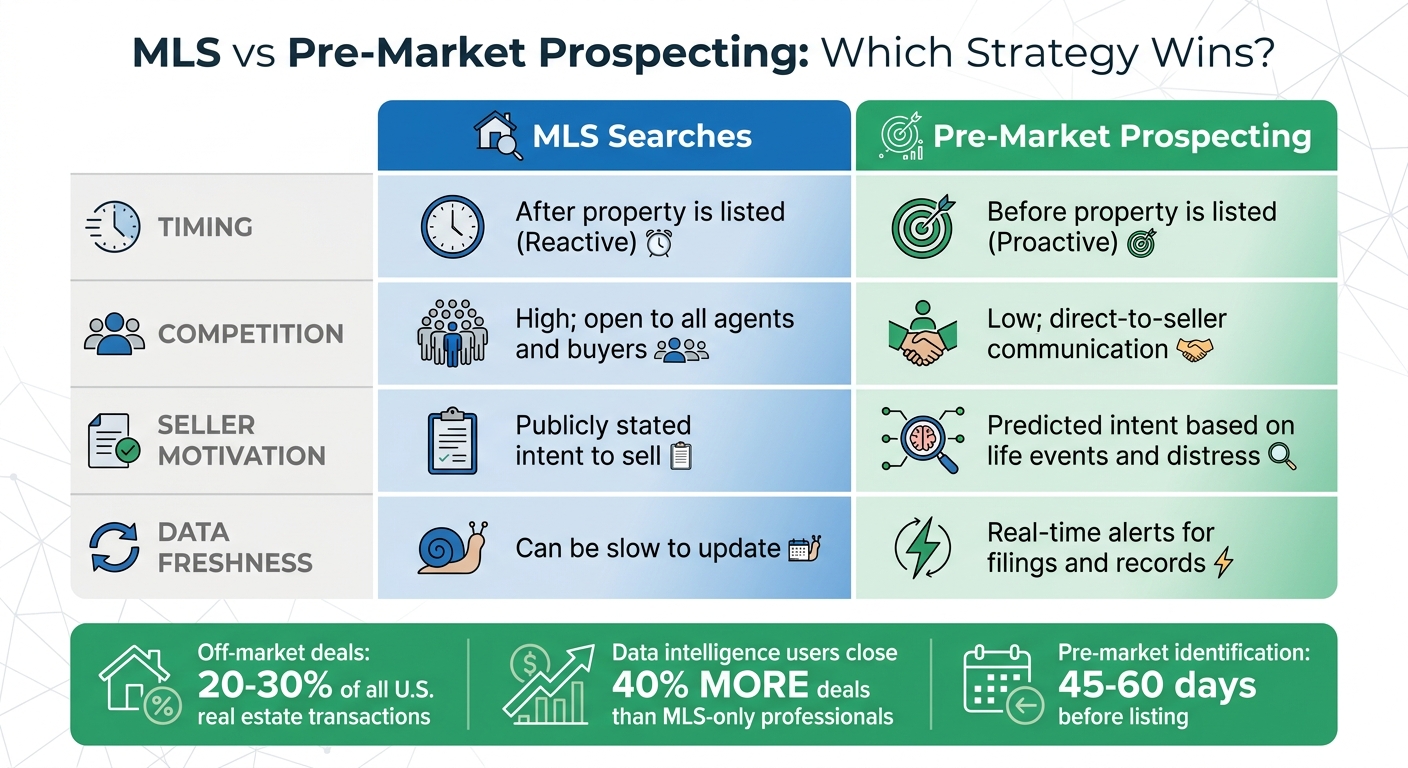
MLS vs Pre-Market Prospecting: Key Differences for Real Estate Investors
Common Reasons Sellers Skip the MLS
Many sellers bypass the MLS because they value speed, certainty, and privacy over the traditional selling process. In fact, about 66% of motivated sellers are drawn to the convenience of a quick, attractive offer rather than being driven purely by financial hardship. For these individuals, avoiding the complexities of retail channels is often more appealing than squeezing out maximum profit.
Privacy is another significant factor. Sellers dealing with sensitive situations – like divorce, probate, or the death of a loved one – often prefer to keep their transactions discreet, avoiding the public exposure that comes with MLS listings. Similarly, property owners facing major repairs, code violations, or deferred maintenance may opt for off-market sales to sidestep the time and expense required to make their homes market-ready.
“Truly motivated sellers rarely list their properties traditionally. They want discretion, speed, and simplicity – not open houses and negotiations.”
Financial distress also plays a key role. Last year alone, foreclosure starts affected 289,441 properties, marking a 14% increase from the previous year. In Q3, foreclosure starts hit 103,000 – a 23% rise year-over-year. For homeowners in these situations, selling pre-market offers a chance to clear debts and protect their credit before facing a public auction. Additionally, out-of-state heirs handling inherited properties and landlords burned out by property management often seek a straightforward, hassle-free exit.
These reasons highlight why many sellers avoid the MLS, creating opportunities for those who use real estate investing data to identify and connect with them early.
Why MLS Searches Miss Pre-Market Opportunities
The MLS operates reactively, meaning properties only appear once the seller has made their intent public. By the time a listing is live, competition is fierce, with multiple investors and agents vying for the same property. This heightened competition often drives up prices and limits your ability to negotiate effectively.
Another drawback? The MLS tends to lag behind real-time developments. It doesn’t capture homeowners experiencing life changes – like job relocations, financial struggles, or other transitions – who might prefer a quick, off-market sale. Instead, MLS searches often focus on expired or withdrawn listings, which are properties from sellers who’ve already attempted the traditional route, rather than uncovering fresh opportunities.
| Feature | MLS Searches | Data-Driven Pre-Market Prospecting |
|---|---|---|
| Timing | After the property is listed (Reactive) | Before the property is listed (Proactive) |
| Competition | High; open to all agents and buyers | Low; direct-to-seller communication |
| Seller Motivation | Publicly stated intent to sell | Predicted intent based on life events and distress |
| Data Freshness | Can be slow to update | Real-time alerts for filings and records |
These limitations make it clear why relying solely on the MLS can leave you one step behind. To get ahead, you need a more proactive approach.
How Predictive Analytics Identifies Sellers Early
Predictive analytics allows you to spot sellers before they even list their properties. By analyzing ownership patterns, equity levels, and life events, this method helps pinpoint homeowners who are likely to sell soon. It’s a proactive strategy that integrates seamlessly with efforts to reach pre-market sellers, focusing on their likelihood to sell rather than waiting for a public listing.
This strategy, often called data stacking, involves combining multiple indicators to identify high-intent leads. For example, factors like high equity (over 40%), vacancy status, and out-of-state ownership can signal a strong likelihood of selling. Pre-foreclosure status paired with solid equity margins is particularly telling, while absentee ownership suggests a more pragmatic, less emotionally attached seller.
“Motivation is about circumstance, not just finances. A seller with 80% equity who must relocate for a new job in 30 days is just as motivated as someone behind on their mortgage.” – BatchData
3 Data Strategies for Finding Pre-Market Sellers
Predictive Analytics for Identifying Motivated Sellers
Predictive analytics uses property data, transaction history, and equity trends to spot homeowners likely to sell before they list publicly. By analyzing factors like ownership duration and equity levels, you can pinpoint sellers who are ready to move.
For example, data shows that homeowners with over 10 years of ownership and at least 50% equity are three times more likely to sell off-market when compared to others. One investor, targeting 500 properties with these criteria, closed 12 off-market deals at 10–15% below market value, saving an average of $25,000 per transaction.
Assigning point values to specific indicators can help prioritize leads. For instance:
- +50 points for pre-foreclosure
- +25 points for high equity
- +15 points for out-of-state ownership
Predictive models can identify motivated sellers 30–50% more effectively than traditional MLS searches. With an 85% accuracy rate, these models can forecast sales within 6 months by flagging signs like tax delinquency, divorce records, or pre-foreclosure status. These tools detect signals 60–90 days before a property hits the market, leading to outreach response rates that are 20–30% higher than average.
Once you’ve identified potential sellers, the next step is gathering their contact information.
Skip Tracing to Find Seller Contact Information
Skip tracing turns property details into actionable leads by uncovering hard-to-find contact information, like phone numbers and email addresses. By cross-referencing public records, credit data, and utility information, you can locate property owners who might not be easy to reach through standard methods.
For absentee owners – who make up 20–25% of pre-market sellers – skip tracing is especially effective, with an 82% success rate in finding contact details. One team traced 1,000 absentee owners, achieving a 25% contact rate and converting 5% into signed contracts.
Skip tracing can provide multiple contact options, including phone, email, and SMS, depending on the data available and the services being used. Different outreach methods have different advantages, limitations, costs, and compliance requirements.
SMS messaging can be useful for reaching contacts through text-based communication, while cold calling provides a more direct way to engage potential leads. Before choosing an outreach method, evaluate the quality and availability of the contact data, applicable communication regulations, and the requirements of your specific workflow.
To stay compliant with TCPA regulations, always include an opt-out option like “Reply STOP.” Violations can result in fines of up to $1,500 per instance.
With verified contact details in hand, you can take things further by enriching your leads.
Data Enrichment for Complete Seller Profiles
Data enrichment enhances your lead list by adding valuable details such as demographics, financials, and property specifics. This transforms basic records into detailed profiles, allowing for more personalized and effective outreach.
Key fields to add include:
- Estimated net worth
- Relocation likelihood scores
- Owner sentiment indicators
By layering in data like equity percentages, loan origination dates, and situational triggers (e.g., probate filings or job changes), you can better understand both the ability and motivation of a seller. Enriched leads tend to convert 40% better than standard lists.
For instance, imagine targeting a homeowner profile like this: John Doe, 62 years old, earning $150,000 annually, with 65% equity in a home owned for 18 years. If recent data shows John is relocating, your message could say:
“John, with your $200,000 equity, sell off-market to avoid commissions – let’s discuss your Denver relocation.”
This kind of tailored messaging boosted engagement by 35% compared to generic approaches.
To streamline the process, you can integrate predictive analytics, skip tracing, and data enrichment into a single workflow using a real estate API. For example, start with 10,000 properties, identify the top 5% most likely to sell, skip trace the top 500 for contact details, and then enrich those leads for personalized outreach. Automating this process can reduce manual work by 70% and generate 15–20 qualified leads per week.
These combined strategies can help you capture up to 70% of off-market deals that never make it to the MLS. Predictive analytics alone can identify 85% of sales three months in advance, increasing close rates by 2.5 times over traditional methods.
BatchData Tools for Pre-Market Success
Property Data Enrichment and Skip Tracing
BatchData offers access to 155 million property records, which can be filtered using financial details like equity and mortgage balance, property features, and ownership types such as absentee or corporate-owned properties. Their skip tracing technology boasts a 76% right-party contact rate, which is three times higher than the industry standard.
The platform’s “See Behind LLCs” feature reveals the actual owners behind corporate entities, while carrier insights help differentiate between landline and mobile numbers. Each record includes multiple contact options, such as phone numbers and email addresses, to maximize your ability to reach sellers.
BatchData also integrates data stacking to combine distress signals like vacancy, tax delinquency, probate filings, and code violations. This approach makes identifying motivated sellers more precise. For instance, combining filters such as “out-of-state owner”, “high equity”, and “recent code violation” creates a targeted list of sellers who are both motivated and in a strong financial position to sell. Interestingly, life events like divorce, probate, and relocation account for over 40% of all motivated seller activity.
Compliance is another key feature, with tools like DNC scrubbing and TCPA Litigator APIs ensuring outreach efforts remain legally compliant.
“The core principle is this: Motivation is about circumstance, not just finances”.
By leveraging these tools, you can identify and contact motivated sellers before competition heats up. This enriched dataset provides actionable insights, enabling real-time property searches with confidence.
Property Search API and Bulk Data Delivery
BatchData’s Smart Search API uses an event-driven “push” architecture that eliminates the need for constant polling. Once you set your criteria – such as high equity, out-of-state ownership, and vacancy – the system instantly sends new matching leads via webhooks or direct integration as soon as they’re identified.
The platform processes over 600 million records, updated daily to capture new deeds or changes like pre-foreclosure in real time. This real-time data stream ensures you’re acting on the latest opportunities, unlike static lists that can quickly become outdated.
“We want to supplement your work and make you superhuman so you can do things in seconds, not hours. That’s where BatchData comes in. What used to take 30 minutes now takes 30 seconds.” – Chris Finck, Director of Product Management at BatchData.
For users without development resources, automated CSV deliveries are available via shared folders, S3, Google Drive, or SFTP. These updates continuously refresh your lists, allowing you to combine geographic boundaries with hundreds of data points like equity, vacancy status, ownership length, and distress signals.
Pricing Plans for Different Business Needs
BatchData offers flexible pricing options designed to support different data requirements, usage volumes, and business needs.
Pricing varies based on the products and services selected, data requirements, usage volume, and integration needs. For the latest pricing, available plans, and options, visit the BatchData pricing page or contact the BatchData sales team.
For businesses with more advanced requirements, Custom Solutions can provide tailored data feeds, API integrations, and workflows based on specific use cases and volume requirements. This flexibility allows teams to choose a solution that fits their current needs while supporting future growth.
When comparing pricing, consider more than the cost per record. Evaluate data coverage, match quality, API capabilities, processing volume, compliance features, and integration requirements to determine the overall value for your business.
With flexible options and regularly updated data, BatchData helps businesses build scalable workflows for identifying and reaching pre-market sellers.
Query and Enrich Data to Find Target Sellers
Start by defining your target criteria. For example, focus on properties that are over 20 years old, those with owners holding more than 50% equity, or homes flagged by recent divorce filings. Use BatchData’s extensive database of 155 million records to filter down your search. The Property Search API lets you refine bulk queries by ZIP code or county, and you can apply filters like absentee ownership or out-of-state addresses to narrow your results further.
Once you’ve created a list, enhance it with additional details like demographics, mortgage data, and contact information. This can increase your reach by 30–40%. Combining these filters allows you to create a highly targeted list of potential sellers. Pay extra attention to properties flagged for major life events, such as probate, divorce, or relocation, as these often indicate motivated sellers.
After compiling and enriching your list, the next step is to verify contact information and craft tailored outreach efforts.
Verify Contact Details and Personalize Your Outreach
Use BatchData’s verification tools to cross-check skip-traced phone numbers and emails. These tools boast an impressive accuracy rate of 85–90%. For additional validation, soft-verify contacts and compare numbers with tax or utility records.
When reaching out, personalize your messages to make them resonate. For instance, include specific property details or reference life events. Examples could be: “Your 3-bedroom on Elm Street has appreciated 25% since 2020” or “Considering selling after your recent job move?”. Personalized messaging can yield a 41% higher response rate compared to generic mailers. A/B testing your message templates, such as using subject lines that highlight equity, can boost open rates to around 22%.
Different outreach channels have varying success rates. SMS tends to perform the best, with response rates between 15% and 30%. Cold calling, while less effective, still delivers response rates of 1–3%, and direct mail typically falls between 0.5% and 2%.
Once you’ve verified your data and created personalized messages, automation can help you scale your efforts efficiently.
Automate Your Workflow with BatchData APIs
With verified contacts and customized messages ready, automation can save you time and effort. By integrating BatchData’s RESTful API with your CRM, you can eliminate the need for manual data pulls. Set up daily automated queries for new properties that meet your criteria – like those with over $150,000 in equity – and enrich these results with contact information. BatchData’s tools can handle over 10,000 records daily, reducing manual work by up to 90%.
You can also set up webhooks for instant notifications when properties match your criteria. Automated CSV deliveries via platforms like Google Drive, S3, or SFTP ensure your lists stay updated without requiring extra development work. For example, a Florida-based investor processed 50,000 records weekly, skip-traced 2,000 contacts, and personalized outreach to 500 leads. This effort led to 45 responses, 12 listings, and 8 closed deals – generating $120,000 in profit within 6 months, with an average property price of $350,000.
To measure success, track key metrics like contact rates (aim for above 60%), response rates (15–20%), and appointment conversion rates (5–10%). Stay compliant by scrubbing your lists against Do Not Call registries and limiting outreach to business hours (9 AM to 8 PM local time).
Conclusion
Data intelligence is reshaping how real estate professionals identify and pursue off-market opportunities. By combining predictive analytics, skip tracing, and data enrichment, investors and real estate teams can identify potential sellers earlier and build more targeted outreach strategies.
The advantage of a pre-market approach is simple: instead of waiting for properties to appear on the MLS, professionals can use property and ownership data to identify potential opportunities based on signals such as equity, absentee ownership, vacancy, and other indicators of seller motivation.
BatchData’s data solutions help make this approach more actionable by providing property data, contact enrichment, skip tracing, and search capabilities that can be integrated into real estate workflows. These tools can help teams build targeted lists, enrich seller records, and automate data-driven prospecting processes.
For best results, start with a focused strategy. Build targeted property lists, apply relevant seller and property filters, enrich the records with contact information, and personalize your outreach based on the available data. As your workflow becomes more effective, you can scale your campaigns and automate repetitive processes through APIs and data delivery options.
The key is to act on reliable data before opportunities become widely visible. By combining accurate property intelligence with timely seller outreach, real estate professionals can build a more proactive approach to finding and engaging potential sellers.
Explore BatchData’s property data and real estate data solutions to build a pre-market prospecting workflow that fits your business needs.
FAQs
What counts as a pre-market listing?
A pre-market listing refers to a property that isn’t yet available on the MLS (Multiple Listing Service) but is in the process of being prepared for sale. Often marketed as “Coming Soon,” these listings give agents the opportunity to create buzz and attract potential buyers before the property is officially listed.
Which seller signals should I target first?
When it comes to finding properties before they hit the open market, focusing on motivated or distressed property owners is a smart strategy. These are the individuals most likely to sell quickly, often at a favorable price. Here are some key signals to watch for:
- Off-market properties: Homes that aren’t actively listed but may still be available for purchase.
- Absentee landlords: Property owners who don’t live in the home they own, often signaling potential interest in selling.
- LLC or trust ownership: Properties held under legal entities can sometimes indicate an investment property or estate situation.
- Distressed or pre-foreclosure properties: Homes facing financial difficulties, such as missed mortgage payments, are often primed for sale.
To get ahead, tools like skip tracing and predictive analytics can be game-changers. Skip tracing helps you track down hard-to-reach owners, while predictive analytics uses data to pinpoint those most likely to sell. Acting quickly on these leads allows you to connect early, giving you a leg up on the competition.
How do I stay TCPA-compliant when texting sellers?
To comply with TCPA guidelines, make sure to secure prior express consent before sending out marketing texts, particularly when using automated systems. Stick to the allowed time frame of 8 am to 9 pm in the recipient’s local time zone, and be mindful of additional state-specific rules. Gaining clear consent and honoring these quiet hours are critical steps to minimize legal risks and potential penalties.