
































Licensing large real estate datasets in 2026 involves securing access to continuously updated property and homeowner data streams. These datasets power underwriting, marketing, and AI workflows. Here’s what you need to know:
- What’s in these datasets? Over 1,000 data points per property, including parcel details, ownership info, contact data, and compliance flags (e.g., DNC, TCPA).
- Why license? Licensing ensures legal compliance, up-to-date data, and clear usage rights for analytics, AI, and outreach.
- Key considerations: Define your use cases (e.g., lead generation, risk modeling), check data quality and coverage, and negotiate contracts for AI rights and compliance.
- Delivery options: Choose between bulk delivery (e.g., Snowflake, S3) for analytics or real estate API access for real-time workflows.
- Compliance focus: Adhere to CCPA, TCPA, and the California DELETE Act, with vendor agreements ensuring suppression and deletion requests are handled properly.
Licensing isn’t just about access – it’s about ensuring data quality, legal compliance, and operational efficiency. Whether you’re sourcing off-market deals or training AI models, a well-structured agreement is critical.
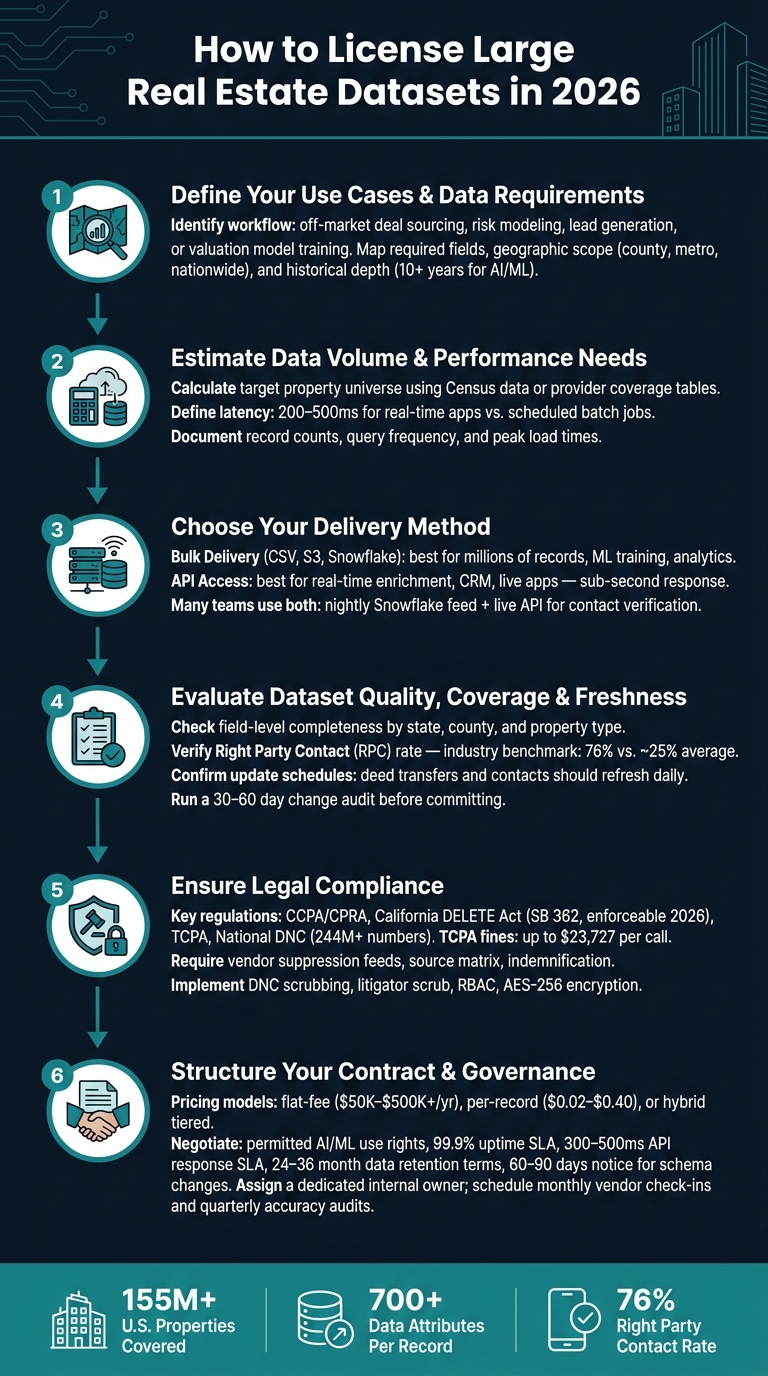
How to License Large Real Estate Datasets in 2026: Step-by-Step Guide
Defining Use Cases and Licensing Requirements
Common use cases for real estate datasets
Knowing your use case is key to determining the fields, geographic coverage, and licensing rights you’ll need. This clarity shapes the agreement you’ll negotiate. By 2026, the most common applications for real estate datasets include off-market deal sourcing, risk modeling, lead generation, and valuation model training. Each of these relies on specific portions of the data.
| Use Case | Core Data Fields Needed | Typical Geographic Scope |
|---|---|---|
| Off-market deal sourcing | APN, equity estimates, lien history, distress indicators, owner contact (RPC) | Targeted MSAs or county-level |
| Risk modeling / underwriting | Transaction history, loan-to-value proxies, flood/hazard data, tax delinquency | Nationwide or multi-state |
| Lead generation | Ownership tenure, equity, property use, verified phone/email, DNC/TCPA flags | Metro or regional service areas |
| Valuation model training | Historical sale prices, structural attributes, neighborhood trends, 10+ years of data | Nationwide, broadest coverage possible |
To avoid overpaying for unnecessary data, create a matrix that aligns your use cases with must-have fields, optional fields, and geographic coverage. This approach keeps licensing discussions focused and ensures you only pay for the data you’ll actually use. Clear use case definitions also simplify contract negotiations and help pinpoint the legal terms you’ll need.
Legal and contractual factors in data licensing
Once you’ve nailed down your use cases, your contract should address how you can use the data while staying compliant with legal requirements. Most licensing agreements divide usage into categories, each with specific rights and costs. For example:
- Internal analytics: This includes dashboards, scoring models, or routing tools and is often the baseline for licensing.
- External display: If you’re showing property data in a customer-facing product, you’ll likely need an additional agreement specifying which fields can be displayed.
- Redistribution or resale: Selling raw data to third parties usually requires a separate reseller clause.
A major focus for 2026 buyers is derived works and AI/ML model rights. Some contracts claim ownership over outputs created using the provider’s data, such as valuation models or AI-generated predictions. To protect your work, ensure the contract explicitly states you retain ownership of any models, scores, or predictions, as long as they don’t replicate large portions of the dataset. For contact-enriched data, confirm that phone numbers and emails were collected in compliance with TCPA and applicable privacy laws.
Clear volume estimates and performance benchmarks can further refine these legal and operational terms.
Estimating data volumes and performance needs
Getting accurate volume and performance estimates upfront can save you time and prevent costly surprises later. Start by defining your target property universe. For instance, you might focus on “all single-family residences and 2–4 unit properties in California, Texas, Florida, and Georgia.” Use Census data or provider coverage tables to calculate the total record volume. BatchData, for example, covers over 155 million U.S. properties, representing 99.8% of the market.
Next, consider whether your workload will be batch-based or real-time. A nightly scoring job for 500,000 records will have very different needs compared to a live property search portal requiring sub-second responses. For real-time applications, define your latency requirements – typically 200–500 milliseconds for user-facing tools – and confirm the provider’s SLA. BatchData’s setup, for example, supports both bulk data delivery via S3 or Snowflake for analytics and low-latency REST endpoints for transactional tasks.
Before engaging vendors, document your requirements in detail. Include record counts, query frequency, peak load times, acceptable latency (P95/P99), and update frequency. This preparation ensures smoother conversations and helps you find a provider that meets your needs.
sbb-itb-8058745
Choosing a Delivery and Integration Approach
Bulk Delivery vs. API-Based Access
Once you’ve defined the volume and performance needs of your system, the next step is figuring out how the data will make its way into your workflows. The two main options are bulk delivery and API-based access, and the best choice depends on the specific demands of your processes.
Bulk delivery – using formats like CSV, Parquet, AWS S3, or Snowflake Data Sharing – is designed for handling large-scale data. This method is perfect if your team needs to load millions of property records into a data warehouse for tasks like machine learning model training or portfolio-wide analytics. Snowflake’s data sharing model, for instance, lets you query shared data directly with standard SQL, cutting out the need for traditional ETL processes. Similarly, AWS S3 works well if you’re already managing a cloud data lake or need flexible, file-based ingestion for tools like Databricks or Redshift.
On the other hand, API-based access is built for speed and precision. It’s ideal for operational workflows, such as enriching a new lead in your CRM, verifying property ownership during a loan application, or powering a live property search portal. With BatchData’s REST API offering sub-second response times and a 99.99% uptime SLA, this option is a great fit for customer-facing or time-critical applications.
| Dimension | Bulk Delivery (CSV / S3 / Snowflake) | API-Based Access |
|---|---|---|
| Best For | Analytics, ML training, warehouse loading | Real-time enrichment, CRM, live apps |
| Data Volume | Millions of records per batch | Single-record or small-batch requests |
| Latency | Scheduled (minutes to hours) | Sub-second per request |
| Cost Structure | Tiered by record count; efficient at scale | Per-call or subscription |
| Engineering Effort | ETL/ELT pipelines or warehouse sharing | API integration, error handling, rate limits |
Many teams find that combining both methods works best. For example, you could load a nightly Snowflake feed for analytics and segmentation, while using the API to verify contact data during live form submissions.
Once you’ve picked your delivery method, the next step is integrating the data into a pipeline that’s ready to support AI.
Building an AI-Ready Data Pipeline
Getting data into your warehouse is just the beginning. For it to be useful in machine learning models or automated decision-making, the data must be cleaned, standardized, and matched to stable identifiers before it reaches your analytics or modeling tools.
Start by standardizing addresses. Small differences, like "123 Main St" versus "123 Main Street", can disrupt joins between your internal records and external property data. Using USPS CASS-certified address normalization before enrichment or modeling can significantly improve match rates. It’s also crucial to enforce consistent formatting for parcel IDs (APNs) and owner names, and to maintain a single "golden record" per property to prevent issues like label leakage during model training.
Keep raw and curated data clearly separated. Begin by landing the original provider files or Snowflake shares into a raw schema. Then, transform the data into a curated schema that includes only the fields, quality guarantees, and update cadence required for production systems. This separation protects downstream models from unexpected schema changes and ensures a transparent data lineage. By following this approach, BatchData’s datasets can consistently support AI-driven processes across your systems.
Before fully rolling out your integrated pipeline, it’s essential to test its performance and quality through phased deployment.
Sandboxing and Phased Rollout Planning
Skipping a sandbox phase can lead to costly mistakes during integration. Issues like schema mismatches, duplicate records, and compliance errors are much easier to address in a controlled testing environment than in full production.
Start with a small pilot project – perhaps focusing on one or two states, a specific property segment, and a limited set of fields. Test everything: ingestion processes, CRM joins, API latency under load, and data match quality. Set clear success metrics upfront, such as achieving an enrichment match rate above 80%, maintaining API P95 latency under 300 milliseconds, or ensuring nightly file deliveries are completed by 3:00 a.m. ET. Once these benchmarks are met, you can gradually expand, avoiding a risky nationwide rollout all at once.
| Phase | Scope | Key Activities |
|---|---|---|
| Sandbox / PoC | 1–2 states, limited fields | Schema mapping, match rate testing, latency validation |
| Pilot | One business line (e.g., marketing) | End-to-end integration, early ROI measurement |
| Scale | Nationwide, full field set | Full user base, SLA enforcement, automated quality assurance |
| Optimize | Ongoing | Query tuning, partition strategy, cost controls, refresh cadence refinement |
BatchData supports this phased approach by offering geographic-specific data samples. These allow teams to validate coverage and schema compatibility before committing to a full national license. This step minimizes integration risks and gives your engineering team time to set up governance and monitoring systems before scaling up completely.
Inconsistent Licensing Undermines Interoperability – RESO 2026 Spring

Evaluating Dataset Quality, Coverage, and Freshness
Securing a solid licensing agreement depends on datasets that are accurate, up-to-date, and meet your specific needs. Once your pipeline is set up, it’s critical to assess the data across three key areas: coverage, contact accuracy, and freshness. Skipping these checks can lead to unreliable results and wasted resources.
Checking Geographic and Structural Property Coverage
Vendors often claim extensive coverage, but gaps – especially in rural areas, manufactured housing communities, or regions with limited digital public records – are common. The best way to confirm coverage is to compare it directly to your target areas.
Ask for a detailed field-level completeness report broken down by state, county, and property type. Focus on the percentage of records containing the attributes you need, such as year built, living area, lot size, bed/bath count, assessed value, and last sale date. Missing data can make records unusable for tasks like underwriting, lead scoring, or AI feature development. For instance, BatchData provides 240+ core property data points and 140+ mortgage and lien data points per record, but it’s essential to verify fill rates for your specific needs before committing.
Don’t forget to check historical depth. Many workflows – like trend analysis, portfolio stress testing, and propensity modeling – require at least 10 years of deed, tax, and lien history. Confirm how far back the data goes and whether historical snapshots are available for backtesting.
Once you’ve ensured structural data completeness, move on to evaluating the quality of homeowner contact data.
Verifying Homeowner Contact Data Accuracy
Structural property data and contact intelligence are two separate challenges. Even if a dataset has excellent parcel coverage, it won’t deliver value if its contact data is outdated or inaccurate.
The key metric to evaluate is the Right Party Contact (RPC) rate, which measures how often outreach actually reaches the intended property owner. BatchData reports a 76% RPC accuracy rate, roughly three times the industry average. This difference is huge at scale – across 100,000 records, a jump from 25% to 76% RPC can significantly cut wasted effort and missed opportunities.
Beyond RPC, independently verify phone and email accuracy. For phone data, look for real-time carrier validation, line-type identification (mobile vs. landline), and scrubbing against the Federal Do Not Call (DNC) registry and known litigator databases. For email, aim for a hard bounce rate below 2%, as higher rates can lead to inbox throttling or blocking. Additionally, confirm whether the vendor performs entity resolution, which identifies the actual decision-maker behind LLC ownership structures.
Once contact accuracy checks are complete, focus on how frequently the data is updated to ensure it stays relevant and compliant.
Measuring Data Freshness and Update Schedules
Outdated data can lead to compliance risks and inefficiencies. Ownership changes, new liens, address updates, and contact reassignments happen frequently, and acting on stale records can result in wasted outreach or regulatory violations under laws like TCPA and the updated CCPA framework.
Ask vendors to specify their update schedules by data layer, not just overall. For example, tax and assessment data may follow county-driven cycles (quarterly or annually), while deed transfers, listing statuses, and contact records should be refreshed daily. BatchData, for instance, processes millions of documents daily from county recorders, tax assessors, and private sources to maintain current property profiles across 700+ attributes. Also, check the lag time between record creation and its appearance in the dataset – vendors with a two-week delay risk falling behind daily operational needs.
To confirm freshness, run a 30-to-60-day change audit. Select parcels in a few target counties and monitor how quickly the vendor captures updates like deed transfers, new liens, or mailing address changes. Compare their performance against your benchmarks before finalizing any licensing agreement.
Compliance and Risk Management
After verifying the quality and timeliness of your data, the next critical step is ensuring your licensing agreement aligns with legal requirements. The regulatory landscape for real estate data in 2026 has become more stringent, and the consequences of non-compliance can be severe.
Key Regulations Affecting Real Estate Data in 2026
Several major frameworks govern the licensing and use of homeowner contact data in the U.S.
The CCPA/CPRA (California Consumer Privacy Act, as amended by the California Privacy Rights Act) classifies mobile numbers, email addresses, and online identifiers as personal information. This means you need a lawful reason for using such data, must provide opt-out options for "sale" or "sharing", and must ensure your data vendors follow these rules. The "publicly available" exemption is narrow – once parcel records are combined with contact data for marketing, they fall under CCPA regulations.
The California DELETE Act (SB 362), fully enforceable in 2026, requires data brokers to register with the California Privacy Protection Agency (CPPA) and comply with centralized consumer deletion requests. If your vendor qualifies as a data broker, your license must ensure they pass along those deletion requests to you regularly. Non-compliance risks both financial penalties and reputational harm, as the CPPA maintains a public list of registered brokers.
The TCPA and National DNC rules regulate all outbound calls and texts to homeowners. The National Do Not Call Registry now includes over 244 million phone numbers, and telemarketers must scrub against it every 31 days. Violating robocall rules can result in FCC fines of up to $23,727 per call.
Other states, including Colorado, Virginia, Connecticut, and Utah, have also enacted privacy laws with opt-out and data processing requirements. Generally, designing your compliance framework to meet California’s stricter standards will help you address these additional state laws. These regulations are essential considerations when structuring your licensing agreements.
Building Compliance into Licensing Agreements
A strong data license should clearly define permitted uses, such as "internal analytics, propensity modeling, and direct marketing to property owners", while explicitly listing prohibited uses like employment screening or credit eligibility decisions. This is critical because using property data for credit or housing decisions can trigger obligations under the FCRA, which comes with its own compliance requirements.
For suppression and opt-outs, your vendor must enforce CCPA, DELETE Act, and DNC requests. They should also provide periodic suppression files or API flags to help you keep your data updated. Your contract should allow you to add records to your internal suppression list and ensure the vendor cannot reintroduce those records in future data deliveries.
When it comes to data provenance, require a source matrix that details the categories of data sources – such as public records, utility files, or private brokers – and the vendor’s lawful basis for collecting each type of data. This documentation is critical for responding to regulators or fulfilling privacy notice obligations. Vendors like BatchData offer transparency through source disclosures and daily suppression updates, making it easier for you to maintain an audit trail.
Lastly, include an indemnification clause in your contract. This should guarantee that the vendor’s data collection practices comply with all applicable laws and that they will indemnify you for any claims arising from unlawful collection or misrepresentation of consent. Be sure to agree on liability caps to manage potential risks.
Technical Safeguards and Data Scrubbing Tools
While contractual protections are essential, technical safeguards add another layer of security for your licensed data. These tools ensure your data remains secure and compliant.
- Role-based access control (RBAC): Restricts access to sensitive data based on user roles, reducing insider risks.
- Encryption: Use TLS 1.2 or higher for data in transit and AES-256 for data at rest to protect against breaches.
- Access and export logs: Track all data interactions to support audits and regulatory reviews.
For outbound campaigns, implement a multi-layered DNC scrubbing process. This includes applying vendor-provided suppression flags, cross-checking against the National DNC Registry, and referencing your internal opt-out list. BatchData’s tools, such as TCPA/DNC scrubbing and litigator scrubs, can further reduce exposure to lawsuits by identifying numbers linked to known professional plaintiffs.
| Safeguard | What It Does | Risk Mitigated |
|---|---|---|
| DNC scrubbing | Filters numbers against federal/state registries | Avoids TCPA fines and telemarketing violations |
| Litigator scrub | Flags numbers tied to professional plaintiffs | Reduces risk of predatory litigation |
| Role-based access control | Limits access based on user roles | Prevents unauthorized data exposure |
| Encryption (transit + at rest) | Secures data during transfer and storage | Protects against data breaches |
| Suppression API/feeds | Handles opt-outs and DELETE Act requests | Ensures compliance with privacy laws |
For AI applications, such as model training or automated underwriting, document a Data Protection Impact Assessment (DPIA) for any high-risk profiling activities. Some state laws now require this for automated decision-making that impacts consumers. Having a DPIA on file shows good-faith compliance and can be crucial if regulators investigate your practices.
Structuring Contracts and Operational Playbooks
Once your compliance framework is in place, the next step is transforming your data agreement into a functional, operational system.
Selecting a Pricing and Volume Model
Choosing the right pricing model hinges on how predictably you consume data. If your organization uses data consistently and at a high volume, flat-fee subscriptions are typically the best choice. These plans often range from $50,000 to $500,000+ annually, depending on the geographic scope and included features. For more fluctuating data needs, per-record pricing (ranging from $0.02–$0.40 per enriched contact, depending on the fields and accuracy guarantees) or tiered API plans may offer the flexibility you need. A common tiered structure might include 1 million API calls per month for $10,000, with additional calls costing $0.01–$0.03 each.
For many organizations, a hybrid model strikes the right balance. This approach combines a base subscription for essential property data with usage-based pricing for premium features like homeowner contact enrichment or real-time ownership alerts. For instance, BatchData offers a tiered structure where property data starts at $1,000/month for 100,000 records and scales to $5,000/month for 750,000 records. Meanwhile, contact enrichment services range from $2,000/month at the Growth tier to $20,000/month for up to 3 million traces at the Enterprise level. To plan effectively, estimate your annual data volume across workflows and budget with a 10–20% buffer for growth. Once your pricing model is in place, the next focus should be negotiating licensing terms.
Negotiating Key Licensing Terms
After determining your cost structure, it’s critical to secure licensing terms that align with your operational and legal needs. Start with permitted use and derived works. Ensure your license explicitly allows internal analytics, AI/ML model training, and the commercial use of outputs like automated valuation models or propensity scores. Many older agreements restrict "derived works", which could hinder your AI initiatives.
Next, lock in clear commitments for data coverage and refresh schedules. Avoid vague promises – define specifics instead. For example, clarify delivery methods, whether through Snowflake, S3, or API. If you’re relying on API-based access, negotiate a 99.9% monthly uptime SLA, response times under 300–500 milliseconds for 95% of requests, and service credits for significant breaches. Also, address data retention and deletion policies, such as how long you can retain identifiable homeowner contact data (commonly 24–36 months), how contract termination is handled, and the status of derived data after the agreement ends. Finally, request 60–90 days’ notice for any schema changes that might disrupt your data pipelines.
Setting Up Governance and Performance Reviews
Once pricing and licensing terms are finalized, focus on building processes to ensure they’re effectively implemented. Assign a dedicated internal owner – someone with expertise in both data engineering and legal matters – to oversee vendor management, compliance tracking, and escalation. Establish a routine review schedule: monthly vendor check-ins to address data quality issues, quarterly reviews to evaluate fill rates and accuracy against your benchmarks, and annual legal and compliance reviews to reflect changes like updated CCPA guidelines or new state privacy laws.
During quarterly reviews, test a sample of records against known ground truth in your key markets. Check field fill rates, contact accuracy, and refresh completeness. If your vendor offers a dashboard or monthly report detailing uptime and refresh status, use it as a baseline for these discussions. For AI workflows, maintain a versioned contract log that tracks schema changes, accessible to legal, procurement, data engineering, and compliance teams. This transparency ensures everyone knows what changed, when, and why. By establishing structured governance, you turn your data license into a managed, auditable resource, maximizing the value of your agreement.
Conclusion
A strong licensing strategy can turn raw data into a powerful tool. Successfully licensing large real estate datasets in 2026 involves several key steps: defining your use cases, assessing the required scale, selecting the right delivery system, ensuring data quality and timeliness, adhering to compliance standards, and establishing clear governance in your agreements. Skipping any of these steps could lead to costly mistakes – whether operational or legal.
When it comes to data, quality and compliance aren’t optional. Using outdated or non-compliant homeowner contact data can lead to financial penalties and damage to your reputation.
For teams leveraging AI-driven workflows, securing rights for derived outputs – like propensity scores, automated valuations, or risk rankings – is crucial. This ensures you can fully utilize the results from your models. Tools like BatchData, with its normalized schemas and low-latency endpoints, integrate seamlessly into machine learning pipelines, making these workflows smoother and more effective.
Even small improvements in data accuracy can have a big impact. In large-scale campaigns, better contact accuracy translates to significantly improved results.
"What used to take 30 minutes now takes 30 seconds. BatchData makes our platform superhuman." – Chris Finck, Director of Product Management
The right licensing choice in 2026 transforms raw information into a reliable, compliant, and actionable resource. Whether you’re running predictive marketing campaigns, building AI-driven valuation models, or managing a nationwide lending portfolio, having a well-licensed and integrated dataset is essential. It ensures your operations are efficient, compliant, and ready to meet the demands of AI-powered processes – from start to finish.
FAQs
What rights do I need to train AI models on licensed real estate data?
To train AI models using licensed real estate data, it’s crucial to ensure your agreement explicitly grants rights for derived works. This permission is essential for legally applying the data to AI-driven tasks like valuation models, propensity scoring, or machine learning algorithms. Many standard licenses restrict usage to internal analytics, so carefully review the permitted use clause to avoid limitations. With BatchData, you’ll receive normalized, AI-ready datasets tailored for large-scale model training and custom algorithm development.
Should I choose bulk delivery or an API for my workflow?
When deciding between bulk delivery and an API, it all comes down to how you plan to use the data. If you need instant access for tasks like quick property lookups or applications requiring live updates, a real-time API is the way to go. On the other hand, if you’re handling large-scale projects – like market research or training machine learning models – bulk delivery is often more efficient.
In fact, many choose to use both: APIs for quick, on-the-spot tasks and bulk datasets for more in-depth analysis. Ultimately, your choice should align with your technical setup, budget, and how much latency your workflow can handle.
How do I stay compliant with CCPA, TCPA, and the DELETE Act?
To keep your business in line with regulations like the CCPA, TCPA, and the California DELETE Act, it’s essential to use data solutions equipped with automated, real-time compliance tools. BatchData provides built-in features designed to scrub contact lists against the National Do Not Call (DNC) Registry and litigator lists. These lists are updated every 24 hours to ensure accuracy.
By leveraging these tools, you can reduce legal risks, honor consumer preferences, and meet regulatory standards. Plus, they help maintain the integrity of your data, keeping it accurate and current.