
































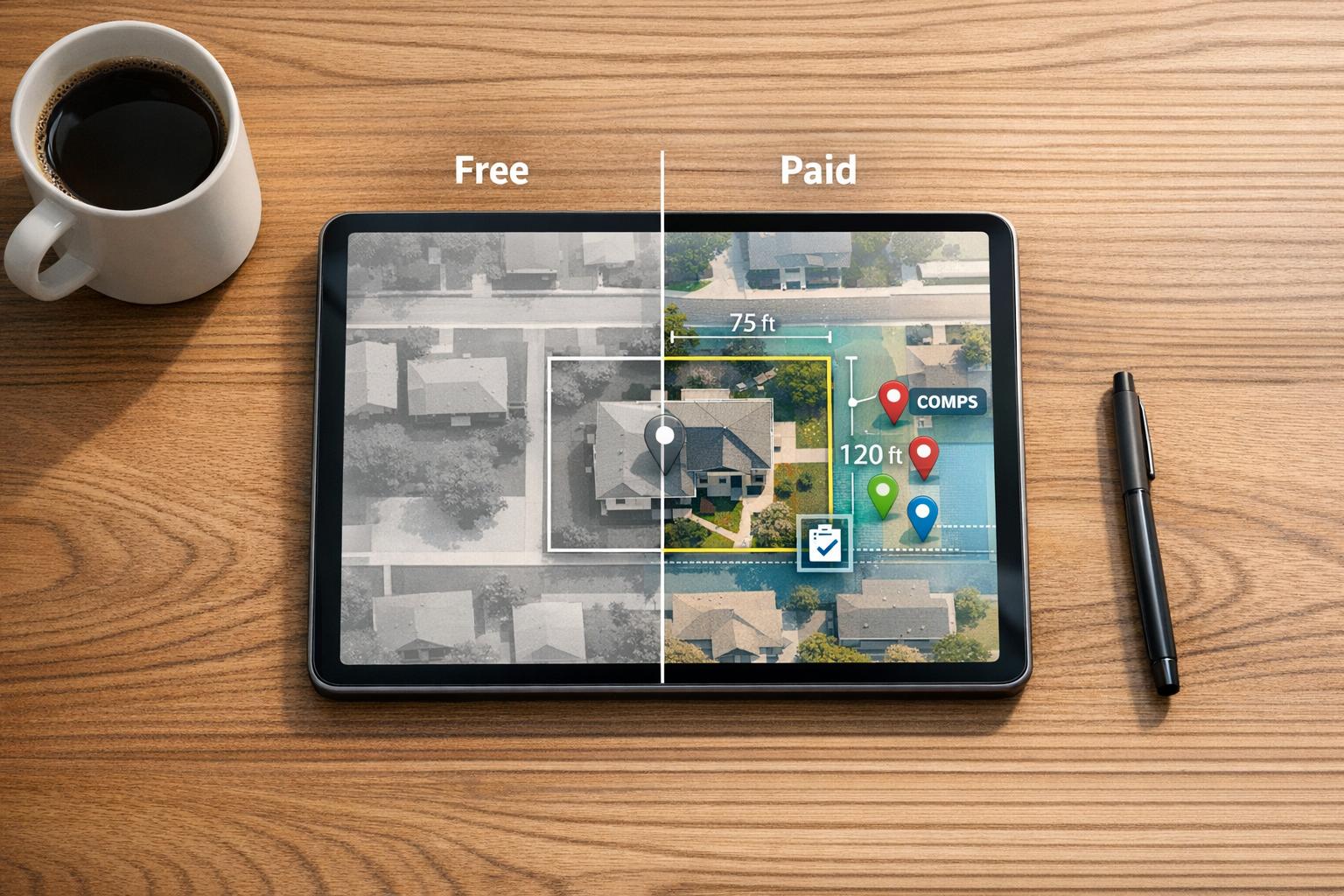
When investing in real estate, choosing between free and paid property data depends on your goals, budget, and the scale of your operations. Here’s a quick breakdown:
Key Takeaways:
- Free data: Accessible through public records, platforms like Zillow, and government resources. Best for beginners or small-scale investors analyzing a few properties. However, it often lacks accuracy, depth, and timely updates.
- Paid data: Offers detailed insights, advanced analytics, and up-to-date records. Ideal for professional investors managing larger portfolios or making quicker decisions. The downside? It comes with a higher cost.
Quick Overview:
- Free tools are great for basic research but can be time-consuming and incomplete.
- Paid services streamline processes, provide reliable data, and support scaling – but they require a financial commitment.
The right choice comes down to how much data you need and how accurate and efficient you want your analysis to be. Start small with free tools and transition to paid services as your portfolio grows.
Free Property Data: Features and Sources
Where to Find Free Property Data
You can access free property data across six main categories: tax records, deed/transfer records, mortgage/lien records, court records, building permits/code violations, and voter/utility data. Most of this information is available through county assessor and clerk websites.
In addition to government resources, major real estate platforms like Zillow and Redfin provide free tools for market insights. For instance, Zillow offers metrics like the Zillow Home Value Index (ZHVI), which tracks typical home values within the 35th to 65th percentile range, and the Zillow Observed Rent Index (ZORI). Through the Zillow Developer Portal, investors can even download neighborhood-level data and real estate metrics in CSV format. For broader demographic and economic insights, the U.S. Census Bureau‘s QuickFacts tool provides a concise overview of population and economic statistics for cities and counties.
These resources make it easier to tap into valuable information without spending a dime, offering a solid foundation for property analysis.
Benefits of Free Property Data
The biggest draw of free property data is its accessibility and zero cost, making it an excellent starting point for new investors. It allows for basic market research before diving into property-specific details. County websites, in particular, are a trusted source for verifying ownership and liens, as they provide legally binding, authoritative data. As Deal Run puts it:
Public records are the single most valuable data source for real estate investors.
Free data also allows investors to assess market trends. For example, understanding whether a market is growing or declining can help determine where to focus investments. Additionally, combining different types of free data – like identifying absentee owners with tax delinquencies or code violations – can help create targeted lead lists at no cost. This approach can significantly improve the chances of finding promising opportunities.
While these benefits are valuable for initial research, free data isn’t without its challenges.
Drawbacks of Free Property Data
Despite its advantages, free property data has notable downsides that can complicate deeper analysis. One major issue is data lag. Tax records, for example, often update just once a year, and there can be a 30–90 day delay between a transaction and its digital appearance. Additionally, many county websites are outdated and lack features like bulk export, forcing users to manually search for properties one by one.
Real estate platforms like Zillow and Redfin, while user-friendly, also have their flaws. Their estimates can sometimes be off by as much as 10–20% in certain markets. In non-disclosure states, where sale prices aren’t public, these platforms rely on estimated tax assessments instead of verified market data. As Property Scout 360 cautions:
A rookie mistake is just grabbing the first three sold properties you find. The real skill is in the validation – making sure every comp you use represents a true market-value transaction.
These limitations can make it harder for investors to rely solely on free data for informed decision-making or scaling their analysis effectively.
sbb-itb-8058745
Paid Property Data: Features and Capabilities
What You Get with Paid Property Data
Paid property data services simplify access to public records by turning scattered information into actionable insights. Instead of juggling data from numerous county websites, these platforms pull information from over 3,200 sources across the U.S. and present it in a standardized format. For example, BatchData covers more than 155 million U.S. properties, offering over 1,000 attributes per record. These details range from basic property specs like square footage and construction year to more advanced analytics such as Automated Valuation Models (AVMs) and sale propensity scores.
One standout feature is skip tracing, which combines data from multiple sources to provide verified contact details – phone numbers, email addresses, and mailing addresses – with match rates between 80% and 95%. Additionally, bulk data delivery is seamless, whether through CSV downloads or CRM integration via REST APIs. Pricing for BatchData starts at $1,000 per month for access to 100,000 records, with optional add-ons available for an extra cost. These features illustrate how paid property data services elevate raw information into a powerful tool for decision-making.
Benefits of Paid Property Data
Paid property data offers the precision and timeliness that free sources often lack. Unlike free services that may only update quarterly or annually, platforms like BatchData refresh critical details – such as liens, ownership changes, and pre-foreclosure statuses – on a daily basis. This ensures you’re working with the most current information, a crucial factor for making timely investment decisions.
API integration is another game-changer, cutting underwriting labor by more than half. Advanced filtering options, like targeting properties with over $100,000 in equity or those built before 1980, help focus marketing efforts on high-probability leads, reducing costs by 50% to 70%. Moreover, the multi-source approach ensures uninterrupted access to data, even if a specific county’s website is temporarily down. These benefits make paid data an essential resource for investors looking to make faster, more informed decisions.
Drawbacks of Paid Property Data
The biggest downside? Cost. Subscriptions range from $99 to over $999 per month, with per-record costs between $0.10 and $1.00. For beginners or those handling only a few deals annually, these expenses can feel steep. However, experienced professionals often see a 5–10× return on investment, thanks to the deals these tools help facilitate.
There’s also a learning curve. Features like API integrations and custom filtering might take a week or two to fully master. While platforms like BatchData offer user-friendly, U.S.-localized dashboards (complete with dollar formatting and imperial units), new users might need some initial training to get up to speed. That said, platforms like BatchData prioritize ease of use, providing clear, interactive documentation that allows users to start pulling data in under five minutes. Balancing these challenges against the benefits is key when deciding between paid and free property data options.
Ep. 7: Free Data vs Paid
For those looking to scale their operations, understanding real estate APIs is the next step in automating data collection.
Free vs. Paid Property Data: Direct Comparison
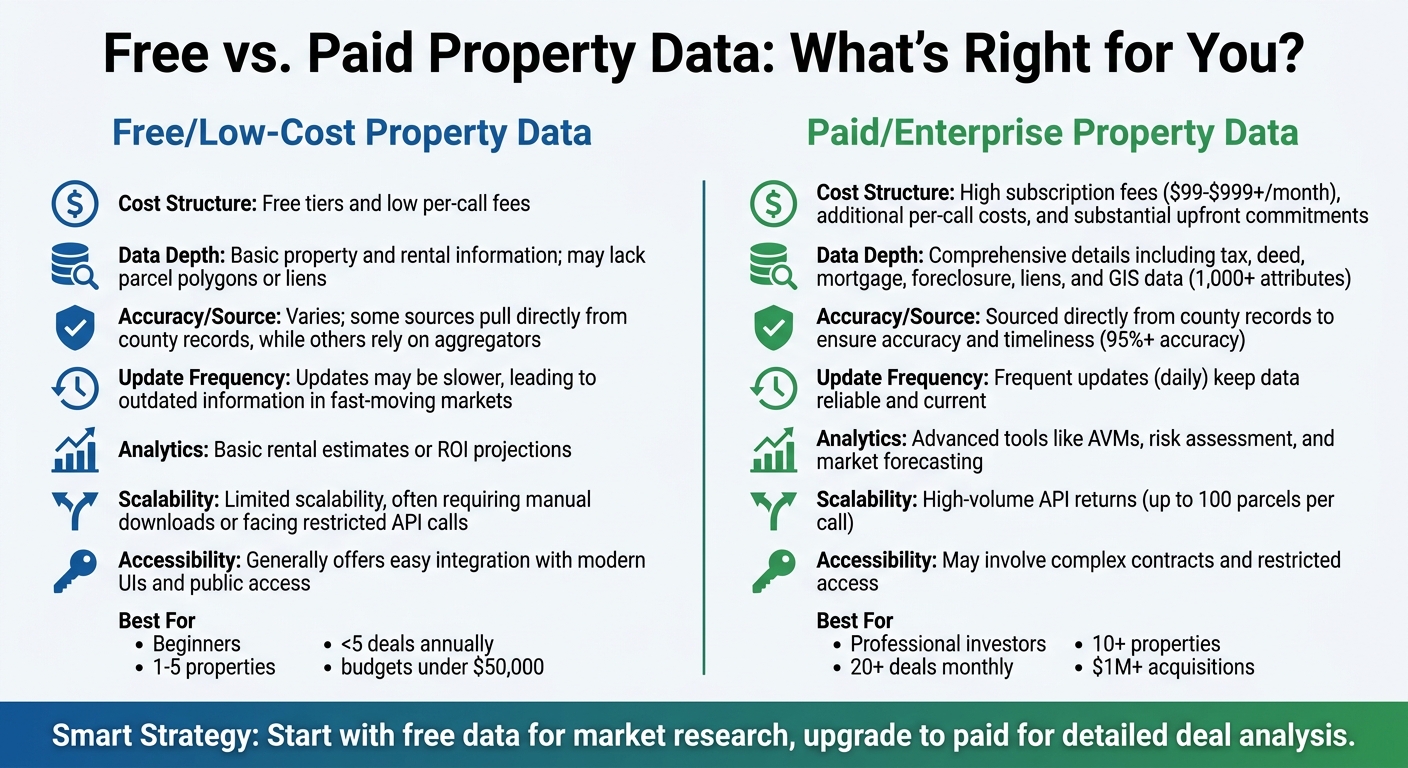
Free vs Paid Property Data Comparison for Real Estate Investors
Comparison Table: Free vs. Paid
When deciding between free and paid property data, it’s all about balancing quality, coverage, and cost. As Alex Franzen, Co-founder & CTO of Realie, explains:
Selecting the right real estate API often comes down to the balance of quality, coverage, and cost.
Here’s a detailed breakdown of the key differences:
| Feature | Free / Low-Cost Property Data | Paid / Enterprise Property Data |
|---|---|---|
| Cost Structure | Free tiers and low per-call fees | High subscription fees, additional per-call costs, and substantial upfront commitments |
| Data Depth | Basic property and rental information; may lack parcel polygons or liens | Comprehensive details, including tax, deed, mortgage, foreclosure, liens, and GIS data |
| Accuracy/Source | Varies; some sources pull directly from county records, while others rely on aggregators | Sourced directly from county records to ensure accuracy and timeliness |
| Update Frequency | Updates may be slower, leading to outdated information in fast-moving markets | Frequent updates keep data reliable and current |
| Analytics | Basic rental estimates or ROI projections | Advanced tools like AVMs, risk assessment, and market forecasting |
| Scalability | Limited scalability, often requiring manual downloads or facing restricted API calls | High-volume API returns (up to 100 parcels per call) |
| Accessibility | Generally offers easy integration with modern UIs and public access | May involve complex contracts and restricted access |
This comparison highlights the trade-offs between cost-effectiveness and the depth of information, accuracy, and scalability, helping you choose the right solution for your needs.
How to Choose Between Free and Paid Data
Deciding between free and paid property data comes down to your investment goals, budget, and how much you’re managing. If your budget is under $50,000, saving costs might be your top priority. On the other hand, professionals handling 50 or more properties often find the efficiency of paid, enriched datasets well worth the expense.
Start by figuring out how many properties you analyze each month. If you’re only evaluating a handful of deals annually – say, fewer than five – free tools like Zillow (which reported a national median home price of $412,300 in 2023) or local county assessor websites can help you research neighborhoods without spending a dime. However, keep in mind that free data often comes with delays of 6 to 12 months and may lack important details, like foreclosure risk scores. For instance, one new investor using free tools found what seemed like a $250,000 deal, only to discover later that a $15,000 lien delayed the closing process.
When Free Property Data Makes Sense
Free property data works great for beginners or small-scale investors managing just a few properties – typically 1 to 5. For example, one first-time investor used Trulia and Census.gov to research Phoenix suburbs. They found a 5% annual appreciation rate and bought a $200,000 duplex that delivered an 8% cash-on-cash return. Free resources like these give you access to public records and basic metrics without any upfront costs, making them perfect for initial research. That said, manually gathering and analyzing this data can take a lot of time, and free tools often lack the depth needed for more advanced strategies. Still, this initial research can help you decide whether investing in paid tools is worth it.
When to Pay for Property Data
If you’re scaling up and analyzing larger volumes – like managing over 10 properties or evaluating 20 or more deals each month – paid data becomes a game-changer. Professional investors, especially those making high-stakes decisions like acquiring multifamily properties worth $1 million or more, often find the investment in paid data essential.
Take BatchData as an example. It offers datasets with over 200 fields, including equity estimates and mortgage details, which can significantly cut down your analysis time. One investor used BatchData’s absentee owner lists to send out 1,000 mailers, landing three deals with an average profit of $30,000 each. That’s a far better hit rate than the typical 2% seen with free data. With accuracy rates exceeding 95% and scalable API access for over 10,000 records, the returns can be substantial – sometimes, a single $50,000 deal can pay for an entire year’s subscription.
A smart approach is to combine both free and paid tools. Start with free resources for initial scouting, then switch to paid data for more detailed due diligence. This way, you can keep costs low while ensuring you don’t overlook critical details when it really matters.
Conclusion
In this discussion, we’ve delved into the pros and cons of using free versus paid property data, focusing on cost, reliability, and efficiency. The choice isn’t about one being better than the other – it’s about finding the right fit for your investment needs and scale. Free resources, like county assessor websites and public records, are great for beginners working on a handful of deals. However, these often require significant effort to clean and verify before they can be used effectively.
On the other hand, paid tools address many of these challenges. Platforms like BatchData offer pre-cleaned, verified property details, including equity estimates, mortgage information, and ownership records. This eliminates the need for technical expertise and saves time, which becomes crucial as your deal volume grows. Paid solutions provide the reliability and efficiency needed to handle larger-scale investments.
A smart strategy blends both approaches: start with free data for general market research and neighborhood insights, then transition to paid tools when more precise and reliable information is required for in-depth deal analysis. This way, you can control costs while still accessing the insights necessary to make informed decisions.
While free data may seem cost-effective, the time and effort to process it can quickly add up. As your investment portfolio expands, the streamlined accuracy of paid platforms like BatchData becomes an indispensable asset for scaling your operations and protecting your investments.
FAQs
How can I verify free property data is accurate before I rely on it?
To make sure free property data is accurate, it’s important to cross-check it with primary sources like county assessor records, which are legally trustworthy. Free data often runs the risk of being outdated or incomplete, so comparing details across multiple sources and ensuring they reflect the latest updates is key. For added confidence, verify essential information – such as ownership and property details – through official government databases or reliable paid services to ensure you’re working with up-to-date and dependable data.
What paid data features matter most for finding deals faster?
Key paid data features that help speed up deal discovery include verified contact details, high accuracy, and frequent updates. Having access to verified owner contact information, such as phone numbers and emails, makes reaching out more efficient. Advanced search filters allow you to zero in on the most promising properties quickly, while real-time data updates ensure you’re always working with the most current information. Together, these tools save time and simplify the process of connecting with motivated sellers.
When does paying for property data start paying for itself?
Paying for property data can be a game-changer. The improved accuracy, faster access, and verified contact details it provides often lead to smarter investment decisions, quicker deal closures, and a boosted return on investment (ROI). While the costs – ranging from $80 to $200 per month or pay-per-use fees – might seem steep, they can easily be justified by the direct impact on profitability and efficiency.