


































Real estate professionals in the U.S. face challenges with fragmented property data spread across thousands of sources. Data aggregation and bulk processing solve this problem by consolidating and refining property data for better decision-making. Here’s what you need to know:
- Data Aggregation: Combines raw data from sources like MLS feeds, public records, and tax databases into a unified dataset, eliminating duplicates and inconsistencies.
- Bulk Processing: Cleans, standardizes, and enriches large datasets, enabling fast analysis and actionable insights for tasks like underwriting, market analysis, and marketing.
- Key Data Types: Includes property characteristics, transaction data, parcel records, market activity, and permits, updated at varying frequencies (e.g., MLS data every 5–15 minutes, tax rolls annually).
- Benefits: Faster decisions, reduced manual work, improved portfolio insights, and more targeted marketing.
With tools like BatchData, users can access enriched property records covering 155 million U.S. properties, automate workflows, and ensure compliance with regulations. This approach enhances speed, accuracy, and efficiency in managing real estate data.
Real Estate Data Aggregation for Your Property Data Management Needs
sbb-itb-8058745
Key Data Types in Real Estate Aggregation
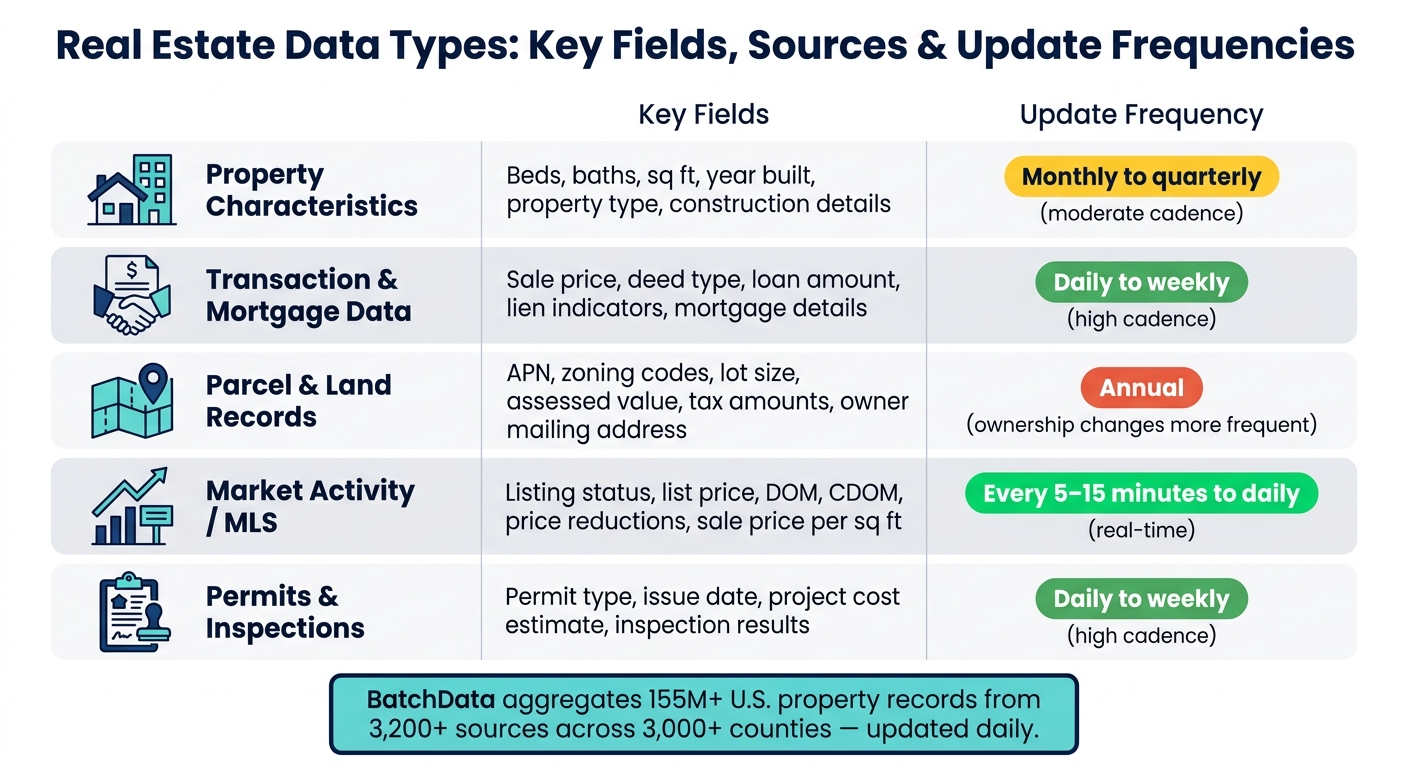
Real Estate Data Types: Key Fields, Sources & Update Frequencies
Real estate data aggregation hinges on three main categories: property characteristics with transaction data, parcel records, and market activity with permits. These categories form the foundation for underwriting, market analysis, and outreach efforts. Let’s break down each category and its role.
Property Characteristics and Transaction Data
Details like the number of bedrooms, bathrooms, living area, lot size, year built, property type, and construction specifics – when paired with transaction data (sale price, sale date, deed type, mortgage details, and lien indicators) – are crucial for accurate property valuation and market comparisons. These data points enable investors, lenders, and brokers to estimate equity and evaluate market conditions quickly.
The timing of updates is critical. Physical property details, often sourced from tax rolls, typically update monthly or quarterly, while transaction data like sales and mortgage recordings are event-driven. In some counties, newly recorded deeds and mortgages appear in aggregated datasets within 24–48 hours. For institutional buyers and lenders, even a short delay in transaction data can lead to inaccuracies in equity calculations and comparative analyses.
Parcel and Land Records
Parcel records revolve around the Assessor’s Parcel Number (APN), which connects tax assessments, ownership history, and land attributes across jurisdictions. Essential fields include lot size, zoning codes, land use classifications, assessed values, tax amounts, and owner mailing addresses.
These records are invaluable for developers evaluating parcels for accessory dwelling units (ADUs), infill projects, or land assemblage. Title professionals also rely on this data to verify collateral documents. The challenge lies in the sheer scale of data aggregation: the U.S. has over 3,000 counties and county-equivalents, each with unique assessor and recorder practices. While parcel data typically updates annually alongside assessment rolls, changes in ownership and tax payment statuses may refresh throughout the year. Platforms like BatchData simplify this process by normalizing APNs and delivering enriched records in bulk, eliminating the need for manual county-by-county GIS pulls.
Market Activity and Permits
Market activity data, including all listing statuses, is highly time-sensitive. Many MLS feeds update status changes as often as every 5–15 minutes, with major real estate portals refreshing at least daily. Key metrics like days on market (DOM), cumulative days on market (CDOM), list price, price reductions, and sale price per square foot provide a real-time snapshot of supply, demand, and market trends at a granular level.
Building permits and inspection data offer additional insights. Cities like New York, Los Angeles, and Chicago publish permit records as open datasets, updated daily. These records cover new job filings, permit issuance, project cost estimates, and inspection results. Investors and insurers use this information to identify recent property upgrades – such as new roofs, electrical work, or HVAC systems – or to flag potential risks from unpermitted construction before closing.
Here’s a quick overview of how these data types fit into a bulk-processing workflow:
| Data Category | Key Fields | Typical Update Frequency |
|---|---|---|
| Property Characteristics | Beds, baths, sq ft, year built, type | Monthly to quarterly |
| Transaction & Mortgage | Sale price, deed type, loan amount, liens | Daily to weekly (event-driven) |
| Parcel & Land Records | APN, zoning, lot size, assessed value, taxes | Annual (ownership changes more frequent) |
| Market Activity (MLS) | Listing status, list price, DOM, price reductions | Every 5–15 minutes to daily |
| Permits & Inspections | Permit type, issue date, project cost, results | Daily to weekly |
Benefits of Real Estate Data Aggregation and Bulk Processing
Better Portfolio and Market Insights
Unified datasets do more than just improve technical accuracy – they give asset managers a clearer view of their portfolios. By consolidating property records, transaction histories, tax assessments, and market data into one standardized system, managers can easily analyze key performance metrics like Net Operating Income (NOI), occupancy rates, lease expirations, and capital expenditures (CapEx) across all properties. This eliminates the need to manually combine data from multiple spreadsheets. For example, a REIT operating in various U.S. markets can quickly spot underperforming submarkets with slow rent growth or identify loans nearing maturity in a high-interest-rate environment.
Aggregated data also sharpens market analysis. Underwriters can filter comparable sales based on property subtype, construction year, or renovation status, resulting in more precise cap rate assumptions than relying on broad metro-level averages. According to a 2023 Altus Group survey, over 60% of commercial real estate firms globally plan to increase their investment in data and analytics technologies, aiming for better decision-making as their primary goal.
Faster Decisions and Less Manual Work
Manual data collection often comes with hidden costs. Analysts typically spend 10–15 hours each week gathering data like comps, tax records, and ownership information from county websites, MLS systems, and internal CRMs. Bulk processing automates much of this work. Automated pipelines can pull assessor, transaction, and permit records on a regular schedule, pre-fill underwriting templates, and flag anomalies. This allows analysts to focus on critical tasks like refining assumptions and structuring deals instead of wasting time on data entry.
Companies that have adopted automated data systems for underwriting and portfolio management report 30–50% faster cycle times compared to manual processes. For lenders, automated tools that pull lien histories and ownership data can cut loan pre-qualification times from days to mere seconds. In competitive U.S. markets, this speed can be the deciding factor in securing a deal.
These operational efficiencies also open doors to more precise and impactful market engagement.
Stronger Marketing and Outreach
With enriched contact data, investors can target specific property owner segments more effectively. For instance, they can focus on properties held long-term by out-of-state owners, those with no recent permits, or those facing rising tax burdens. Skip tracing can help confirm contact details for LLC-held or absentee-owned properties, improving campaign accuracy and reducing wasted spending. The results are tangible: segmented, data-driven campaigns see email open rates improve by 14–18%, while click-through rates increase by over 10%.
Tools like BatchData integrate seamlessly with existing CRMs and marketing platforms, allowing teams to build highly targeted call and SMS lists without overhauling their entire data systems. This streamlined approach enhances outreach efficiency and helps deliver better results for marketing efforts.
Technical Foundations and Best Practices
Pipeline Architecture and Data Ingestion
A well-designed real estate data pipeline flows through several key stages, each tailored to a specific purpose. It starts with raw data entering a staging area in its original format. From there, it moves into a transformation layer where the data is cleaned and standardized, ultimately reaching a curated layer. This final stage makes the data ready for analytics, exports, or integration into customer relationship management (CRM) systems. The accuracy of this process is critical, as it directly supports the operational and portfolio management benefits previously discussed.
The choice of ingestion strategy hinges on how time-sensitive the data is. For instance, nightly batch jobs are ideal for static data like county assessor files, deed transfers, and permit updates. On the other hand, near-real-time or hourly updates are better suited for dynamic data, such as MLS listing changes or price updates. This hybrid approach balances cost efficiency with the need for timely updates, ensuring decision-makers receive critical signals – like new listings or status changes – without delay. Given the massive scope of U.S. property data – spanning 3,200+ sources across 3,000+ counties and 1,200+ MLSs – building connectors tailored to specific sources is far more effective than relying on a generic intake system. Once ingested, this data must be standardized to enable accurate analysis.
Data Standardization and Entity Resolution
Poor data quality can be a serious drain on resources. According to Experian, it can cost companies 15–25% of their annual revenue, while Gartner estimates the average annual cost of bad data at $12.9 million per organization. These losses often stem from wasted marketing budgets and flawed decision-making.
In real estate, the usual culprits include inconsistencies in addresses, dates, and parcel identifiers. For example, a property might be listed as “123 Main Street” in an MLS feed but appear as “123 Main St” in a county recorder file. Without standardization, these entries would be treated as separate properties. The solution? Implement USPS-compliant address parsing, which normalizes street suffixes, directional prefixes, and unit types. This data is then validated against delivery files using CASS-certified software. Dates should follow a consistent format – MM/DD/YYYY for display and UTC for storage – and monetary values should always adhere to U.S. formatting, like $1,250,000.00, with uniform decimal precision.
Entity resolution takes this a step further by merging records from multiple sources into a single “golden record” for each property or owner. This involves techniques like APN matching, fuzzy address scoring, and normalizing owner names, which is especially important for properties held by LLCs, trusts, or corporate entities. Master data management studies show that effective address standardization and entity resolution can reduce duplicate records by 20–40%. This directly enhances the accuracy of analytics and outreach efforts, setting the stage for comprehensive data enrichment.
Using BatchData for Enrichment and Bulk Delivery

Once the pipeline is in place, enrichment fills in the gaps left by public records. Tools like BatchData elevate data accuracy and delivery by covering over 155 million U.S. properties, representing 99% of the population, and offering 1,000+ attributes per record with daily database updates. These daily refreshes have become the industry standard, replacing the outdated quarterly or annual updates still used by some legacy providers.
For teams integrating BatchData into their pipelines, there are two main entry points. First, its bulk delivery options – via AWS S3, SFTP, or Snowflake Data Sharing – are ideal for building foundational datasets. Second, its real-time REST API, which boasts a 99.99% uptime SLA, is perfect for on-demand tasks like ownership verification or skip tracing property owners. To keep outreach lists up-to-date, schedule phone verification and contact enrichment on a monthly or quarterly basis.
Challenges and Risk Management
Data Quality and Freshness Issues
Even with a well-designed pipeline, real estate data often arrives in a messy state. Data from over 3,000 U.S. counties comes in varying formats. For example, one county might log bedroom counts as integers, another as text, while an MLS feed might use terms like “studio” instead of “0 beds.” These inconsistencies can lead to errors that distort property valuations or mislead investors about equity or seller motivation.
Keeping data up-to-date is equally important. The frequency of updates should align with how quickly the data changes. MLS listings might require daily updates, tax assessments could be updated quarterly, and contact information may need monthly re-verification. Tools like BatchData can help by ensuring updates are both timely and accurate.
Compliance and Governance
Data inconsistencies aside, regulatory compliance adds another layer of complexity. MLS licensing rules, for instance, limit how content can be redistributed. Violating these rules could result in fines, revoked access, or even legal action. Regulations like TCPA, FCC Do-Not-Call rules, and the FCRA also regulate how contact data can be used in housing, credit, or employment decisions. For context, the FCC proposed $225 million in fines in 2021 for illegal robocall campaigns, highlighting the risks.
Privacy laws are becoming increasingly stringent. A 2023 IAPP survey revealed that over 20 U.S. states have either passed or seriously considered comprehensive privacy legislation, with California’s CCPA/CPRA leading the way. To navigate this landscape, maintaining a centralized data inventory and license registry is critical. This registry should map each dataset’s source, usage permissions, and geographic applicability. Additionally, pipelines should tag data fields by license type and block the export of restricted attributes automatically. Before launching any outreach efforts, automated Do-Not-Call (DNC) scrubbing and consent verification should be mandatory steps, not afterthoughts.
Scaling and Performance
Scaling data pipelines introduces its own set of challenges. Processing over 29 billion rows annually requires strategies like geographic partitioning, parallel distributed processing, and separate workflows for batch loads versus near-real-time streams. Bulk historical loads and incremental updates have different latency needs and should operate on distinct tracks.
As data volumes grow, automated alerts for pipeline failures and data drift become essential to maintain quality. Without these safeguards, unnoticed issues can lead to significant degradation. Teams attempting to handle this in-house – managing connectors for thousands of sources and maintaining enrichment logic – often find the operational demands overwhelming. These challenges highlight the importance of building a resilient architecture capable of supporting data integrity on a national scale.
Conclusion: Getting the Most from Real Estate Data Aggregation
Key Takeaways
Real estate data aggregation has become a must-have for U.S. investors, brokers, and lenders. Relying on fragmented spreadsheets and manual data lookups not only slows things down but also increases the chances of errors. On the other hand, automated and unified data pipelines provide a competitive edge by offering a clear, reliable view of properties, owners, and markets. This approach supports faster underwriting, more targeted marketing, and better decision-making – whether you’re managing a small portfolio or a large one.
Consider this: McKinsey reports that data-driven organizations are 23 times more likely to acquire customers and 19 times more likely to be profitable. These advantages directly apply to real estate firms looking to source deals and manage assets more effectively.
To scale successfully, it’s crucial to focus on choosing the best real estate data provider, ensure compliance, and build resilient pipelines with features like automated monitoring and parallel processing. With these elements in place, even smaller teams can efficiently manage larger territories and connect with property owners more effectively.
Start small – perhaps by enriching an owner database for a few counties – and then scale up as you see tangible returns. Once the benefits become evident, it’s easier to justify expanding the scope and automation across your operations.
For a smoother transition to automated data processes, tools like BatchData can make a big difference.
Next Steps with BatchData
With BatchData, teams can hit the ground running. The Match & Append service allows you to enrich thousands of property records in bulk, adding details like owner names, mailing addresses, verified phone numbers, and email addresses – all delivered within hours. If you’re targeting absentee owners or vacant properties, skip tracing at scale provides updated contact information, boosting outreach success without the need for time-consuming manual research.
BatchData covers an impressive 155 million U.S. property records with over 1,000 data attributes, pulling from more than 3,200 sources and offering a 99.99% API uptime SLA. Whether you need real-time API lookups for live underwriting or scheduled bulk deliveries via AWS S3, SFTP, or Snowflake for analytics, the platform has you covered.
FAQs
How do I match records across counties when APNs and addresses don’t line up?
When records from different counties don’t align due to mismatched APNs or addresses, fuzzy matching algorithms can bridge the gap. Set the similarity threshold between 90% and 100% to account for minor discrepancies. To improve consistency, normalize addresses using USPS standards. For more precise connections, rely on unique identifiers such as APNs and geocodes. These methods ensure accurate record matching, even when datasets vary.
What update cadence do I need for MLS, deeds, tax rolls, and permits?
The frequency of updates should align with how often the data changes. For highly dynamic details like ownership transfers, liens, and permits, real-time or daily updates work best. On the other hand, data that changes less often, such as property characteristics, can be updated monthly or on a per-transaction basis. Adjust the update schedule based on the significance and regularity of the data changes.
How can I run bulk enrichment and outreach while staying TCPA, DNC, and MLS-compliant?
To ensure compliance with TCPA, DNC, and MLS regulations during bulk data enrichment and outreach, it’s crucial to take a few key steps. Start by using tools that identify TCPA risks and automatically filter out phone numbers listed on the Do Not Call registry. This helps avoid unintentional violations.
Make sure to track consent details in your CRM. Regularly audit your data sources to ensure they meet compliance standards, and exclude any contacts that lack proper consent. Additionally, rely on automated systems equipped with built-in compliance features to streamline your outreach while staying aligned with legal requirements. These precautions can help you maintain both effective communication and regulatory adherence.