


































Energy data is reshaping how real estate decisions are made. By incorporating metrics like energy use intensity (EUI), efficiency ratings, and performance benchmarks, property evaluations are becoming more precise and actionable. This shift is driven by the need to assess operating costs, meet stricter regulations, and improve property value in a market increasingly focused on energy performance.
Key Takeaways:
- Energy Metrics Matter: Buildings account for 42% of global emissions. Using data like EUI and carbon footprints helps investors and managers cut costs, reduce risks, and meet compliance standards.
- Better Decision-Making: Enriched energy data supports smarter property management and investment strategies, from targeting energy upgrades to identifying inefficiencies.
- Market Advantages: Properties with strong energy performance attract higher rents, better occupancy rates, and green financing options.
- Practical Tools: Real estate APIs, IoT sensors, and benchmarking platforms simplify energy tracking and improve accuracy.
Energy data enrichment is transforming how properties are valued and managed, offering insights that drive smarter investments and long-term savings.
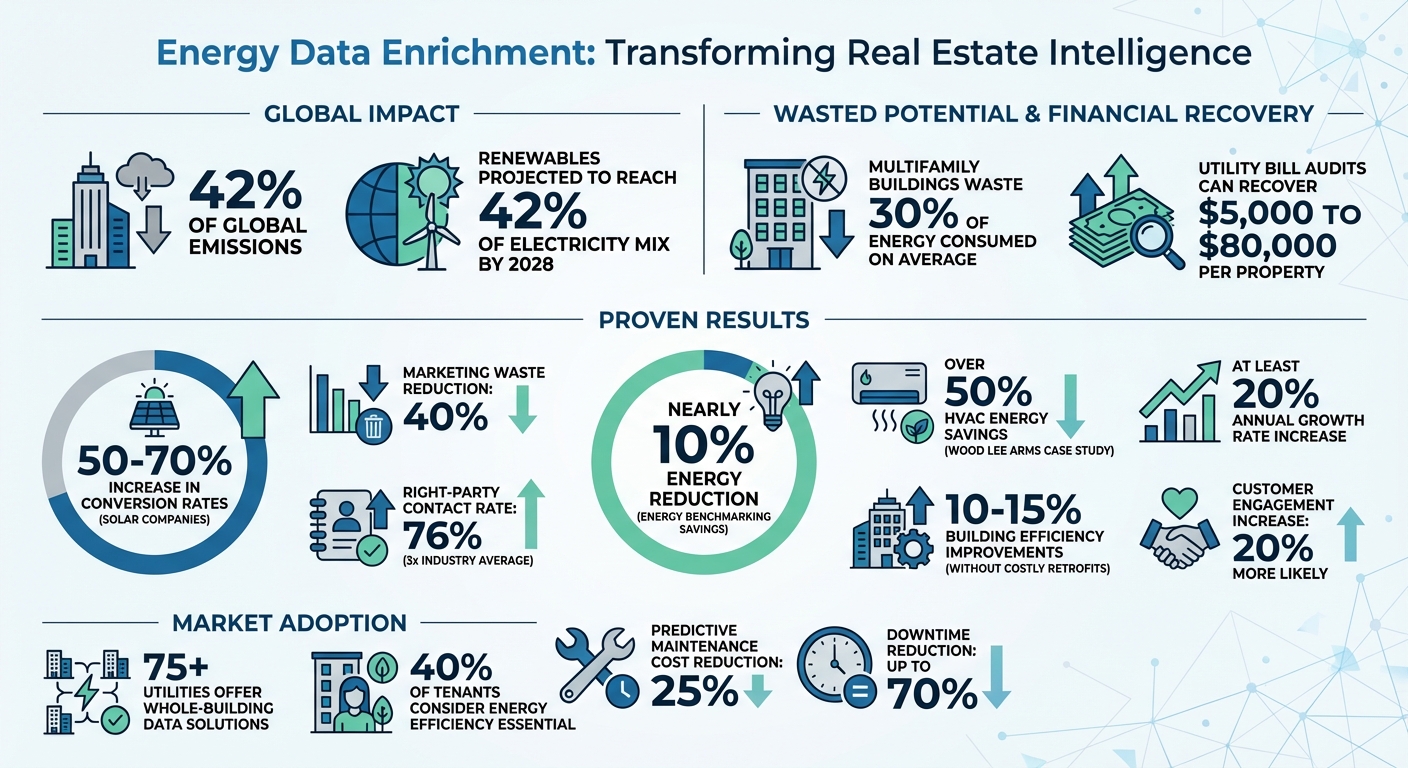
Energy Data Impact on Real Estate: Key Statistics and Benefits
Part 2 – Using Benchmarking Results to Understand Your Building’s Performance
sbb-itb-8058745
How Energy Data Improves Property Intelligence
Traditional property intelligence has often revolved around static details like square footage, ownership records, and transaction history. Adding energy data into the mix takes things to the next level. It shifts the focus from merely describing properties to understanding how they actually perform. This shift unlocks a range of practical benefits, as outlined below.
Benefits of Energy-Enriched Property Data
Energy data adds depth to property insights, enabling smarter decisions in areas like risk assessment, maintenance, and marketing. For example, combining energy performance metrics with details like roof age and material composition allows for sharper risk evaluations. Solar companies leveraging this data have seen conversion rates jump by 50–70%, while precision targeting has cut marketing waste by 40%.
On the maintenance side, real-time IoT sensor data can detect equipment issues early, allowing for proactive fixes. This not only reduces downtime but also extends the lifespan of equipment. Happy tenants are another bonus – lower utility bills and improved indoor conditions lead to higher lease renewal rates. Additionally, properties with strong energy performance ratings often qualify for green financing options, such as loans with better interest rates or access to green bonds.
Marketing also benefits significantly. Advanced contact enrichment tools can achieve a 76% right-party contact rate, which is roughly three times the industry average. This level of precision helps real estate professionals zero in on homeowners who are most likely to invest in energy upgrades, boosting marketing ROI.
Adding Energy Metrics to Property Profiles
While direct access to utility data is often restricted due to privacy concerns, proxy indicators can fill the gap. Features like pool ownership, square footage, and electric vehicle (EV) registrations provide clues about a property’s energy needs. Permit data adds another layer, showing recent investments like solar installations, EV chargers, or pool construction – key signs of homeowners ready to invest in upgrades.
| Energy Data Point | Real Estate Application | Decision-Making Impact |
|---|---|---|
| Roof Specifications | Assessing solar suitability and maintenance needs | Cuts costs for site visits; improves proposal accuracy |
| Solar Permit History | Tracking market adoption and competition | Helps guide territory expansion and upsell strategies |
| Energy Proxies (EVs, Pools) | Estimating household energy consumption | Targets marketing for energy-efficient upgrades |
| Utility Costs & Incentives | Regional market analysis | Pinpoints high-return areas for investment or services |
Using Energy Data for Benchmarking and Market Analysis
What is Energy Performance Benchmarking?
Energy performance benchmarking involves comparing a building’s energy efficiency to industry standards or similar properties. This process transforms utility bills into meaningful metrics like Energy Use Intensity (EUI, measured in kBtu per square foot) and ENERGY STAR Scores, where a score of 75 or higher indicates excellent performance.
Property managers often use tools like the ENERGY STAR Portfolio Manager to monitor energy, water, emissions, and waste across their buildings. The platform simplifies reporting and supports better energy management. Over 75 utilities now offer whole-building data solutions, allowing managers to automate data submissions through APIs instead of manually entering meter readings. This automation not only reduces errors but also ensures real-time updates – essential for quickly identifying inefficiencies.
Benchmarking can also uncover areas for improvement. For instance, one commercial office portfolio identified inefficiencies in HVAC systems. Addressing these through retro-commissioning measures led to a 15% reduction in utility costs. Establishing a 12-month baseline helps property managers spot underperforming buildings and evaluate upgrades, especially those with payback periods of three years or less.
Improving Market Position with Energy Data
Energy data isn’t just about efficiency – it’s also a competitive advantage. Buildings with strong energy performance often achieve higher rents, better occupancy rates, and increased asset value. By reducing operating costs and carbon footprints, energy-efficient properties appeal to both tenants and investors.
This trend is reinforced by regulatory requirements. Many state and local governments now mandate energy benchmarking and performance standards. Examples include New York City’s Local Law 97 and Boston’s BERDO, which require commercial property owners to track and report energy use. Public-facing scorecards not only boost a building’s reputation but also support corporate social responsibility goals. Additionally, lenders and investors increasingly factor energy performance into credit risk models and portfolio decisions.
Lower energy consumption directly impacts a property’s financial performance by improving net operating income and overall asset value. Energy-efficient buildings with verified performance often secure higher rents and maintain stronger occupancy compared to less efficient competitors. These insights are invaluable for assessing risks and shaping investment strategies, making energy transparency a critical factor in today’s market.
Key Energy Metrics for Real Estate Analysis
Core Energy Data Points for Properties
When it comes to analyzing energy use in real estate, Energy Use Intensity (EUI) is a go-to metric. Measured in kBtu or kWh per square foot annually, EUI lets you compare energy performance across properties of different sizes. For example, a 50,000-square-foot office building can be directly compared to a 200,000-square-foot complex. This is especially important since the real estate sector is a major contributor to emissions.
Another essential metric is Time of Use (TOU) data, which shows when energy is consumed throughout the day. This insight can help shift energy-heavy activities to off-peak hours, cutting utility costs without needing expensive upgrades. Carbon footprint measurements, expressed in CO2e (Carbon Dioxide Equivalent), are also critical. These figures are key for ESG reporting and meeting regulations like the EU’s Energy Performance of Buildings Directive.
Efficiency ratings for building systems – such as HVAC, LED lighting, and water heating – shed light on how well individual components are functioning. On top of that, renewable energy capacity tracks on-site energy generation from sources like solar panels, adding another layer of value to property assessments. Together, these metrics guide both day-to-day operations and long-term strategies in real estate.
"They say data is king, but in the case of real estate investments, energy data is the king of kings." – Ryan Stevens, Technical Content Creator, comundo
Practical Applications in Real Estate
These metrics don’t just sit on spreadsheets – they drive real-world decisions. For instance, consistent energy benchmarking can lead to nearly 10% energy savings. On the flip side, multifamily buildings waste an average of 30% of the energy they consume, highlighting the potential for improvement. By analyzing EUI data, professionals can identify underperforming properties and prioritize upgrades that deliver strong returns.
A great example comes from Grady Management and their 2024 project at Wood Lee Arms Apartments. Using PulseIQ‘s Energy Management Solution, they implemented real-time HVAC monitoring and analytics. This uncovered hidden operational issues and resulted in over 50% HVAC energy savings. Beyond cutting costs, these improvements boosted tenant comfort, which helps with retention and increases net operating income.
Another practical tool is utility bill audits. These audits can uncover billing errors, incorrect meter readings, or improper rate structures, recovering anywhere from $5,000 to $80,000 per property. Energy-efficient buildings also appeal to tenants. According to a German survey, 40% of tenants believe energy efficiency is essential in rental properties. Properties with strong energy performance not only attract tenants but also support higher rent premiums and better occupancy rates.
"Energy efficiency is not just low-hanging fruit; it is fruit that is lying on the ground." – Dr. Steven Chu, former US Secretary of Energy
Advanced tools like meter analytics and fault diagnostics can improve building efficiency by 10-15% without requiring costly retrofits. This proactive approach to maintenance not only reduces expenses but also ensures compliance with Building Energy Performance Standards (BEPS) well ahead of deadlines.
Integrating Energy Data with Real Estate Platforms
Data Integration Methods
The first step to incorporating energy data into a property intelligence system is using APIs. These tools provide real-time access to energy metrics, handling millions of requests with ease. Unlike manual data collection, which is slow and prone to errors, or bulk downloads that quickly become outdated, APIs ensure your system remains updated with the latest information.
By using compound queries, it’s possible to retrieve multiple datasets – like property details and energy metrics – in a single request. This approach helps reduce latency and lowers the technical workload.
Maintaining Data Accuracy and Compliance
Ensuring accuracy begins with verified data sources and automated systems. For example, more than 75 utilities currently offer aggregate whole-building data that can be uploaded directly into ENERGY STAR Portfolio Manager accounts. The use of web services APIs eliminates the risk of spreadsheet errors and keeps metrics updated without manual effort.
"Typically, these data access solutions take one of two pathways: Aggregated whole building data are sent directly to a building’s Portfolio Manager record via the Portfolio Manager web services application programming interface (API); or Aggregated whole building data are provided to a building owner/manager in spreadsheet format." – ENERGY STAR
For properties with multiple tenants where individual data is unavailable, aggregate whole-building data solutions provide a complete picture. Building owners can also use tools like Portfolio Manager to monitor utility data access and stay compliant with local benchmarking requirements, especially as more cities adopt mandatory ordinances.
These practices set the stage for advanced solutions, such as those provided by BatchData.
BatchData‘s Data Enrichment Services

BatchData offers real estate professionals access to over 1,000 data points across 155 million properties, including energy-related details like solar permits, HVAC systems, and roof upgrades. The platform also tracks job values, dates, and contractor information – key factors for evaluating a property’s energy efficiency and modernization efforts.
Integration options are flexible. BatchData supports low-latency real-time APIs, bulk data delivery via S3 or Snowflake, and custom professional services for tailored solutions. With compound query capabilities, users can pull detailed property profiles – including energy-related permits and building characteristics – in one request, saving time and reducing technical complexity. For those transitioning from older systems, BatchData provides dedicated support to ensure a seamless migration.
"What used to take 30 minutes now takes 30 seconds. BatchData makes our platform superhuman." – Chris Finck, Director of Product Management
Conclusion
Energy data enrichment is reshaping property evaluation, steering the industry away from instinct-based decisions and toward proactive, data-driven strategies. By integrating energy metrics – like HVAC system age and roof specifications – into property profiles, stakeholders such as investors, service providers, and portfolio managers can better identify opportunities, assess risks, and back their decisions with concrete data.
Companies adopting data-focused approaches experience tangible benefits: annual growth rates increase by at least 20%, while predictive maintenance can cut routine costs by 25% and reduce downtime by as much as 70%. For home service providers offering solar or HVAC upgrades, enriched data enables highly targeted marketing, making potential customers 20% more likely to engage.
Real-time API integration further streamlines operations, replacing manual tasks with instant, continuously updated property intelligence. This not only reduces errors but also speeds up market analysis and ensures compliance as cities implement energy reporting mandates.
As renewables are projected to account for 42% of the electricity mix by 2028, properties with well-documented energy performance will hold stronger market positions. Energy data enrichment transforms raw numbers into actionable insights, helping real estate professionals stay ahead in a market increasingly shaped by sustainability and data-driven practices.
"Ultimately, enriched data bridges the gap between information, intuition, and insight." – Forbes
This quote underscores the pivotal role enriched energy data plays in advancing real estate intelligence and maintaining a competitive edge.
FAQs
What energy data can I use if utility data isn’t available?
If utility data isn’t accessible, you can tap into other sources such as property ownership records, transaction histories, tax liens, and geographic or demographic data. By integrating these datasets with APIs, you can gain insights into property features and location-related risks, bridging the gaps in energy data for more thorough analysis.
How do I benchmark a building’s energy performance with EUI?
To measure a building’s energy performance with EUI (Energy Use Intensity), start by collecting detailed energy consumption data for at least one year. This ensures you capture seasonal variations. Then, calculate the EUI by dividing the total energy consumption by the building’s gross floor area. Use this number to compare the building’s performance against industry standards or similar properties. This comparison helps pinpoint performance gaps, monitor trends, and establish clear energy efficiency targets.
How can I integrate energy data into my real estate platform via API?
To bring energy data into your systems, consider using APIs like Rhino’s Real-Time Utility Data API. This tool delivers verified electricity, water, and gas data in real time, making it easier to access accurate energy consumption metrics. Whether you’re working on analytics, ESG reporting, or energy management, this API ensures you have the reliable data you need.
For a more complete view of properties, BatchData provides APIs that offer property enrichment features. These include ownership details and valuations, which pair well with energy data to help build a more detailed property profile.