Dirty data costs real estate teams money, time, and trust. If your records are stale, missing fields, duplicated, or split across systems, you can end up with wasted outreach, AVM failures, loan rework, and reports people stop believing.
Here’s the short version:
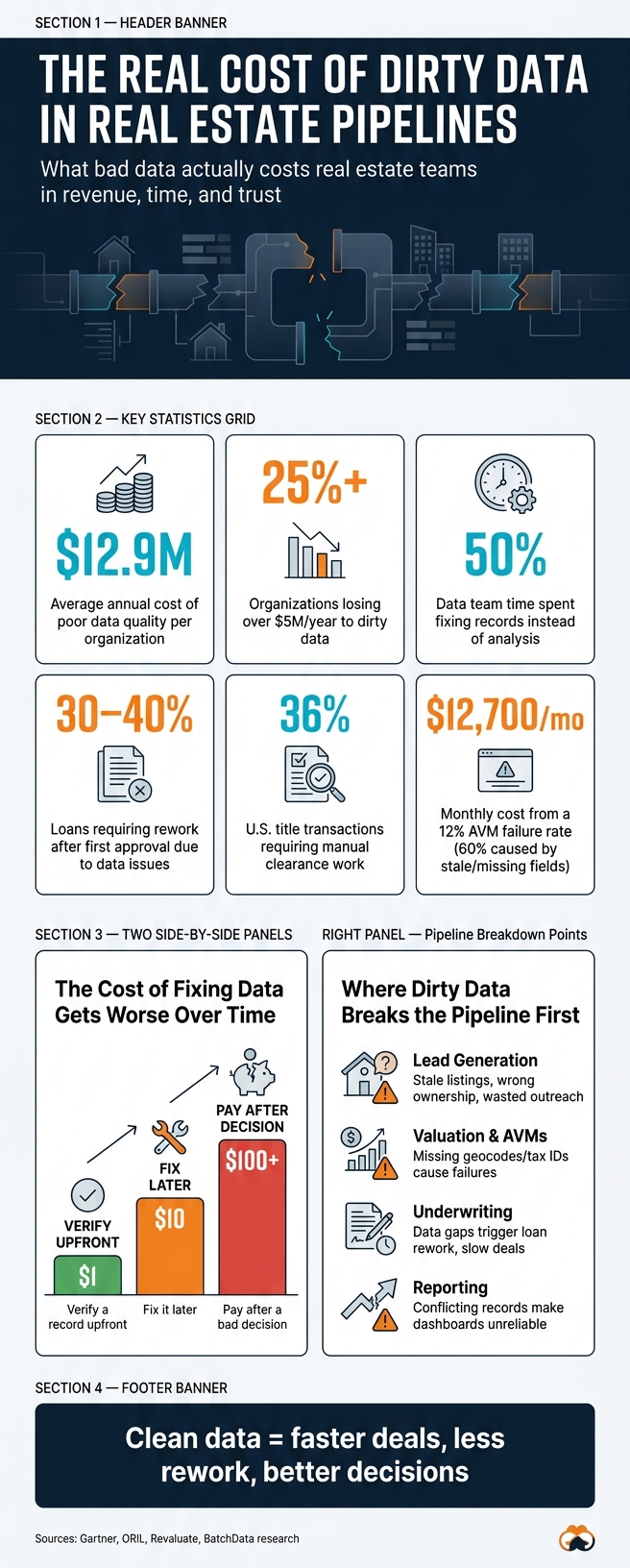
- Poor data quality costs organizations about $12.9 million per year
- More than 25% of organizations lose over $5 million annually
- 50% of data team time can go to fixing records instead of analysis
- 30% to 40% of loans need rework after first approval due to data issues
- 36% of U.S. title transactions need manual clearance work
- One AVM example showed a 12% failure rate, with 60% tied to stale or missing fields, costing about $12,700 per month
If I had to boil it down to one point, it’s this: bad source data spreads through every step of the pipeline. It affects lead routing, underwriting, valuation, marketing, and reporting long before someone notices.
What causes most of the damage?
- Stale listing or ownership data
- Missing tax IDs, geocodes, zoning, or contact fields
- Duplicate owner or property records
- Conflicting IDs and addresses across MLS, CRM, county, and internal tools —often due to fragmented real estate API integrations—
- No clear source of truth for each field
The fix is not complicated, but it does take discipline:
- Profile and audit incoming data
- Standardize addresses and field formats
- Merge duplicate records
- Set validation and freshness checks
- Pick a system of record for each field
- Use enrichment to fill gaps
- Track quality with simple dashboard metrics
A good way to think about it: it’s cheaper to check a record early than fix the mess later. The article shows how dirty data hurts ROI, where it breaks the pipeline first, and what teams can do to keep it under control.
The Real Cost of Dirty Data in Real Estate Pipelines
I Fixed the $15M Problem: How to Clean Business CRMs with AI
What Research Shows About the Business Impact
Once dirty records get into the pipeline, the damage shows up in two places fast: lost revenue and lost time. More than 25% of organizations lose over $5 million a year because of poor data quality, and 7% lose more than $25 million. In real estate, that pressure hits margin and deal speed almost right away.
How Dirty Data Lowers ROI
The 1-10-100 Rule lays it out in plain terms: verify a record for $1, fix it later for $10, or pay $100+ once it leads to a bad decision. In real estate, that can mean bad valuations, weak targeting, and money wasted on campaigns that never had a shot.
Bad contact and property data can also throw off ad platforms and lead-scoring models. If systems on Google or Meta get fed inaccurate data, they start optimizing for the wrong people. A renter may get treated like a luxury buyer, for instance, and ad spend disappears before anyone spots the problem. Bad inputs lead to bad outputs.
In June 2026, one vendor found that its AVM failed on 12% of records. Of those failures, 60% came from stale or missing fields. At 400 runs per month, that translated to about $12,700 in monthly review time and lost margin.
How Dirty Data Slows Execution
The time cost is just as heavy, even if it doesn’t stand out on a P&L right away. Research shows that 50% of data team time goes to remediation instead of analysis. That’s half the team’s bandwidth spent fixing records instead of finding patterns, answering business questions, or helping deals move.
Underwriting gets hit hard. Between 30% and 40% of loans need rework because data issues show up after the first approval, which adds days to time-in-pipeline. Teams have to reopen files, check details again, and revisit calls they thought were already done. Capacity drops, even when output reports don’t show the problem at first glance.
Title work shows the same pattern. A standard transaction takes an average of 22 hours to process. But when fragmented records force manual clearance work, which happens in 36% of all U.S. title transactions, that total climbs to 45 hours. That’s more than double the labor time. When teams can’t rely on the data, they slow down and start checking everything by hand.
These losses tend to surface first in lead workflows, underwriting, valuation, and reporting.
Where Dirty Data Breaks the Real Estate Pipeline
Dirty data usually shows up first in lead, valuation, and reporting workflows. In practice, the damage is easiest to spot in three parts of the pipeline: leads, underwriting, and reporting.
Lead Generation and Contact Workflows
Stale listing statuses and old ownership records are often where things start to fall apart. When a feed is delayed, teams can end up calling about properties that already sold. That wastes agent time and sends outreach to the wrong people.
Fragmented CRM and MLS records make the mess worse. The same owner or property may appear in multiple records, which means outreach runs on old or mismatched data instead of a single source of truth. The result? Lower conversion rates before anyone even spots the problem. And once contact data is off, those same record errors spill into valuation and reporting.
Property Analysis, Underwriting, and Valuation
Missing tax IDs, geocodes, zoning details, or lease terms can break AVMs and qualification logic. Those gaps can lead to mispriced assets and weaker risk models. Deal review gets slower, and teams have less confidence in what they’re looking at.
Reporting, Forecasting, and Portfolio Operations
At the portfolio level, dirty data creates conflicting records when the same asset appears differently across MLS, CRM, and internal databases. Without a single source of truth, dashboards stop being dependable. Teams then spend more time reconciling records than making decisions.
The table below shows how common dirty data issues affect the pipeline:
| Dirty Data Issue | Pipeline Impact |
|---|---|
| Stale listing status | Wasted outreach; agents calling on sold properties |
| Missing property attributes | AVM failures; incorrect qualification logic; mispriced listings |
| Fragmented owner records | Outreach based on outdated ownership records; conflicting records |
| Inconsistent IDs/addresses | Unreliable dashboards; manual reconciliation; conflicting records |
Each of these issues can be fixed, but only if teams know where the problem hits first. The farther a bad record moves downstream, the more expensive it is to correct.
What Research Recommends for Cleaning and Normalizing Real Estate Data
Once the weak spots are clear, research points to a small set of controls that can cut errors before they spread.
Core Cleanup Methods That Reduce Downstream Errors
Start with profiling and auditing. Track coverage metrics, like the share of records that include required fields such as tax ID, geocode, and owner name. Then flag invalid values and outliers as data comes in. One useful benchmark: if 20% to 30% of support tickets come from data accuracy or freshness problems, you likely have a serious data debt issue.
These controls hit the same places where dirty data does the most damage: outreach, valuation, and reporting.
Next comes address normalization and field standardization. Formatting addresses to USPS standards and mapping property fields to a common schema, such as RESO Data Dictionary v2.0, can help stop record mismatches and shaky valuation inputs across split-up sources like MLS, CRM, and property management systems.
Deduplication and field-level validation finish the job. Merging duplicate owner and property records helps create a single source of truth. At the same time, automated checks for emails, phone numbers, and key property fields – along with freshness monitoring for fields like listing status – can cut silent failures in AVMs and outreach flows.
"Stale data… is especially dangerous because it looks valid – passes format checks, throws no errors, and silently produces wrong outputs." – Zorian Fedoryga, CTO, ORIL
Source prioritization also matters when you’re pulling from multiple property data feeds. If you define which source is the system of record for each field – county records for tax data, for example, and MLS for listing status – it’s much easier to settle conflicts and avoid bad outputs.
Taken together, these controls cut stale records, missing fields, and duplicate entries that can throw downstream workflows off track.
Why Enrichment and Verification Matter in Real Estate
Even after cleanup, some fields will still be missing. That’s where enrichment comes in. Cleanup fixes what’s already there. Enrichment fills in what never made it into the system in the first place.
A database audit completed in April 2026 for Drew Deck of the ReeceNichols Preferred Realty team, part of HomeServices of America, shows what that looks like in practice. The team’s CRM had grown to more than 8,000 contacts, but 5,005 of them were missing valid addresses. After deduplication, field standardization, and homeowner address appending, the project repaired 2,320 mailing addresses in three business days. That pushed complete address inventory up by 188% and increased usable records from 837 to 2,900, a 246% jump.
"That would’ve taken me a year to do manually at nearly a full-time job." – Drew Deck, Real Estate Agent, ReeceNichols Preferred Realty
| Metric | Before Repair | After Repair | Improvement |
|---|---|---|---|
| Complete Mailing Addresses | 1,234 | 3,554 | +188% |
| Usable Records | 837 | 2,900 | +246% |
Source: Revaluate Database Audit Case Study
Governance, Monitoring, and Key Takeaways
Governance Practices That Keep Data Clean
Once cleanup rules are set, governance stops bad data from sneaking back into the pipeline. The first step is a clear source-of-truth hierarchy. In plain English: decide which system owns each field across properties, owners, and contacts. When MLS, PMS, and CRM overlap, use conflict-resolution rules so teams aren’t stuck guessing which value to trust. Refresh SLAs should match the job at hand: daily for AVM inputs, weekly during remediation, and monthly for portfolio reporting.
To make data quality visible to leadership, build a data quality dashboard that tracks the failure points that lead to downstream cost: outreach waste, AVM failures, and manual rework.
| Health Metric | What It Measures |
|---|---|
| Coverage | % of records with required fields such as owner, tax ID, and geocode |
| Freshness | Median record age; % not updated in 30, 60, or 90 days |
| Duplication | Duplicate rates by entity type |
| Fragmentation | % of records with conflicting values across MLS, CRM, and PMS |
| Failure Rate | % of AVM or geocoding failures tied to missing or stale inputs |
| Business Impact | Support ticket volume tied to data issues; hours spent on manual data corrections |
If reactive data work is eating up more than 15–20% of engineering time, the price of doing nothing is already higher than the price of a remediation sprint. That’s why data cleanup should sit in the priority backlog and be scored by impact, frequency, and effort, instead of getting pushed aside as routine maintenance.
"Data debt is not a data team problem. It’s a business problem that lives inside your data infrastructure." – Zorian Fedoryga, CTO, ORIL
Conclusion: Clean Data Protects Margin, Speed, and Decision Quality
Dirty data doesn’t just create annoyance. It chips away at revenue, slows execution, and quietly weakens trust in the tools teams use every day.
"Customers who get wrong data don’t always file a ticket – they stop trusting the product." – Zorian Fedoryga, CTO, ORIL
The damage shows up in lead conversion, underwriting speed, and trust in reporting. One of the clearest warning signs is repeated manual review. A 12% AVM failure rate, with 60% of those failures caused by stale or missing data, can cost a mid-sized operation about $12,700 per month in manual review time and lost deal margins.
The way out is straightforward: normalization, verification, enrichment, and steady governance working together. For operators, developers, and investors, the business case is simple. Clean, verified, and closely monitored data helps teams move faster, spend less time fixing records by hand, and make better calls. BatchData (batchdata.io) supports this with property and contact enrichment, skip tracing property owners, phone verification, APIs, and bulk delivery.
FAQs
How can I tell if dirty data is hurting my pipeline?
Watch for red flags like too much manual rework, mismatches between MLS and county records, and duplicate listings that can inflate inventory counts or reset days on market.
Other warning signs show up fast in outreach and system logs. High email bounce rates, disconnected phone numbers, and automated alerts for failed API calls, schema mismatches, or invalid formats all point to dirty data.
Which data issues should real estate teams fix first?
Real estate teams should first fix data quality issues at the base level: inconsistent records, scattered data, and old information. A single source of truth, or Golden Record, helps bring together MLS, tax, and CRM data with clear rules for accuracy and recency.
Teams should also focus on mistakes in property zoning, valuation, and old or duplicate contact records. These problems can lead to fines, failed deals, wasted marketing spend, and legal risk.
How often should real estate data be cleaned and verified?
Real estate data needs regular cleaning and verification because it decays by 2% to 3% per month. That adds up fast.
For 2026, industry standards put the most weight on daily updates, especially for county assessor and recorder data.
Some fields need to move even faster. Listing status, price, and property identity should sync in real time. Other records, like tax and assessment history, can be updated daily.