


































Sales teams waste time chasing leads that don’t convert. Propensity models fix this by using machine learning to predict which leads are most likely to act, helping reps focus on high-priority opportunities. These models analyze historical and real-time data to assign scores (0–100) to leads, ensuring smarter decisions and faster follow-ups. For example, responding to a hot lead within 5 minutes can increase qualification odds by 21x.
Key takeaways:
- What they do: Predict lead behavior and rank pipeline opportunities.
- How they work: Use data like purchase history, website visits, and property records.
- Why they matter: Boost sales efficiency – teams using these models spend 80% of their time on qualified leads (vs. 30% manually).
- Impact: Real estate teams have closed 36 deals/year by focusing on high-scoring leads, while roofing and solar companies report 50–70% higher conversion rates.
Propensity models turn CRMs into actionable tools that prioritize leads, reduce wasted effort, and improve results across industries like real estate, roofing, and solar.
Propensity Model Mastery: Step-by-Step Roadmap for Implementation
sbb-itb-8058745
How Data Intelligence Powers Propensity Models
Propensity models are only as effective as the data they rely on. Without detailed property records, verified contact details, and up-to-date information, even the most advanced algorithms can produce unreliable results. High-quality data intelligence turns basic address data into actionable insights, enabling accurate predictions of homeowner behavior. For example, enriched datasets can cut model error rates by up to 30% in sales forecasting, which directly influences how sales teams prioritize leads.
The key difference between a standard lead list and a high-performing propensity model lies in feature engineering – the process of converting raw data into meaningful predictive signals. Take “last sale date”, for instance. Instead of using it as-is, a strong model transforms it into “years of ownership”, which is a much stronger predictor. Why? Because homeowners in the 7-10 year ownership range are statistically more likely to sell, making this data conversion essential for accurate scoring. Without access to historical records and property details, such predictive features simply aren’t possible.
How BatchData Enriches CRM Data
BatchData specializes in property enrichment, skip tracing, and homeowner profiling, integrating these directly into CRMs. With API access to over 155 million property records, BatchData can append critical details like square footage, year built, ownership length, and equity estimates to existing CRM entries. This process uses automated matching algorithms with 95% accuracy, ensuring that propensity scores reflect current, verified information rather than outdated or incomplete data.
Skip tracing is another essential component, verifying phone numbers and email addresses through multi-source databases. When a propensity model flags a homeowner with a high score, sales teams need to act fast. Invalid contact information can delay outreach, but with verified data, teams can connect with leads immediately. This combination of property insights and accurate contact details turns static CRM lists into dynamic opportunities that update as new information becomes available.
Key Data Points for Real Estate, Roofing, and Solar
Different industries rely on specific data signals to power their propensity models:
- Real estate: Key signals include property value appreciation, recent ownership transfers, mortgage details, and estimated equity. Homeowners with over 50-60% equity are more likely to sell or invest in improvements. Models using these signals have been linked to 25-40% higher close rates. Ownership duration remains a standout predictor, with the 7-10 year mark being the prime window for listing activity.
- Roofing contractors: Propensity models focus on roof age estimates (often derived from satellite imagery), last permit dates for repairs, property condition scores, and severe weather history. Homes with roofs over 20 years old show a conversion likelihood exceeding 50% when targeted with data-informed outreach. Additionally, recent storm activity in a specific ZIP code can trigger score updates, helping contractors reach homeowners at the perfect moment – when they’re assessing damage and considering repairs or replacements.
- Solar installers: These models rely on signals like roof orientation, south-facing suitability, annual sunlight hours, property values above $300,000, and energy consumption patterns. By integrating these factors, solar companies can prioritize leads more effectively. Studies show a 35% increase in qualified leads for solar businesses using propensity scoring. High scores typically align with properties that have strong sunlight exposure, optimal roof angles, and significant equity.
With this enriched data foundation, your CRM becomes a powerful tool for building models and integrating accurate propensity scores seamlessly.
How to Build and Deploy Propensity Models
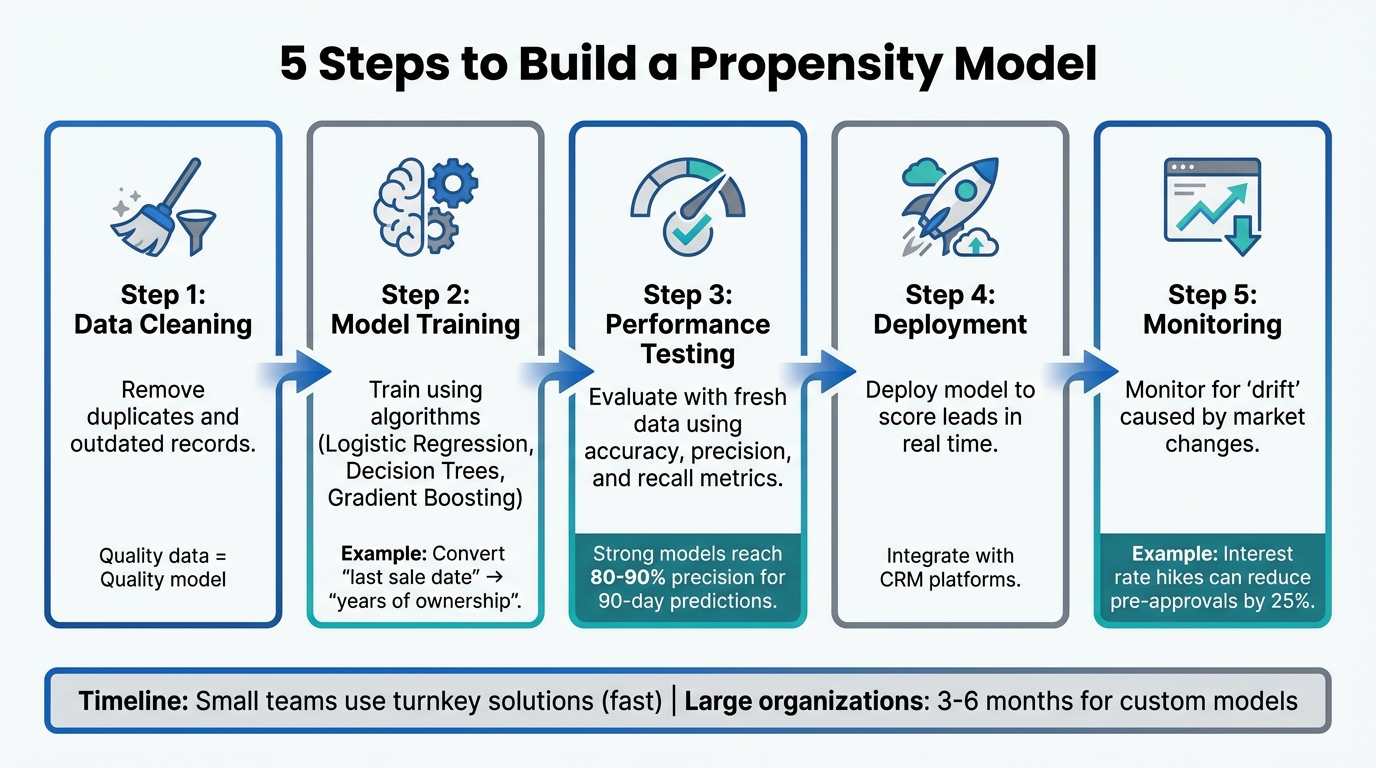
5-Step Process to Build and Deploy CRM Propensity Models
Creating a propensity model starts with one crucial step: defining a clear, measurable goal. Avoid vague objectives like “find good leads.” Instead, focus on specific actions such as “homeowners likely to list their property in the next 6 months” or “roofing leads likely to request a quote within 6 months”. This clarity shapes every subsequent step, from data collection to evaluating the model’s success.
After setting your target, the next step is gathering historical data on individuals who have and haven’t taken the desired action. From there, feature engineering transforms raw data into meaningful predictive signals. For instance, BatchData’s API simplifies this process by adding details like square footage, assessed value, equity estimates, and ownership length directly to your CRM entries. By enriching your CRM data, you create a foundation for real-time, actionable insights.
Steps to Build a Propensity Model
Using enriched property data and verified contact details makes building a propensity model more efficient. The process typically involves five key steps:
- Data Cleaning: Start by cleaning your CRM data. Remove duplicates and outdated records because the quality of your model depends on the quality of your data.
- Model Training: Train your model using algorithms like Logistic Regression, Decision Trees, or Gradient Boosting to identify patterns. For example, converting “last sale date” into “years of ownership” can significantly enhance predictive accuracy.
- Performance Testing: Evaluate the model with fresh data, using metrics like accuracy, precision, and recall. Strong real estate models often reach 80–90% precision for predicting property sales within 6 months.
- Deployment: Once validated, deploy the model to score leads in real time.
- Monitoring: Keep an eye on model performance to detect “drift” – a drop in accuracy caused by changing market conditions, such as interest rate hikes that reduce pre-approvals by 25%.
For small teams, turnkey solutions offer a fast, effective way to implement propensity models without needing a dedicated data science team. Larger organizations, however, may invest 3–6 months in building custom models tailored to their unique data needs. Regardless of approach, the goal is the same: turn static CRM data into dynamic, continuously updated opportunities.
Adding Propensity Scores to Your CRM
Once your model is ready, the final step is integrating it into platforms like Salesforce or HubSpot. RESTful APIs and webhooks allow you to push propensity scores directly into CRM lead scoring fields. This ensures sales teams can immediately act on high-priority leads. For example, in Salesforce, you can configure custom objects so reps see a “health score” or “sell score” directly on their dashboard. High scores – like a 9 out of 10 – can trigger automated workflows, such as personalized emails, follow-up reminders within six hours, or targeted ad campaigns.
“Gro’s propensity scoring changed how our SDRs start their day. Instead of guessing, they open the dashboard and see exactly which 20 leads have a 9/10 score. It’s the difference between hitting quota and missing it.” – Aimee Chung, Sales Operations Leader
Automated data collection through propensity tools can also cut lead processing time by 20%, saving $12 to $15 per lead in labor costs. The real game-changer? Ensuring scores update in real time as new data – like a recent storm or a change in property equity – becomes available. This keeps sales teams equipped with the most up-to-date intelligence, transforming static CRM lists into a dynamic, prioritized sales pipeline.
Best Practices for Using Propensity Models in Real Estate Sales
Building on effective model deployment, these practices can help maintain efficiency and drive revenue growth.
Update Models with Fresh Data
The real estate market is always changing, so keeping your model updated is crucial. Models trained on outdated data lose their edge, especially in today’s environment where interest rate fluctuations have caused a 25% drop in pre-approvals. This phenomenon, known as model drift, occurs as economic conditions shift and predictive accuracy fades.
To counter this, retrain your models regularly using fresh data. BatchData’s database of over 155 million property records is a great resource for updating metrics like equity levels, ownership tenure, and recent permit activity. Top-performing real estate teams frequently monitor and retrain their models – especially after major market changes – to stay ahead. Automated systems now make this process even faster, with updates occurring within hours of events like new building permits, which often signal a homeowner’s readiness to sell.
Connect Scores to Sales Actions
Propensity scores are only valuable if they lead to actionable steps. For example, leads with scores above 80 should be immediately routed to your best sales reps. High scores can also trigger automated workflows, such as personalized email campaigns or targeted digital ads, ensuring timely and relevant engagement.
use tailored data solutions to match each lead’s situation. For homeowners with substantial equity, focus on downsizing opportunities. For those facing high interest rates, emphasize refinancing options. This kind of targeted outreach has been shown to boost conversion rates by as much as 3× compared to generic messaging. Mortgage lenders, for instance, have used this approach to retain 15–20% more customers during volatile periods. By aligning actions with scores, sales teams achieve measurable improvements in performance.
Measurable Benefits of Data-Driven Sales
Accurate and regularly updated propensity scores can deliver clear financial benefits across various industries. In real estate, teams using well-designed models can achieve 80–90% accuracy in predicting property sales within a 6 months window. This precision significantly improves efficiency, reducing customer acquisition costs by about 35% while increasing conversion rates.
Other industries have also seen impressive results. Roofing companies using data-driven targeting have cut lead acquisition costs by 35–50% and improved crew utilization by 15–20%. For example, a Florida roofing business spent $1,500 per month targeting “Very Likely” leads in hurricane-prone areas, achieving a 4.5% conversion rate and generating $270,000 in monthly revenue – a 22:1 return on investment. In mortgage servicing, propensity models have helped cut losses by up to 30% by identifying high-risk foreclosure properties, enabling quicker intervention – 18 times faster than average.
Conclusion
Propensity models elevate CRMs from static data repositories to powerful tools that prioritize high-value leads. By focusing on statistical conversion likelihood, these models streamline pipelines and improve targeting. BatchData, with its database of over 155 million enriched property records, offers insights into equity levels, ownership tenure, and permit activity – key factors for identifying prospects with strong intent.
The financial advantages are clear: 80–90% accuracy in 90-day property sales forecasting, twice the speed in solar pipeline velocity, and propensity scores that significantly enhance conversion rates through focused outreach. With regular updates and smooth CRM integration, these benefits are not just one-time gains but sustainable over the long term.
FAQs
What data do I need to build a reliable propensity model in my CRM?
Creating a dependable propensity model starts with having high-quality data. The data should encompass property details, financial metrics, and behavioral patterns. Here’s what to focus on:
- Property Attributes: Information like ownership status, equity levels, and mortgage history forms the foundation of your model.
- Enriched Data: Details such as property value and liens provide deeper insights.
- Real-Time Signals: Keep track of dynamic indicators like foreclosure status and recent transactions to stay updated.
Additionally, historical data – such as past sales and behavioral trends – plays a crucial role. It allows the model to learn patterns and make predictions about which leads are worth prioritizing.
How often should propensity models be retrained to avoid model drift?
Propensity models need consistent retraining, typically every 3 to 6 months. This schedule helps prevent model drift – a situation where the model’s predictions become less accurate due to shifts in data patterns. By updating the model regularly, you ensure it stays aligned with current trends and maintains reliable predictive performance.
How do I turn propensity scores into automated CRM workflows for reps?
To streamline CRM workflows with propensity scores, connect the scores to your CRM using APIs or webhooks. Once integrated, create rules to automate tasks like assigning top-scoring leads to sales reps, flagging them for follow-up, or enrolling them in targeted campaigns. Set up notifications to ensure timely actions, and periodically review your workflows to refine lead prioritization and improve conversion rates. This approach helps your team focus on prospects with the highest potential.