






































Real estate professionals often lose leads due to missed or delayed follow-ups. Automating follow-ups using APIs can save time, improve lead engagement, and increase deal closure rates. This article reviews four APIs designed for real estate workflows:
- BatchData Property Search API: Provides detailed property data, verified contact details, and compliance features like DNC scrubbing. Ideal for data-driven lead generation.
- Follow Up Boss API: A CRM-focused tool for managing leads, automating tasks, and scheduling follow-ups natively.
- Zapier API: Connects thousands of apps to enable workflow automation, including lead follow-ups and scheduling.
- OnceHub Scheduling API: Optimized for appointment booking and team scheduling with real-time updates.
Each API has unique strengths. BatchData excels in data accuracy and property data and intelligence. Follow Up Boss simplifies CRM tasks. Zapier offers broad app connectivity, while OnceHub streamlines scheduling. Choosing the right API depends on your priorities – data enrichment, CRM integration, or scheduling efficiency.
1. BatchData Property Search API
Integration Capabilities
BatchData provides real-time API endpoints with flexible integration options. You can connect through a REST API for immediate requests or use cloud platforms like Snowflake, BigQuery, or Amazon S3 for handling bulk operations. This means real estate teams can select the delivery method that works best for their needs – whether it’s quick, on-demand searches or large-scale data processing.
The API enhances property records by appending verified contact details, such as mobile/landline numbers and emails. This feature allows CRMs to automate communication workflows seamlessly. To ensure compliance, it includes built-in DNC (Do Not Call) and Litigator scrubbing, which helps avoid contacting restricted numbers during outreach campaigns.
"What used to take 30 minutes now takes 30 seconds. BatchData makes our platform superhuman."
_ – Chris Finck, Director of Product Management_
This robust integration lays the groundwork for the platform’s standout data accuracy.
Data Accuracy
BatchData’s database covers over 155 million properties and includes access to more than 1 billion data points, with over 1,000 attributes per record. The platform boasts a 76% right-party contact accuracy rate, which is about three times higher than the industry standard. This impressive accuracy is achieved through a property enrichment engine that cross-verifies data from over a dozen sources in real time.
To further streamline lead prioritization, the API provides reachability scores and carrier details for each contact. Daily updates ensure the data remains current and reliable.
This high level of accuracy supports seamless scalability, whether for small tasks or enterprise-level operations.
Scalability
BatchData’s infrastructure is designed to handle everything from single on-demand lookups to bulk processing of millions of records. For businesses with larger needs, custom plans are available, offering higher rate limits and dedicated infrastructure. Trusted by over 10,000 real estate professionals, BatchData serves both PropTech startups and growing enterprises.
Additionally, event-driven webhooks can cut server load by up to 70–80% compared to traditional polling methods, making it an efficient solution for high-volume operations.
Real Estate Specific Features
The API is packed with features tailored for real estate professionals. It provides real-time updates on listing statuses (Active, Pending, Sold) and Days on Market, enabling timely follow-ups in CRMs. For targeting motivated sellers, users can apply filters for financial distress indicators, pre-foreclosure status (e.g., Notice of Default/Sale), high-equity properties, and ownership duration.
The platform also excels at entity resolution, identifying the actual owners behind LLCs and trusts to ensure follow-ups reach decision-makers. With CASS-certified address cleansing, it eliminates wasted marketing spend on undeliverable addresses.
Pricing is flexible, operating on a pay-as-you-go basis with optional subscription tiers for high-volume users.
sbb-itb-8058745
2. Follow Up Boss API
Integration Capabilities
Follow Up Boss uses a REST API that relies on JSON and HTTPS, ensuring secure and efficient data exchange. With webhooks, the system provides real-time updates for events like peopleCreated, appointmentsCreated, and tasksCreated, eliminating the need for constant polling.
To register, developers use unique X-System and X-System-Key headers. Registered systems can handle up to 250 requests every 10 seconds, while unregistered systems are limited to 125. Additionally, POST requests to the /v1/events endpoint are unlimited, and webhooks include automatic retries for up to 8 hours if delivery fails.
Real Estate Specific Features
The API is designed with real estate workflows in mind, offering features that cater to industry-specific needs. For example, the /v1/events endpoint handles lead activity like property inquiries, viewed listings, and registrations. This data automatically triggers internal processes such as "Action Plans" and "Automations", which can assign agents or send follow-up notifications.
"This endpoint is the only correct option to send leads and their activity to Follow Up Boss from an IDX website, real estate portal, your custom website, or any other lead source."
By using this endpoint, developers can channel lead activity from IDX websites, real estate portals, or custom platforms. To prevent duplicate entries, the API allows developers to include a Person ID in event objects, ensuring new activity is linked to existing contacts rather than creating redundant records. It also adheres to ISO 8601 standards for date and time formatting in UTC.
Serving over 10,000 real estate professionals – including the #1 RE/MAX team worldwide, which manages over $1 billion in sales – the platform is a trusted choice for the industry. Developers can explore its capabilities through a 14-day free trial, with the option to request a permanent "dev account" for ongoing integration work. These tools make it easier to schedule follow-ups and maintain consistent, automated engagement with every lead.
3. Zapier API for Scheduling Integrations
Integration Capabilities
Zapier connects lead sources with CRMs and scheduling tools using a trigger-action system. For example, when a new contact comes in through Zillow Tech Connect – which includes Zillow, Trulia, HotPads, and StreetEasy – the platform can automatically create calendar events or activate follow-up workflows. With support for over 8,000 apps, including real estate-focused CRMs like Follow Up Boss, kvCORE, Realvolve, and Brivity, it’s a versatile solution for real estate professionals. Staying updated on industry trends is essential for optimizing these automated workflows.
Zapier’s automation tools handle timing and logic seamlessly. Features like Delay by Zapier allow for custom-timed follow-ups, while Schedule by Zapier enables recurring tasks on a daily, weekly, or monthly basis to maintain consistent lead engagement. The Filter and Paths feature adds conditional logic, ensuring follow-ups are only triggered for leads that meet specific criteria. Setting up workflows is quick – most users complete them in under 6 minutes – and 93% report improved effectiveness.
These integrations are designed to provide the flexibility and precision needed for real estate workflows.
Real Estate Specific Features
Zapier’s Real Estate Automation suite is tailored to meet the needs of agents, covering tasks like transactions, marketing, and property management. The Zillow Tech Connect integration uses a "New Contact" trigger, which immediately activates when a lead is added to an agent’s hub from any connected platform. AI-powered customizations further enhance efficiency by analyzing conversations, gauging buyer intent, and auto-generating deal names to streamline follow-ups.
With the Formatter tool, Zapier ensures data consistency by standardizing details like phone numbers and dates. For time-sensitive actions, it’s best to use apps with "Instant" triggers rather than "Polling" triggers, which check for updates every 15 minutes on the Free plan and may cause delays. To protect sensitive client information, the platform adheres to SOC 2 and GDPR standards and employs AES-256 encryption for data at rest.
4. OnceHub Scheduling API
Integration Capabilities
OnceHub provides a flexible three-tier integration system. Its native integrations work seamlessly with platforms like Salesforce, HubSpot, and Keap, offering a straightforward setup process. For businesses with more tailored needs, the custom API and Webhooks tier offers advanced options for customization.
The webhook functionality is particularly useful for real-time updates. For example, the system sends instant notifications for bookings, cancellations, or reschedules. This eliminates the need for constant polling and allows CRMs to react immediately. Think about sending a confirmation SMS through Twilio or updating a lead’s status in seconds – OnceHub makes it happen. Additionally, its data mapping tools enable agents to link booking form responses directly to CRM fields. Details like budget preferences or property types get automatically added to the system, cutting down on manual input and saving time. This integration approach simplifies CRM automation and keeps real estate workflows running smoothly.
Scalability
OnceHub’s robust architecture is built to handle growing demands. As Dante Ludolf from OnceHub explains:
"The OnceHub API is designed so that it can handle large amounts of data and requests at any given point, so you can rest assured that you can continue to make efficient use of it even as your business grows".
The REST API empowers developers to manage booking calendars, contacts, and settings programmatically. This is especially important for real estate firms juggling schedules across multiple agents or offices.
The platform also offers team scheduling features like round-robin and pooled availability. These tools ensure appointments are distributed evenly, prevent double-bookings, and use automated confirmations and reminders to reduce admin workload.
Real Estate Specific Features
OnceHub is designed to support the automation needs of real estate professionals. One standout feature is its ability to pass UTM parameters and Lead IDs through hidden fields directly into CRMs. This ensures accurate tracking and attribution for every lead. Beyond CRMs, OnceHub integrates with tools like TextMagic to send automated reminders for property showings, keeping communication smooth and timely.
For businesses needing broader automation, Zapier integrations are available, though they require a paid plan that includes 24/7 support. Ludolf highlights the advantages of these integrations:
"By sharing real-time booking data, everyone involved can stay informed about upcoming events, meetings, or tasks, fostering efficiency and minimizing miscommunication".
These features make OnceHub a powerful tool for real estate teams looking to streamline scheduling and enhance client interactions.
Real Estate Lead Automation: Build a System
Strengths and Weaknesses
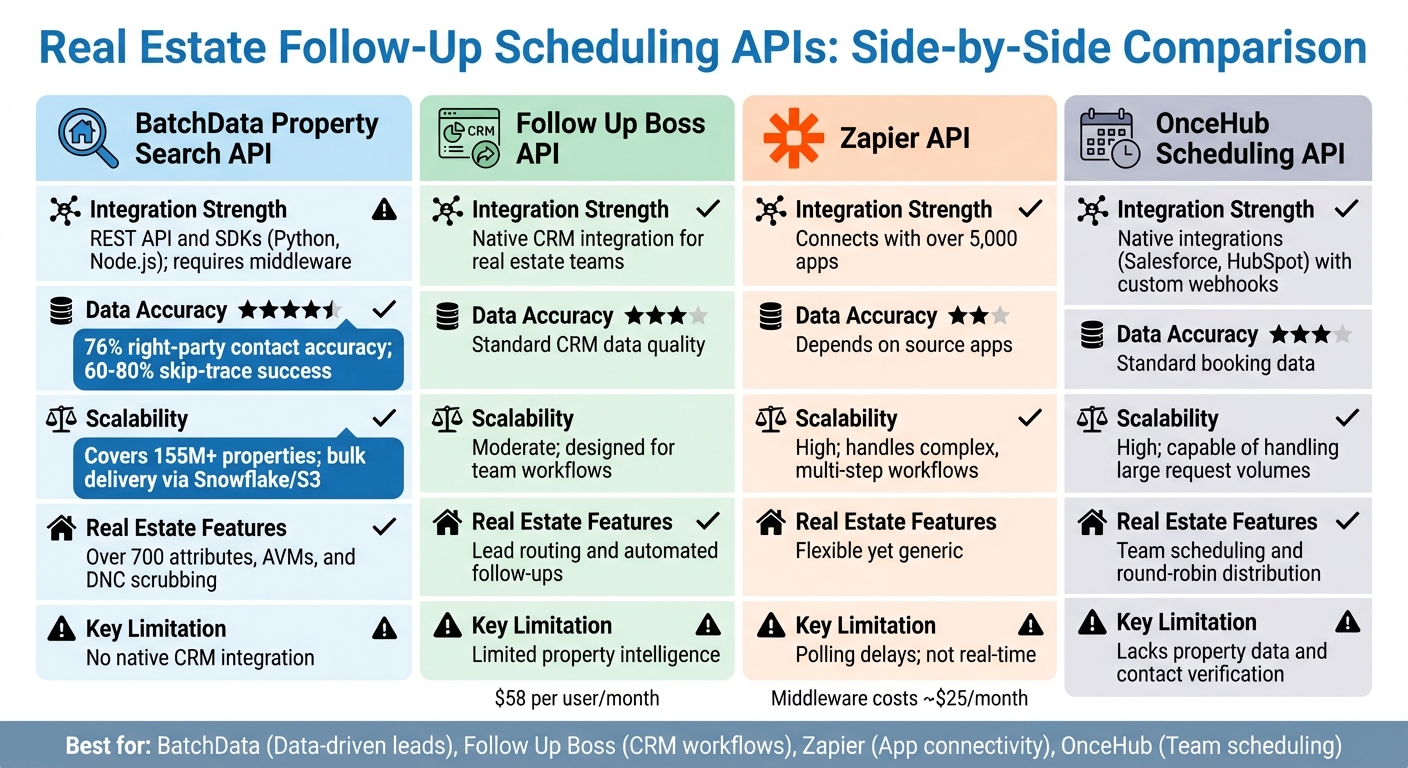
Real Estate Follow-Up APIs Comparison: Features, Accuracy, and Scalability
APIs designed for automated follow-up scheduling in real estate each come with their own set of strengths and limitations.
BatchData stands out for its depth and precision in data, boasting an impressive 76% right-party contact accuracy – three times the industry average – and covering 155 million properties with over 700 attributes. Its event-driven Smart Search API uses webhooks to instantly push leads that meet your criteria, avoiding the inefficiencies of polling. The downside? It requires middleware like N8N or Zapier for integration, which can take 30–45 minutes to set up and adds $25/month in costs. However, this investment can yield substantial returns, automating workflows to deliver 10–25 qualified leads daily while saving over 15 hours of manual research weekly.
Follow Up Boss API shines in its native CRM integration, tailored for real estate teams. It simplifies lead management with features like contact syncing and follow-up scheduling. However, it lacks the extensive property data and skip tracing capabilities that BatchData offers.
Zapier API is a powerhouse for connecting thousands of apps and creating complex workflows. While its flexibility is unmatched, its pull-based model can cause delays, making it less suited for real-time scheduling needs.
OnceHub Scheduling API excels at handling high-volume scheduling with team-focused features like round-robin distribution. It integrates seamlessly with platforms like Salesforce and HubSpot but doesn’t provide property-specific data or contact verification. Still, it delivers essential booking data for managing appointments efficiently.
Here’s a quick comparison of these APIs across key metrics:
| API | Integration Strength | Data Accuracy | Scalability | Real Estate Features | Limitation |
|---|---|---|---|---|---|
| BatchData | REST API and SDKs (Python, Node.js); requires middleware | 76% right-party contact accuracy; 60–80% skip-trace success | Covers 155M+ properties; bulk delivery via Snowflake/S3 | Over 700 attributes, AVMs, and DNC scrubbing | No native CRM integration |
| Follow Up Boss | Native CRM integration for real estate teams | Standard CRM data quality | Moderate; designed for team workflows | Lead routing and automated follow-ups | Limited property intelligence |
| Zapier | Connects with over 5,000 apps | Depends on source apps | High; handles complex, multi-step workflows | Flexible yet generic | Polling delays; not real-time |
| OnceHub | Native integrations (e.g., Salesforce, HubSpot) with support for custom webhooks | Standard booking data | High; capable of handling large request volumes | Team scheduling and round-robin distribution | Lacks property data and contact verification |
For professionals focused on data-driven lead generation, BatchData’s robust property intelligence and high contact accuracy can make it worth the extra setup effort. On the other hand, if your priority is scheduling efficiency with minimal technical complexity, Follow Up Boss or OnceHub might be better suited to your needs. These differences play a crucial role in how automated tools can enhance response rates and boost agent productivity.
Conclusion
After examining the available API options, it’s clear that each one offers specific strengths tailored to various real estate needs. For professionals looking to leverage data-driven insights, BatchData stands out with its in-depth property intelligence and accurate contact details. This rich data resource enables targeted, automated communication, improving both lead quality and engagement.
Follow Up Boss is a solid choice for teams managing a high volume of leads. With native CRM integration and a budget-friendly price of $58 per user per month, it streamlines lead responses for busy professionals. For agents who need seamless scheduling without coding, the Zapier API provides versatile connectivity across tools. Meanwhile, OnceHub shines in appointment scheduling, offering features like round-robin assignment and calendar syncing.
The importance of automated follow-ups is backed by recent data, showcasing how automation can significantly boost efficiency. Real estate professionals focusing on distressed properties, high-equity leads, or investor outreach can achieve a strong return on investment by combining BatchData’s extensive database with automation tools. On the other hand, those emphasizing simple scheduling and team workflows may find Follow Up Boss or OnceHub better suited to their needs.
Ultimately, selecting the right API depends on your workflow priorities and goals. The right choice can make a big difference in lead engagement and overall success.
FAQs
How can APIs improve automated follow-up scheduling in real estate?
APIs make automated follow-up scheduling in real estate much easier by connecting CRMs with other tools effortlessly. This integration ensures real-time updates for property details and contact information, helping teams respond faster and more effectively.
By automating tasks like transferring leads and setting follow-up reminders, APIs free up agents’ time, streamline lead management, and improve conversion rates. The result? A more efficient workflow and better client interactions.
Why is BatchData’s property data considered highly accurate?
BatchData offers property data with impressive precision, boasting a 76% right-party contact accuracy rate and consistently verified details about properties and their owners. The platform taps into a vast database of over 155 million properties, enriched with 700 detailed attributes, giving users access to highly reliable and current information.
This accuracy empowers real estate professionals to make informed decisions, improve follow-up processes, and seamlessly optimize their CRM workflows.
What is the best API for improving scheduling efficiency in real estate?
For real estate teams looking to improve scheduling workflows, an API like Calendly‘s can make a big difference. It streamlines follow-up scheduling, works effortlessly with CRM tools, and makes managing appointments straightforward. This not only saves time but also helps prevent missed opportunities.
When selecting an API, prioritize simple integration, reliable data handling, and ease of use to ensure it fits seamlessly into your team’s processes.