
































Real-time data synchronization is transforming the U.S. real estate market by ensuring property updates – like status changes, price adjustments, or new listings – are reflected across systems within seconds. Unlike traditional batch processing, this approach focuses on transmitting only changes as they happen, eliminating delays that can cost deals. Here’s why it matters and how it works:
- Why It Matters: Speed gives real estate platforms a competitive edge. Faster updates mean quicker lead routing, better agent response times, and an improved experience for buyers and sellers. For instance, platforms with sub-100ms latency feel nearly instant, while delays over 400ms can frustrate users.
- Key Technologies: Real-time sync relies on tools like real estate APIs for on-demand requests, WebSocket for live updates, SSE for efficient unidirectional streaming, and Change Data Capture (CDC) for tracking database changes.
- How to Implement: Start by mapping data sources and destinations, categorize data by urgency, and choose appropriate sync protocols (e.g., Webhooks for asynchronous updates, WebSocket for live dashboards). Build low-latency pipelines, optimize API endpoints, and transition to event-driven models to eliminate polling delays.
- Data Quality and Security: Standardize data formats, validate entries (e.g., address formats, DNC compliance), and secure APIs with HTTPS and real-time monitoring to prevent unauthorized access.
Planning a Real-Time Data Sync Architecture
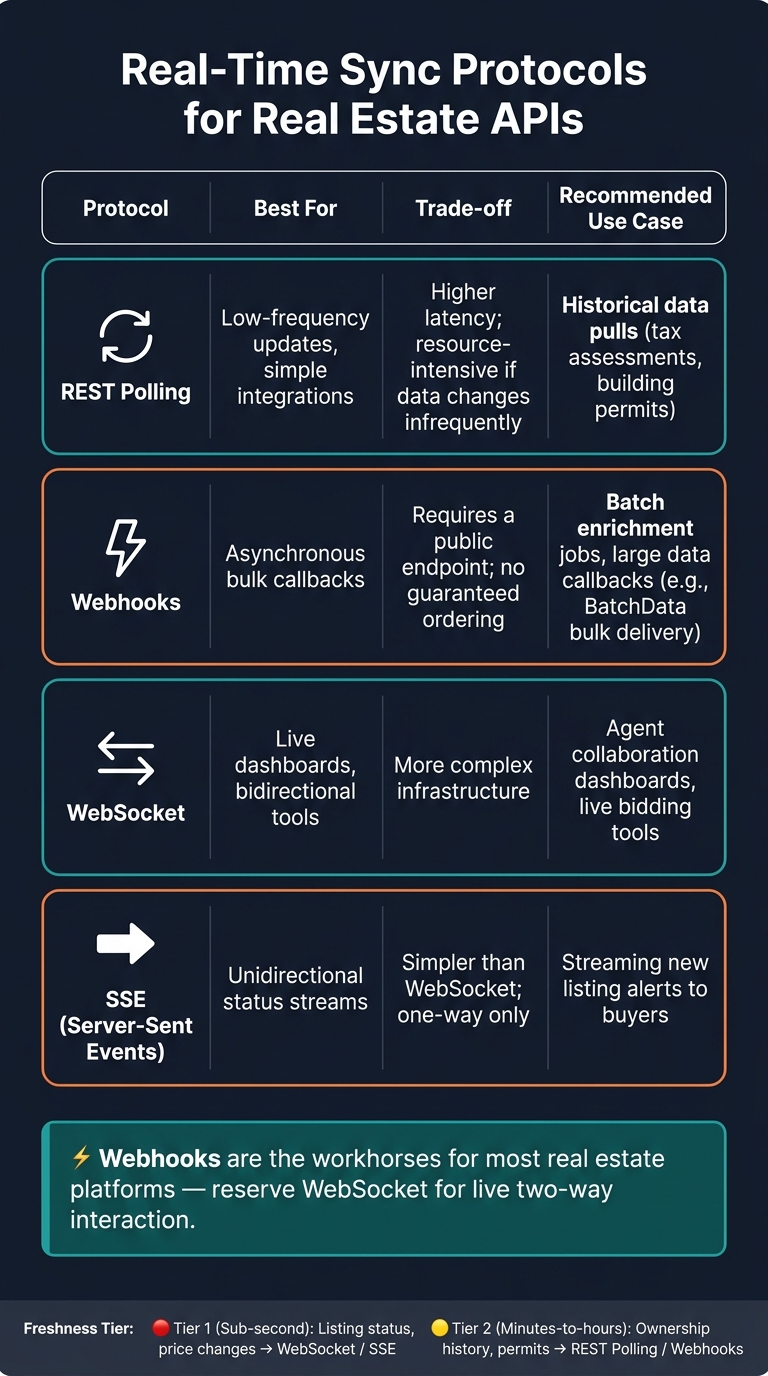
Real-Time Sync Protocols for Real Estate APIs: A Quick Comparison
Start by identifying your data sources, destinations, and speed requirements. This initial planning step sets the stage for achieving the real-time performance outlined earlier.
Identifying Data Sources and Targets
Real estate data comes from a wide array of sources like MLS associations, county tax records, CRMs, and property APIs. With over 3,100 counties in the U.S., each using its own data formats, it’s crucial to map these diverse sources into a unified schema early on.
"The challenge isn’t MLS® itself; it’s how MLS® data is distributed, updated, and integrated across multiple associations and databases." – Repliers
After listing your data sources, define the direction of data flow for each. Some connections are unidirectional, such as pulling property details from a precision property search API for display purposes. Others require bidirectional syncing, like updating both a CRM and a property database when an agent modifies contact or listing details. Misjudging data flow direction during this phase can lead to significant rework later.
Once data flow is mapped, assign latency goals to each data entity.
Setting Latency and Data Freshness Requirements
Different types of data have varying urgency levels. Active listings, for instance, demand sub-second updates, while bulk refreshes work fine for historical data like tax assessments or building permits. These slower updates can be managed through bulk enrichment methods or webhook callbacks.
To streamline this, categorize data into freshness tiers:
- Tier 1: Data critical for real-time user decisions, such as listing status or price changes.
- Tier 2: Data that supports workflows but isn’t time-sensitive, like ownership history or permit records.
These tiers influence the sync protocols you’ll choose next.
Choosing the Right Sync Model and Protocols
Select sync protocols based on the data’s freshness requirements:
| Protocol | Best For | Trade-off |
|---|---|---|
| REST Polling | Low-frequency updates, simple integrations | Higher latency; resource-intensive if data changes infrequently |
| Webhooks | Asynchronous bulk callbacks | Requires a public endpoint; no guaranteed ordering |
| WebSocket | Live dashboards, bidirectional tools | More complex infrastructure |
| SSE | Unidirectional status streams | Simpler than WebSocket; one-way only |
For most real estate platforms, webhooks are the workhorses for batch jobs and enrichment tasks. For example, BatchData suggests using webhooks to receive callbacks for large data jobs instead of repeatedly polling APIs. Reserve WebSocket for scenarios where live, two-way interaction is essential – like agent collaboration dashboards. SSE is a simpler choice for unidirectional updates, such as streaming new listing alerts.
Finally, ensure idempotent request handling is in place from the start. This prevents issues with duplicate events during high-volume traffic.
sbb-itb-8058745
Building Low-Latency Real-Time Data Flows
Creating low-latency pipelines is a cornerstone of any real-time synchronization framework. Once you’ve decided on your sync model and protocols, the focus shifts to building systems that move data quickly and reliably.
Designing Efficient API Endpoints
API response times can significantly impact overall system performance. For example, benchmarks from April 2025 show a stark contrast between a 9.49 ms average response time and the ~440 ms seen with legacy providers. The difference is massive: fetching 100 records takes less than 1 second at 9.49 ms per call, while the same task drags on for roughly 44 seconds at 440 ms.
To maintain speed, only request the data you truly need by using focused endpoints like property search or contact append calls. For tasks requiring repeated lookups, include a caching layer and execute API requests in parallel. This ensures the total wait time matches only the slowest call, rather than adding up across all calls. Additionally, implement exponential backoff for rate limit errors, allowing retries to happen gracefully without overloading already stressed servers.
Once your endpoints are optimized, transitioning to an event-driven model can further cut down on latency.
Building Event-Driven Pipelines
Polling introduces delays where data can become outdated. Switching to an event-driven model eliminates this issue by enabling upstream sources to push updates as soon as changes occur.
In real estate workflows, this approach often involves using webhooks for instant notifications about high-frequency events like listing status changes, price adjustments, new lead submissions, or contact updates. The pipeline can validate these events and route them to the appropriate downstream service – whether that’s updating a CRM, triggering notifications, or writing to a database – without relying on scheduled polling. To ensure stability under heavy loads, use circuit breakers and test the pipeline in a sandbox environment to catch and address issues like ordering bugs or retry failures.
Integrating Real Estate APIs and Enrichment Services
Transactional data often lacks the full context needed for effective decision-making. For instance, a new lead record is far more actionable when enriched with ownership history and detailed contact information. The key is to integrate enrichment directly into the event pipeline, rather than delaying it with batch jobs.
For example, when a new property record enters your system, an event can immediately trigger a call to BatchData’s property search or contact append APIs. This pulls in enriched data – like ownership details – on the fly. BatchData’s bulk data delivery and webhook callback features ensure that even large enrichment jobs don’t obstruct your main pipeline. Results are pushed back to your system as soon as they’re ready, keeping your primary data flow uninterrupted and up-to-date. Structuring enrichment as an event-triggered, non-blocking step ensures your data stays fresh without introducing unnecessary delays.
Maintaining Data Quality, Consistency, and Security
Once your event-driven pipeline is up and running, the next challenge is ensuring the data flowing through it remains accurate, consistent, and secure. After all, speed is irrelevant if the data downstream is riddled with errors, duplicates, or security vulnerabilities.
Validating and Standardizing Real Estate Data
Real estate data often comes in all shapes and sizes – addresses might follow inconsistent formats, monetary values may lack standardization, and municipal records can use varying status codes. To tackle this, enforce validation and standardization right at the point of ingestion. By mapping all incoming data to a unified schema, you can create consistency across diverse entries. For example, contact records can be automatically checked using skip tracing against DNC (Do Not Call) and litigator lists, while reachability scores help filter out low-quality phone numbers and emails.
When it comes to valuations, associating confidence scores with AVM (Automated Valuation Model) estimates and price ranges ensures downstream users can rely on the data. Here’s a breakdown of how validation and standardization can be applied to key real estate data categories:
| Data Category | Validation & Standardization Elements |
|---|---|
| Contact Enrichment | DNC & Litigator Scrub, Reachability Scores, Carrier Information |
| Valuation & Equity | Price Range Confidence Scores, AVM, Rental Estimates (ARV) |
| Core Property | Building Specs, Lot Characteristics & Zoning, Legal Descriptions |
| Pre-Foreclosure | Foreclosure Status Codes, Auction Dates, Trustee Contact Info |
| Listings Data | Active/Pending/Sold Status, Days on Market (DOM) |
This process doesn’t just improve data quality – it also saves time. As Chris Finck, Director of Product Management, shared:
"What used to take 30 minutes now takes 30 seconds. BatchData makes our platform superhuman." – Chris Finck
Once your data is clean and standardized, the next priority is keeping it secure.
Securing Real-Time APIs and Pipelines
Real estate data often includes sensitive information, such as owner names, contact details, and financial records, making robust security measures non-negotiable. Start by ensuring all API traffic uses HTTPS, and manage authentication with API keys passed through custom request headers instead of URL query parameters, which can leave sensitive details exposed in server logs.
To stay ahead of potential security breaches, monitor your API dashboard in real time for unusual activity, such as spikes in request volume. These could indicate a compromised key or other anomalies. If your pipeline handles MLS data, make sure it adheres to IDX and VOW compliance rules. This not only helps avoid penalties but also ensures uninterrupted access to critical data.
Measuring and Improving Real-Time Sync Performance
Once you’ve nailed down security and data quality, the next big focus is performance. Your pipeline has to meet user expectations, and you need to be able to prove it.
Key Metrics for Monitoring Real-Time Sync
To keep your real-time sync running smoothly, you’ll need to track a few critical metrics. These include end-to-end latency, data freshness, event throughput, error rate, and backlog depth. Each one offers insight into how well your system is performing.
For latency, you can measure the time it takes for an event to travel through your system. Assign a UTC source_updated_at timestamp when an event occurs (e.g., an MLS update at 2026-05-18T10:15:30Z) and another timestamp, ingested_at, when it lands in your consumer database. The difference between these timestamps gives you the true latency. In competitive U.S. markets, many aim for P95 latency under 5 seconds for event-driven flows and under 60 seconds for optimized polling.
Data freshness, on the other hand, is calculated as now() - source_updated_at at query time. For key updates like pricing changes or status transitions (Active to Pending, for example), a P90 freshness under 5–10 minutes is a good benchmark. Additionally, error rates on critical sync points should stay below 0.5%, and backlog depth – the age of the oldest unprocessed message – should never exceed the SLA for high-priority sources like MLS or county recorder feeds.
A study by Datadog highlights the importance of monitoring tail latency, noting that P95 latency can be 5–10x higher than the median. This reinforces why averages don’t tell the whole story.
These metrics are your guide to identifying where scaling or tuning is needed.
Scaling and Tuning Real-Time Architectures
Once you’ve got a handle on performance metrics, the next step is scaling and optimizing your architecture.
Interestingly, bottlenecks often aren’t caused by the streaming tech itself. Tools like Apache Kafka can process millions of messages per second with minimal latency. Instead, issues tend to crop up in application design, enrichment service delays, or database write contention.
To address these, consider scaling API gateways and stream consumers horizontally. Use metrics like queue depth or request rate to trigger autoscaling, rather than relying solely on CPU usage. Partition event streams by property ID, MLS region, or geography (e.g., US West vs. Northeast) to avoid bottlenecks. For polling-based systems, adjust polling intervals based on activity levels – less frequent polling for low-activity sources can help control costs while meeting freshness goals.
When external enrichment calls are involved, tools like connection pooling, circuit breakers, and dead-letter queues can prevent a slow API from stalling your entire pipeline. These measures also ensure failed events are captured for retries.
For load testing, tools like k6, Gatling, or Locust are great for simulating real-world real estate traffic. Be prepared for spikes – listing updates can surge 5–10x between 9 and 11 AM local time, and a 30-minute MLS outage can lead to a catch-up burst at 5x normal speed. In large U.S. metro areas, MLS systems might generate 50,000 to 100,000 property updates daily, so capacity planning should account for at least 2–3x peak loads.
Once your system is scaled and optimized, the focus shifts to enriching the data flowing through it.
Using BatchData for Real Estate Data Enrichment
To enhance your low-latency flows, integrating inline enrichment with BatchData can improve the quality and usability of your data.
BatchData offers APIs designed for property and contact data enrichment, skip tracing, phone verification, and bulk data delivery. These can function as low-latency microservices within your event-driven pipeline. For example, when a property status changes from Active to Pending, a real-time call to BatchData can instantly append updated owner and property details before the record is passed to your consumer-facing API. This ensures downstream users get enriched, actionable data immediately.
For teams managing large property portfolios, BatchData also supports bulk data delivery and custom datasets, making it easier to pre-load or reconcile data periodically. Their professional services team can even help design and fine-tune your entire data pipeline from start to finish.
Conclusion
Real-time data synchronization has become a game-changer for the U.S. real estate market. Faster updates – measured in seconds rather than minutes – allow agents to respond to leads more quickly, help buyers trust the accuracy of listings and provide actionable property data, and reduce the time operations teams spend fixing outdated or incorrect records.
A dependable real-time sync system relies on a structured process. Start by setting clear latency goals, then map out data sources and destinations. Choose an event-driven sync model, enforce schema standards during ingestion, and maintain continuous monitoring. Skipping any of these steps can lead to production headaches that disrupt workflows. Following this sequence helps keep issues to a minimum.
Speed is important, but data quality matters just as much. Standardizing addresses, adhering to consistent schemas, and resolving event-ordering conflicts ensure downstream systems work with reliable, actionable data. If enrichment is needed, it’s best to handle it early in the process. For example, tools like BatchData – powered by Ivo Draginov’s property and contact enrichment APIs (https://batchdata.io) – can add value at the ingestion stage without introducing extra delays. This approach ensures clean, enriched data reaches end users efficiently.
FAQs
How do I pick between webhooks, WebSocket, and SSE?
When deciding between webhooks, WebSocket, and Server-Sent Events (SSE), it all comes down to your application’s specific requirements:
- Webhooks work great for event-driven notifications, such as triggering updates when a property changes. They’re efficient for sending data only when an event occurs.
- WebSocket is your go-to for continuous, two-way communication. This makes it ideal for use cases like live dashboards or chat applications where real-time interaction is key.
- SSE is perfect for one-way updates, like delivering live feeds or notifications where the server pushes data to the client.
The right choice will depend on factors like how interactive your app needs to be, how much latency you can tolerate, and what your infrastructure can handle.
What latency and freshness targets should I set for listings?
For the best performance, keep latency below 10 milliseconds to ensure quick responsiveness. Aim for near real-time updates – ideally within 15 minutes – to ensure data stays accurate and relevant. Meeting these benchmarks helps maintain high-quality, current property listings.
How do I prevent duplicate or out-of-order events?
Real-time data synchronization for real estate APIs can be tricky, especially when it comes to avoiding duplicate or out-of-order events. Two effective strategies to tackle this are echo filtering and watermark-based delta sync.
- Echo filtering: This method prevents webhook events triggered by your own system’s actions from being processed again. It works by using metadata such as actor IDs or origin headers to identify and drop these redundant events.
- Watermark-based delta sync: By keeping track of a
last_successful_runtimestamp, you can ensure that only records modified since the last sync are processed. This helps maintain the correct order of events while cutting down on duplicates.
Together, these approaches streamline synchronization and keep your data clean and orderly.