




































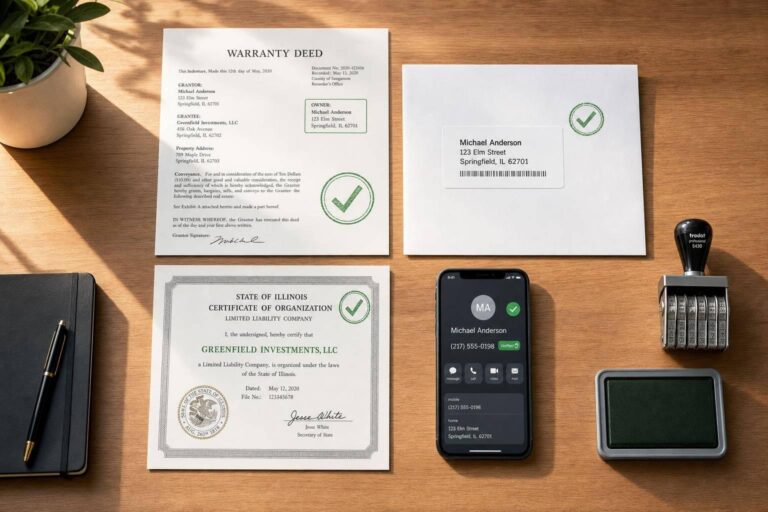
Bad property data wastes calls, mail, and money before skip tracing even starts. If more than 30% of records carry errors or old contact details, and TCPA fines can run $500 to $1,500 per violation, I’d treat validation as the first step, not the cleanup step.
Here’s the short version: I’d check four records before any outreach goes live:
- Owner names: match the legal owner to the right parcel
- Mailing addresses: confirm where notices should go, especially for absentee owners
- Entity records: verify LLCs, trusts, and corporations through filing records
- Phone numbers: check line type, active status, and DNC flags
That work helps cut wrong-party calls, returned mail, and dead numbers. It also gives skip tracing property owners a better shot at reaching the actual decision-maker instead of a stale record.
A few numbers make the case fast:
- Public records can have 30%+ bad or old contact data
- Clean validation workflows can support 70%–90% contact-data hit rates
- Validated data can drive 74% right-party contact rates
- Contact and address data can decay by 2%+ per month
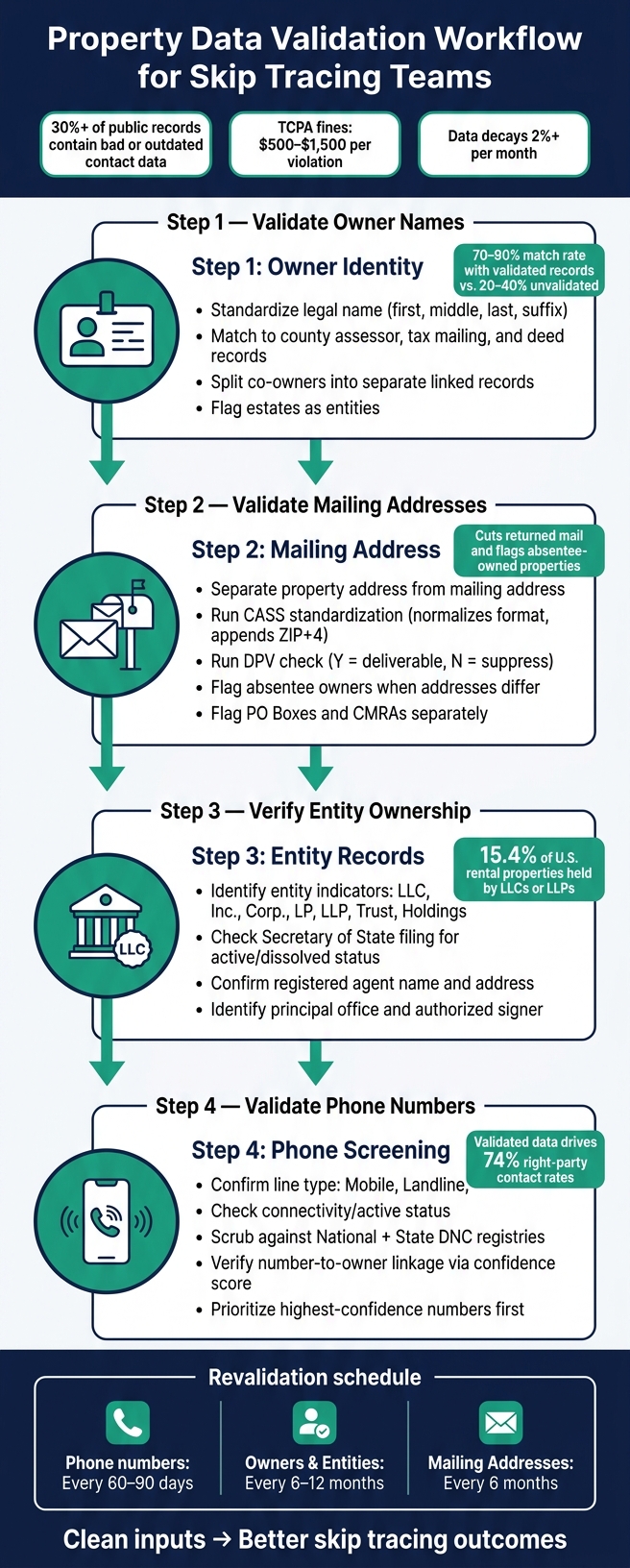
Property Data Validation Workflow for Skip Tracing Teams
Best Practices to get most accurate Property data using BatchSkipTracing and BatchLeads

sbb-itb-8058745
Quick comparison
| Record type | What I check | Why it matters |
|---|---|---|
| Owner | Legal name, co-owner split, deed and assessor match | Stops weak identity matches at the source |
| Address | Mailing vs. property address, CASS, DPV | Cuts returned mail and flags absentee owners |
| Entity | Secretary of State filing, agent, office address | Points outreach to the party that controls the property |
| Phone | Line type, live status, DNC, owner match | Cuts wasted dials and lowers compliance risk |
If I had to sum up the skip tracing process in one line, it would be this: clean the owner, confirm the address, verify the entity, then screen the phone.
Step 1: Validate owner names and person-level identity
Owner names are your first match key. If they don’t line up with public records, every match that comes after gets weaker. Clean data by itself isn’t enough. The name has to connect to the right parcel record. Start with the legal name, then check the owner record tied to that parcel.
Standardize legal names before matching
Break names into separate fields – first, middle, last, and suffix – instead of keeping everything in one string. For example, "SMITH, ROBERT J JR" should be split into parts and normalized before matching starts.
Suffixes and middle initials matter more than people think. "Robert Smith" and "Robert Smith Jr." may be two different people. If you strip suffixes just to make matching easier, you can end up contacting the wrong person. Middle initials help too, especially when family members share the same first and last name in county records.
Use the legal name as the main match key. Store nicknames as aliases. If the deed says "Michael T. Garcia," matching on "Mike Garcia" weakens the result. A better move is to build a normalized match string from the legal name and still keep the original source value for audit purposes.
Co-owners should be split into separate person records that stay linked to the parcel. Estates should be flagged as entities, not individuals.
Confirm ownership against public property records
The owner name on your list should be checked against three core sources:
- County assessor records
- Tax mailing records
- Deed/grantor-grantee indexes
Each source tells you something a little different. The assessor record shows the current assessed owner. The tax record shows where the bills are going. The deed shows the legal chain of title.
When those sources don’t match, use the deed chain and the parcel identifier (APN) to figure out whether the name in the skip tracing file is current, stale, or missing part of the picture. This matters because tax rolls often lag after a transfer. That’s why you should log the record date for every validation check.
Once the owner record is verified, the next step is the mailing address tied to the parcel.
Validated vs. unvalidated owner records: comparison table
The gap shows up fast in match quality and contact cost downstream.
| Metric | Unvalidated Records | Validated Records |
|---|---|---|
| Match rate | 20%–40% | 70%–90% |
| Wrong-party contacts | High – wrong party reached, disconnected numbers, no match | Low – right party reached, fewer wasted contacts |
| Cost | High – wasted dials, returned mail, compliance risk | Lower – targeted spend, fewer wasted contacts |
Validated records don’t just improve match rates. They cut the cost of bad outreach at every step. A 33% lift in right-party contact rates has been documented when organizations use more accurate identity and contact data matching.
Step 2: Validate mailing addresses and entity ownership records
Once you’ve confirmed the owner name, the next job is simple: make sure your notice is going to the right place.
That matters more than a lot of teams think. Many rental properties are owned by entities, which means the property address often has nothing to do with where mail should go. Roughly 15.4% of U.S. rental properties are held by LLCs or LLPs. So if your team sends outreach to the property itself, you can burn time, money, and response rate fast. After the owner is verified, validate the address tied to that record.
Separate property address from mailing address
The property address is the physical location of the asset. The mailing address is where tax bills and legal notices go.
Start by comparing the assessor address and tax mailing fields. That side-by-side check helps you spot absentee ownership. If the two addresses don’t match, flag the record as absentee-owned and send outreach to the mailing address – not the property address.
Then clean and verify the mailing address before anything goes out. Use CASS to standardize the address, and use DPV to confirm that USPS can deliver to that exact point. CASS normalizes street suffixes, directionals, and unit fields to USPS format and appends ZIP+4 codes. DPV checks whether the address is deliverable at the point level – a "Y" means deliverable, and an "N" means non-deliverable. Running CASS and DPV before outreach helps cut down on returned mail.
Parse address metadata, not just validity. A missing suite can make an otherwise valid address undeliverable.
PO Boxes and CMRAs need their own flag. They’re valid mailing destinations, but they do not tell you whether someone physically occupies the property.
Verify entity ownership records
If the owner record is an entity, switch tracks. At that point, you don’t need a person lookup first – you need the filing record that controls the entity.
Entity-held properties call for a filing-based check because those records show where outreach should go and who has the power to act on the property.
Names that include LLC, Inc., Corp., LP, LLP, Trust, Holdings, or Enterprises should be treated as entities and sent through a business registry check. The matching Secretary of State filing can confirm the legal entity name, whether the entity is active or dissolved, the formation date, the registered agent name and address, and the principal office address.
Use the registered agent for legal notices. For outreach, use the principal office or an authorized signer. If you’re dealing with a closely held LLC or a family trust, property data enrichment can help surface the likely decision-maker’s mailing address.
Address and entity validation checks: comparison table
| Validation Check | Implementation Effort | Expected Accuracy Lift | Primary Impact |
|---|---|---|---|
| Address standardization (CASS) | Low | High | Reduces returned mail from formatting errors |
| Delivery Point Validation (DPV) | Medium | High | Eliminates non-deliverable addresses before mailing |
| Parcel cross-check (property vs. mailing address) | Low | Medium | Flags absentee owners; prevents wrong-destination outreach |
| Business registry name verification | Low–Medium | Moderate | Filters dissolved entities; confirms legal name match |
| Business registry address verification | Medium | High | Syncs entity mailing/principal office to current official records |
| Registered-agent lookup | Medium | High | Ensures legal notices reach the designated contact |
| Officer/authorized signer identification | High | Very High | Connects entity records to real decision-makers; reduces generic "Attn: LLC" waste |
Step 3: Validate phone numbers for contactability and compliance
With owner names confirmed and mailing addresses checked, phone validation becomes the last filter before your team makes a call or sends a text. Skip this step, and batch skip tracing contact rates drop. You also take on more TCPA risk. Once a number clears these checks, you can sort it by reachability and compliance risk.
Check line type, status, and DNC and carrier risk checks
Phone numbers don’t all behave the same way in a dialing workflow. Start by confirming the line type: mobile, landline, or VoIP. Mobile numbers carry more risk, so use automated dialing or texting only when you have documented consent.
Next, check connectivity status and scrub your lists before every launch. Disconnected numbers burn through dials, and phone data goes stale fast. Then screen each record against the National Do Not Call Registry and any state DNC lists that apply. If a number matches, suppress it from marketing outreach.
Confirm number-to-owner linkage
A live number doesn’t prove the right person owns it. You still need to cross-check the number against independent records to confirm the owner match. Start with the highest-confidence number first. If that one doesn’t hold up, move to the next best match.
Phone validation checks and outreach impact: comparison table
| Validation Check | Right-Party Contact Impact | Compliance Value | Outreach Decision |
|---|---|---|---|
| Line Type (Mobile/Landline/VoIP) | High – shows whether SMS or auto-dialing is workable | Critical – sets TCPA consent rules | Use automated dialing or SMS only with documented consent |
| Connectivity Status | High – filters out disconnected numbers and improves dialer efficiency | Low – mainly an operations check | Remove inactive numbers before launch |
| DNC Scrubbing (National + State) | Neutral – avoids non-responsive or opted-out parties | Critical – prevents fines of $500 to $1,500 per violation | Suppress all matching records |
| Carrier and caller ID data | Medium – helps confirm name-to-number linkage | Low – used for identity verification | Use as a supporting signal before outreach |
| Confidence Score / Number-to-Owner Linkage | Very High – puts the numbers most likely to reach the intended owner at the top | Medium – cuts down on wrong-party complaints | Start with highest-confidence numbers; remove low-confidence records |
Build a repeatable validation workflow and measure results
Pre-outreach validation checklist
Once you’ve validated each record type, turn that work into one repeatable workflow. Validation falls apart when people do it differently from one campaign to the next.
Start with de-duplication. Then validate owner names against your approved ownership source, standardize mailing addresses, confirm entity ownership, and verify phone numbers. After each step, store a timestamp. Fields like owner_validated_at, address_verified_at, and phone_verified_at make it clear when each record was last checked.
Data goes stale fast. Revalidate phone numbers every 60-90 days, owners and entities every 6-12 months, and mailing addresses every 6 months. If a record is older than that, flag it as stale before the next campaign. Contact and address data decays at over 2% per month, so a list that looked clean six months ago may already be unreliable.
Track match rate, right-party contact rate, and list waste by campaign
Measure this workflow at the campaign level, not as one blended total across everything. That’s how you spot where waste is creeping in.
Five KPIs will tell you if validation is doing its job:
| KPI | Formula | What It Reveals |
|---|---|---|
| Owner match rate | Confirmed owners ÷ Total records | How much of the list is usable before outreach |
| Phone hit rate | Records with ≥1 verified phone ÷ Total records | How many records have at least one verified phone number |
| Right-party contact (RPC) rate | Owner-confirmed conversations ÷ Total connected calls | Direct measure of skip-tracing effectiveness |
| Returned mail rate | Undeliverable mail pieces ÷ Total mail sent | Address quality and wasted postage |
| Cost per valid contact | Total campaign spend ÷ Confirmed owner conversations | Spend efficiency |
Better validation cuts list waste and improves RPC. These metrics show where the holes still are and where the workflow is earning its keep. If owner match rate or phone hit rate drops from one campaign to the next, stop outreach and re-enrich the list before putting more money into it. It also helps to track RPC rate, cost per valid contact, and time to resolution side by side.
Conclusion: Clean inputs produce better skip tracing outcomes
Every part of this guide leads to the same point: outreach results are set before the first call even happens. When you validate owner names, mailing addresses, entity records, and phone numbers in a consistent, documented order, you improve right-party contact rates, cut returned mail, and lower the cost of reaching each confirmed owner.
Bad data burns payroll, causes missed deals, and hurts your reputation.
Once the workflow is set, automate it inside the tools your team already uses. For teams doing this at scale, BatchData provides the APIs and bulk delivery infrastructure to automate those steps inside existing CRM and dialer pipelines, so records are checked the same way across every campaign without manual work slowing things down.
Clean inputs aren’t a one-and-done project. They’re an operating standard that gets better over time. Each validated campaign gives you sharper benchmarks, tighter suppression lists, and a better sense of what good data looks like in your market.
FAQs
How often should I revalidate property data?
Revalidate property and contact data monthly or quarterly to keep it accurate and cut down on wasted leads.
Phone numbers and email addresses can decay by more than 2% per month or 30%–70% per year. That’s a lot of bad data piling up fast. To stay ahead of it, add real-time monitoring and weekly audits so your records stay reliable and data decay doesn’t eat into outreach.
What should I do when owner, deed, and tax records conflict?
When owner, deed, and tax records don’t match, use a clear source hierarchy. Start with county assessor records for legal ownership, tax assessments, and legal descriptions. Then use recent comparable sales for market values or other secondary details.
BatchData can help automate cross-checks across trusted databases, flag inconsistencies, and standardize fragmented fields so your team follows the same resolution process every time.
Which validation step has the biggest impact on right-party contacts?
Multi-source data validation has the biggest impact on right-party contact rates. Instead of trusting a single source, it checks contact details against multiple authoritative sources to improve accuracy.
That extra layer of checking helps spot mismatches, update old records, cut list waste, and improve the odds of reaching the right owner.