




































More data doesn’t always lead to better results. In real estate, relying on massive, outdated datasets often wastes time, reduces efficiency, and hurts conversion rates. Here’s the key takeaway: smaller, accurate lists consistently outperform bulk data.
- Outdated Data Problems: Old lists (6–12 months) are only 30–50% accurate, leading to low conversion rates (0.3–0.8%) and wasted effort.
- Accuracy Matters: Fresh, targeted data (less than 30 days old) can boost conversion rates to 2–5% and save hours of work.
- High-Quality Leads: Focused filters and real-time data improve targeting and reduce costs. For example, a Phoenix wholesaler increased accuracy to 92% and quadrupled conversions by switching to smaller, timely lists.
- Efficiency Gains: right-sized data solutions save time and reduce legal risks, improving ROI and team morale.
The bottom line? Quality beats quantity. Instead of chasing bigger lists, prioritize accurate, timely data to connect with motivated sellers and close deals faster.
Data and Marketing for Real Estate Investors
sbb-itb-8058745
Problems with Excessive Data
Outdated data is one thing, but having too much information can create an entirely new set of problems.
Data Noise and Information Overload
When massive datasets are filled with irrelevant or outdated information, they overwhelm your team. Take a stale list of 10,000 properties, for example: roughly 30% contain wrong numbers, 20% are already sold, and 15% involve owners who are upset from being contacted repeatedly by different agents. The result? A lot of wasted time and effort.
In fact, stale data can waste 70–80% of your team’s efforts on dead-end leads. And that inefficiency comes at a cost.
"Calling stale data means 70-80% of your effort contacts wrong people, outdated situations, or already-resolved problems. You’re essentially paying for the privilege of wasting time." – Tracerfy Team
Analysis Paralysis
When you’re dealing with an oversized dataset, decision-making slows to a crawl. Imagine sifting through 50,000 leads. It’s easy to fall into the trap of thinking that more leads automatically mean more revenue. But in reality, the chaos of excess volume often leads to wasted time on low-quality follow-ups that rarely convert.
Here’s a stark comparison: working through 1,000 fresh leads takes about 75 hours to close three deals. Tackling a bloated list of 10,000 stale leads? That balloons to 200 hours to close the same three deals. While you’re stuck deciding which segment of your massive dataset to pursue, competitors with smaller, high-quality lists are already closing deals with motivated sellers.
Poor Audience Targeting
Too much unfiltered data often results in a "spray and pray" approach, where you contact as many people as possible, hoping something sticks. The outcome? Conversion rates consistently under 1%. The core issue is clear: you’re reaching out to people who aren’t motivated, no longer own the property, or have already been annoyed by multiple agents.
Data freshness is critical here. Lists older than six months see accuracy drop to 30–50%, while lists older than a year plummet to just 20–40%. This doesn’t just hurt efficiency – it drives up your cost per acquisition and tarnishes your reputation with homeowners who’ve already resolved their situations. Too much bad data isn’t just a nuisance; it’s a liability.
Why Data Quality Beats Data Quantity
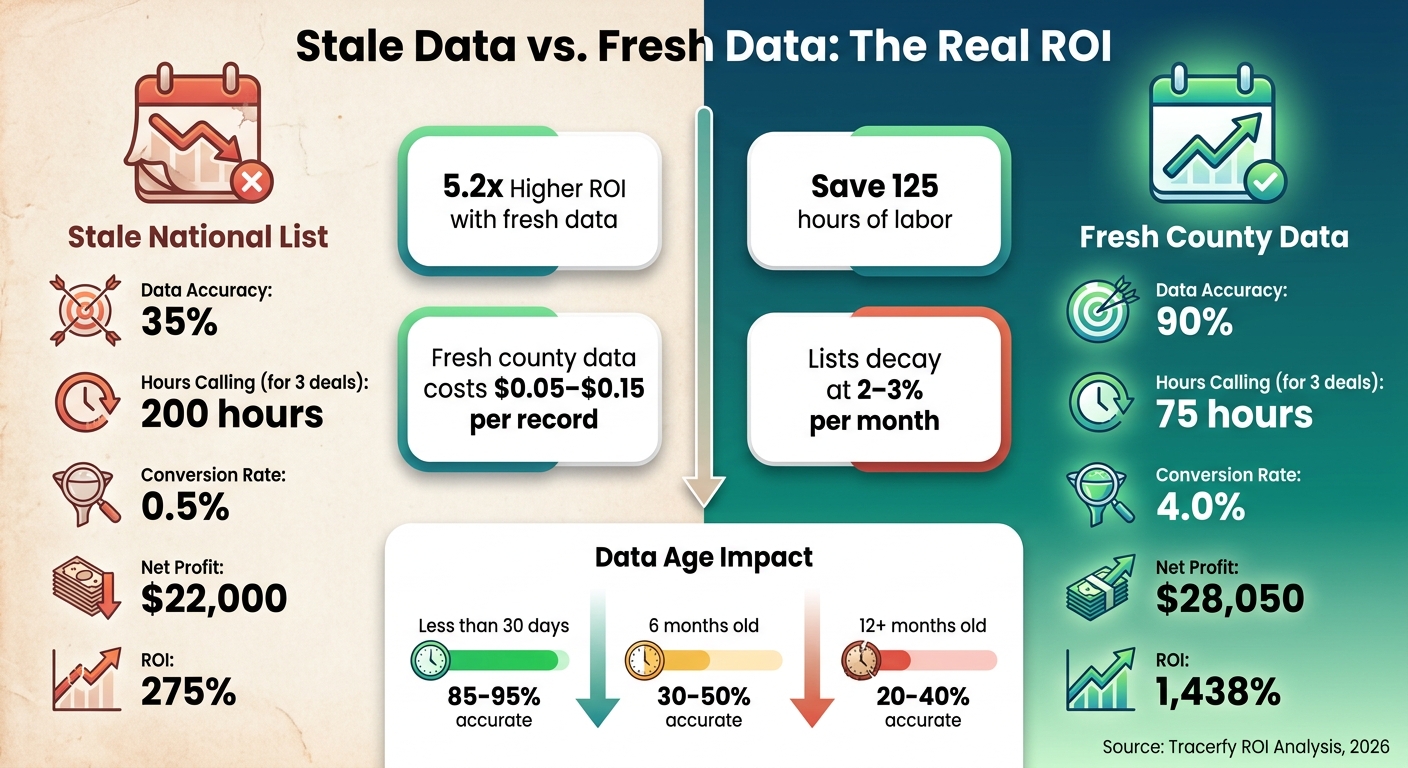
Fresh vs Stale Real Estate Data: ROI and Performance Comparison
When it comes to real estate data, having the largest list isn’t the goal – having the most accurate datasets is. Big datasets might seem impressive, but they often come loaded with outdated phone numbers, sold properties, and incorrect information. A smaller dataset with 85–95% accuracy will consistently outperform a massive one that’s only 30–50% accurate. This is why precision matters far more than sheer volume.
Focus on Relevance and Accuracy
In today’s fast-paced market, accuracy is the real game-changer. Fresh data, pulled within 24–48 hours, connects you with people whose situations are relevant right now. Compare that to six-month-old lists, which often include properties that have already sold or issues that are no longer relevant.
Take the example of a Phoenix wholesaler who transitioned to using fresh, targeted data. By layering filters like "tax delinquent + 40% equity + 15+ years ownership", they found motivated sellers and achieved conversion rates of 5–10%. Compare that to less focused methods, where conversion rates hover around 0.5%. The difference? Targeted data ensures you’re spending your time on leads that are ready to act.
Practical Data vs. Excess Data
The value of data lies in its timing and context. Practical data tells you when to reach out and why someone might be ready to sell. Excess data, on the other hand, is just a list of names and addresses without actionable insights.
Consider Sarah, a Dallas investor. In early 2026, she shifted her focus from competitive pre-foreclosures to fresh Dallas County probate filings pulled bi-weekly. This change led to a 6.2% conversion rate, up from 2.1% on pre-foreclosures. Over 90 days, she closed 4 deals from just 500 fresh leads, each property offering an average equity of $85,000.
| Metric | Stale National List | Fresh County Data |
|---|---|---|
| Data Accuracy | 35% | 90% |
| Hours Calling (for 3 deals) | 200 hours | 75 hours |
| Conversion Rate | 0.5% | 4.0% |
| Net Profit | $22,000 | $28,050 |
| ROI | 275% | 1,438% |
Source: Tracerfy ROI Analysis, 2026
The bottom line? A smaller list of verified, current leads outperforms a huge database of outdated contacts. You’re not paying for volume – you’re paying for relevance.
Compliance and Data Cleanliness
Accurate data doesn’t just improve performance; it also protects your business. Poor-quality data wastes time and increases legal risks. High-quality data providers include safeguards like DNC scrubbing and TCPA compliance flags, which help you avoid costly penalties. On the other hand, cheap, excessive data often lacks these protections, leaving you exposed to legal trouble.
"If the data is wrong, the workflow is wrong."
- Lusha Blog
Clean data doesn’t just keep you compliant – it ensures your systems work smoothly. Automated workflows – like routing leads, scoring prospects, or triggering email campaigns – rely on accurate information. When data is incorrect, you risk bounced emails, misdirected communications, and a breakdown in your go-to-market strategy. Utilizing property enrichment API solutions can help maintain this accuracy by updating records in real time.
Fresh county data, priced at $0.05–$0.15 per record, offers better accuracy and compliance. But remember, even the best lists decay at 2–3% per month. That’s why savvy investors are shifting to on-demand extraction, pulling data directly from county records in real time to stay ahead of the curve.
How to Use Data for Better Lead Generation
Turning raw data into actionable leads is what separates wasted effort from successful deal-making. Once you’ve prioritized quality over sheer volume, it’s time to apply techniques that help refine and leverage your data effectively. Here’s how you can make your data work harder for you.
Apply Filters and Segmentation
Finding motivated sellers becomes much easier when you layer multiple filters instead of relying on a single criterion. This approach narrows your focus to high-intent prospects. For example, combining filters like "tax delinquent + equity over 40% + absentee owner" targets property owners who are financially capable of selling but may lack the desire to manage their property. This precise targeting can boost conversion rates from the typical 0.5% for generic lists to 5–10% for layered lists.
A case study from Phoenix demonstrated how layered filters significantly improved conversion rates, showcasing the effectiveness of targeted segmentation.
You can take segmentation even further with lead scoring. Assign numerical values to specific attributes, such as +50 points for pre-foreclosure status, +25 for equity above 40%, and +15 for out-of-state ownership. This scoring system helps prioritize your outreach, ensuring the highest-scoring leads receive attention first. Automated workflows can also enhance your response times. For instance, when a distress signal like a Notice of Default is filed, your CRM can trigger an alert and initiate contact within 24–48 hours. Predictive analytics can then help you anticipate when sellers are ready to act.
Use Predictive Analytics and Market Signals
Predictive analytics tools can identify high-potential leads even before they’re obvious. Platforms like BatchRank assign "propensity to sell" scores by analyzing factors like ownership tenure and recent permit activity. This lets you connect with property owners just as they begin to consider selling.
Tracking signals such as probate filings, divorce records, or mechanic’s liens can also reveal when an owner is likely to sell. Real-time triggers like these have been shown to elevate conversion rates in similar markets.
Another overlooked signal is permit activity. Monitoring building permits for major renovations – like new roofs or HVAC systems – can help you time your outreach perfectly. You might contact owners during construction to discuss financing options or after completion to explore refinancing opportunities based on the updated property value.
Data Refinement Tools and Techniques
Once you’ve identified your target segments, refining your data ensures your outreach is accurate and efficient. Skip tracing services can verify phone numbers and addresses, while enrichment tools fill in missing details like email addresses or property characteristics. APIs that pull real-time data from county records can also help minimize outdated information.
Fresh county data, typically costing $0.05–$0.15 per record, is more reliable for outreach. Phone verification tools can confirm if numbers are active, differentiate between mobile and landline numbers, and flag disconnected ones, saving you from wasted calls. Similarly, address verification ensures your direct mail campaigns reach the right recipients, reducing bounce rates and improving ROI. When combined with automated workflows and lead scoring, these tools create a system that consistently delivers high-quality leads.
Conclusion
Quality data stands out as the cornerstone of effective lead generation. It’s not about how much data you have but how accurate and timely it is. For instance, fresh county data – less than 30 days old – yields a 5.2x higher ROI and saves around 125 hours of labor compared to using outdated national lists for the same number of closed deals.
This shift from prioritizing volume to focusing on precision does more than just save time. It transforms your acquisition strategy into one that centers on human motivation rather than just property details. By incorporating distress signals, tracking real-time triggers, and emphasizing fresh data over bulk purchases, you eliminate wasted effort on unqualified leads and instead connect with sellers who are genuinely ready to engage.
So, the question to ask isn’t “How many leads can I generate?” but rather, “How current is this data?” and “Does this lead indicate real motivation?” The investors dominating in 2026 won’t be those with the largest lists – they’ll be the ones leveraging the smartest, most targeted data strategies. Sharpen your focus on data quality, and you’ll sharpen your path to success.
FAQs
How do I know if my lead list is too old to use?
If your lead list is more than 12 months old, chances are it’s outdated. Over time, contact details and property information can change, which lowers the quality of your leads. To maintain accuracy and keep your leads relevant, it’s crucial to update your lists regularly. Fresh property data ensures you’re working with current and reliable information, which can greatly enhance your lead generation efforts.
What filters should I combine to find more motivated sellers?
To connect with motivated sellers, focus on combining filters that highlight life events – like divorce, inheritance, or job relocation – with property-specific factors such as high equity, vacancy status, and out-of-state ownership. These indicators can point to owners who may be more inclined to sell. Additionally, leveraging propensity models to predict the likelihood of a sale can fine-tune your search, increasing your chances of identifying sellers who are ready to make a deal.
How can I keep my data accurate without constantly buying new lists?
To keep your data reliable and up-to-date, focus on verification, cleaning, and enrichment. Use tools like APIs to confirm contact details, standardize addresses, and fill in any missing pieces of information. Regular maintenance is key – regularly clean your CRM by removing outdated leads and refreshing property data. For an extra boost, consider enrichment methods like skip tracing or incorporating real-time updates. This way, you can maintain a dependable database without constantly buying new lists.


