





































If I had to cut this down to one takeaway, it would be this: the best API depends on the job. For investor lead gen, I’d lean toward BatchData. For deep public-record analysis, I’d look at ATTOM. For rental-first use cases, RentCast is the easier starting point. For forecast-heavy valuation work, HouseCanary stands out. And if you need Zillow + MLS data, Zillow Bridge Interactive is the one to check.
Here’s the short version:
- BatchData: best for deal sourcing, owner lookup, skip tracing, and alert-based search
- ATTOM: best for large public-record datasets, foreclosure data, and underwriting
- Estated: simple lookup layer, but it’s in a sunset phase
- RentCast: best for residential rent and value estimates on a lower budget
- HouseCanary: best for AVMs, rent estimates, and forecast-led analysis
- Zillow Bridge Interactive: best for broker or MLS-connected products
This space moves on four things: coverage, search signals, setup, and cost. The APIs in this list span about 136 million to 160 million U.S. properties, but they do not serve the same buyer. Some are built for investor workflows. Some lean into valuation. Some are gated behind broker, MLS, or enterprise access.
Quick Comparison
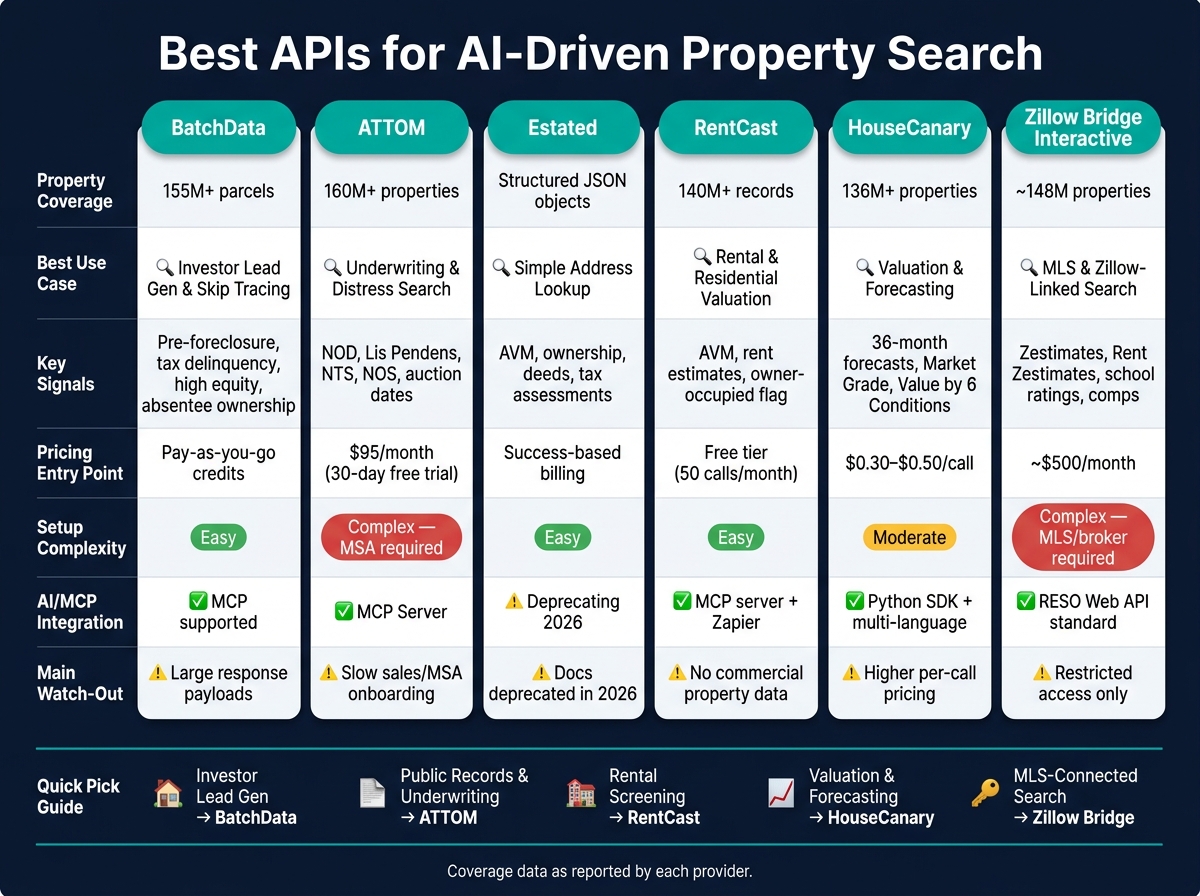
Best Real Estate APIs for AI Property Search: Side-by-Side Comparison
| API | Best use | Coverage snapshot | Main watch-out |
|---|---|---|---|
| BatchData | Investor search and outreach | 155 million+ parcels, 99.8% U.S. coverage | Response payloads can get large |
| ATTOM | Underwriting and distress search | 160 million+ properties, 9,000+ fields | Sales process and MSA can slow setup |
| Estated | Simple address/property lookup | Structured property JSON objects | Docs are being deprecated in 2026 |
| RentCast | Rental and residential valuation | 140 million+ records, strong residential focus | No office, retail, or industrial data |
| HouseCanary | Valuation and forecasting | 136 million+ properties, 122 million+ AVMs | Higher per-call pricing on some use cases |
| Zillow Bridge Interactive | MLS and Zillow-linked search | About 148 million U.S. properties | Access is restricted |
My read: if you want AI-driven property search to work well, don’t start with field count alone. Choosing the right real estate API requires looking beyond raw data volume. Start with what your system needs to do – find off-market leads, score deals, estimate rent, monitor distress, or search active listings – then pick the API that fits that workflow.
sbb-itb-8058745
1. BatchData
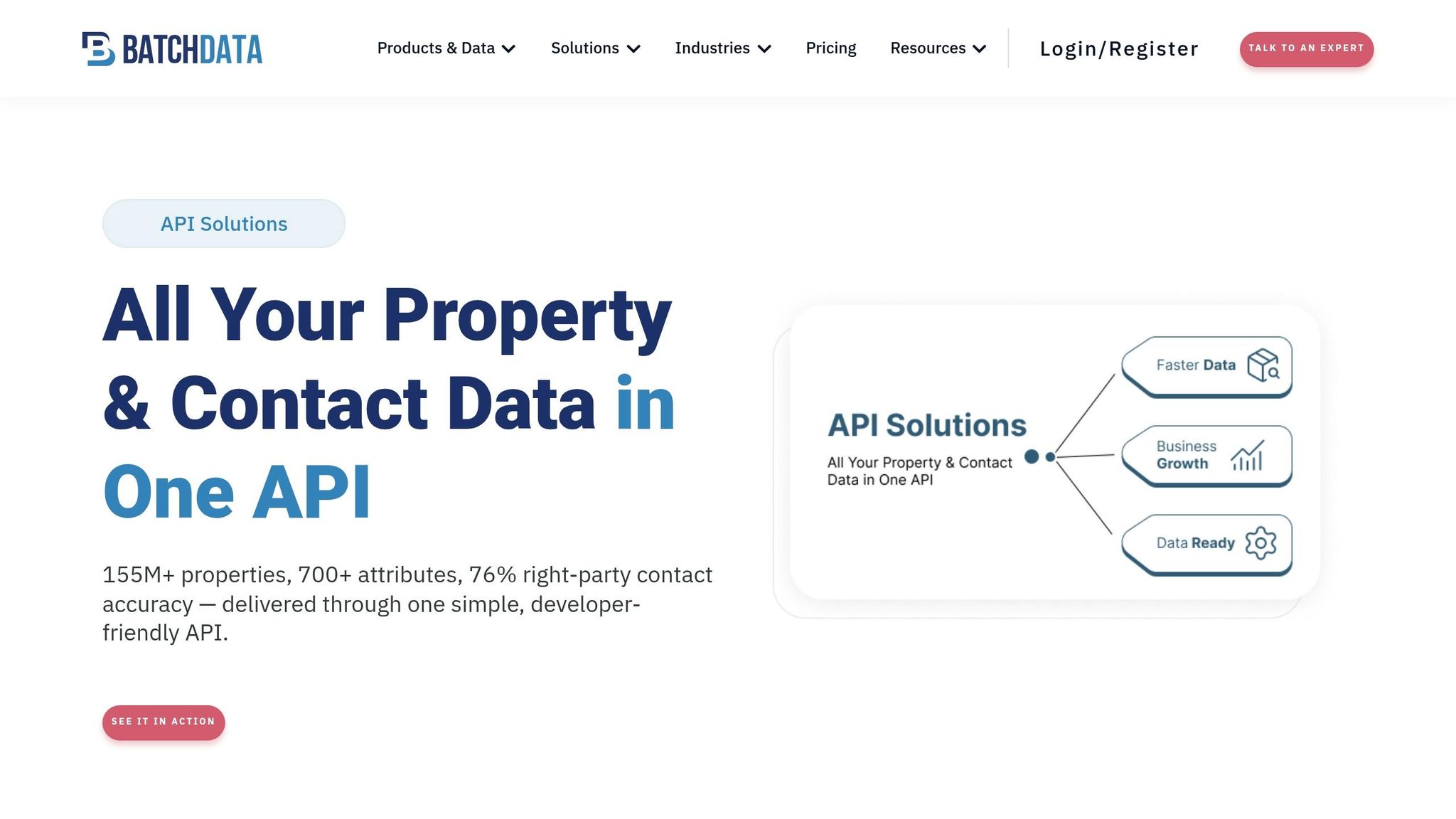
BatchData supports AI-driven property search with property data, contact enrichment, skip tracing, and verification APIs. It’s built for teams that source and enrich properties at scale.
U.S. Data Coverage
BatchData covers 155 million+ parcels across 99.8% of the U.S., pulling from 3,200+ sources and refreshing data daily. Each parcel includes 800+ attributes tied to physical traits, ownership history, mortgage liens, listing status, and financial data.
That kind of depth matters when you’re searching across the country. It gives teams enough signal to power national property search, lead routing, and high-volume prospecting without piecing data together from multiple vendors.
AI-Ready Property Signals
BatchData includes signals like pre-foreclosure, tax delinquency, high equity, absentee ownership, and corporate ownership. These can plug into investment scoring models or natural-language search tools.
It also supports MCP, which means LLMs can query property data, verify addresses, and run skip traces from natural-language prompts without extra middleware. In plain English, that’s what helps turn raw property records into useful search filters, ranked leads, and deal alerts.
Integration and Scale
Finding the right properties is only part of the job. Getting that data where your team needs it is just as important.
BatchData offers a standard REST API for on-demand lookups, along with a Smart Search API that uses a push-based alert model. Smart Search keeps watching your criteria and sends webhook alerts when a property matches your rules.
For bigger teams and data-heavy workflows, BatchData also supports bulk delivery to Amazon S3, Snowflake, Google Drive, and SFTP, plus no-code connectors through Zapier and Make.com.
Pricing and Usage Fit
BatchData uses a BatchData offers flexible pricing based on your use case and volume. Contact sales for current pricing. with no long-term contracts or minimum commitments. Custom data pulls and enterprise delivery options are available through consultation with their data experts.
That setup makes sense for teams that want room to scale up or stay lean, especially when usage can change from month to month.
| Feature | Details |
|---|---|
| Coverage | 155M+ parcels; 99.8% of U.S.; 3,200+ sources; daily updates |
| Skip Tracing | 76% right-party contact rate; entity resolution for LLCs; DNC and litigator scrubbing |
| Pricing Model | BatchData offers flexible pricing based on your use case and volume. Contact sales for current pricing. |
2. ATTOM Property Data API
ATTOM is a public-records property data API built for national search, valuation, and underwriting workflows. It covers licensed property data for mortgage origination and insurance underwriting. So if your AI search setup needs broad U.S. coverage plus structured signals for ranking and alerts, ATTOM is a strong fit.
U.S. Data Coverage
ATTOM covers 160M+ U.S. properties nationwide, with 9,000+ fields and 70 billion rows of data. The API also supports up to 5 years of sales trends, including average and median prices and sales counts.
That kind of scale matters. If you’re trying to search across markets, compare areas, or spot patterns over time, you need more than a basic property lookup. You need a large, consistent dataset that can feed search, ranking, and alert logic without a lot of patchwork.
AI-Ready Property Signals
This is where ATTOM gets interesting for AI use cases.
Its distress, valuation, and ownership fields can help rank leads, surface likely deals, and trigger alerts without waiting for manual review. The Transaction V3 endpoint surfaces Notice of Default (NOD), Lis Pendens, Notice of Trustee Sale (NTS), and Notice of Foreclosure Sale (NOS), along with default amounts, judgment dates, and auction schedules.
On the valuation side, ATTOM provides home equity estimates and assessed vs. appraised values. Ownership data adds another layer, including owner names, mailing addresses, absentee-owner indicators, original loan amounts, interest rates, loan balances, maturity dates, and lender or servicer identities.
Tax and sale history fill in more of the story through:
- Tax amounts and years
- Sale types
- Recording dates
- Price-per-square-foot calculations
Building permit data can also help models spot renovation openings. And ATTOM offers an MCP Server for AI-native access, which allows direct LLM integration with its datasets.
Put simply, these signals give LLMs and scoring models more to work with before a person ever steps in. They’re strongest when the goal is automated lead scoring, distress monitoring, or valuation-driven search.
Integration and Scale
ATTOM uses standard REST conventions with JSON and XML responses. It supports radius searches by latitude, longitude, and miles, area searches by ZIP code or school district, and property-characteristic filters.
One detail that stands out: ATTOM assigns a persistent ATTOM ID that stays stable across APN and address changes. That’s a big help when you’re matching records over time and don’t want IDs shifting under your feet.
A single search request can return up to 10,000 properties. For larger workflows, ATTOM also offers bulk file delivery and an ATTOM Cloud option.
The trade-off is setup. ATTOM requires sales contact and an MSA, which can add several weeks before go-live. This is more of a depth-and-control platform than a lightweight self-serve API.
Pricing and Usage Fit
ATTOM offers a 30-day free trial for developers. Entry-tier pricing starts at $95/month for low-volume access, while production-tier pricing starts at $1,000+/month and is billed per API report.
At higher volumes, costs scale to about $0.01 per report. On usage, successful 200 OK responses count toward billing, while 400 Bad Request responses are not charged.
| Feature | Details |
|---|---|
| Coverage | 160M+ properties; 9,000+ fields; 70B rows |
| Distress Signals | NOD, Lis Pendens, NTS, NOS; auction dates and default amounts |
| Pricing Model | Per API report; starts at $95/month; 30-day free trial |
| Onboarding | Requires sales contact; MSA required; several weeks to go live |
3. Estated Property Data API
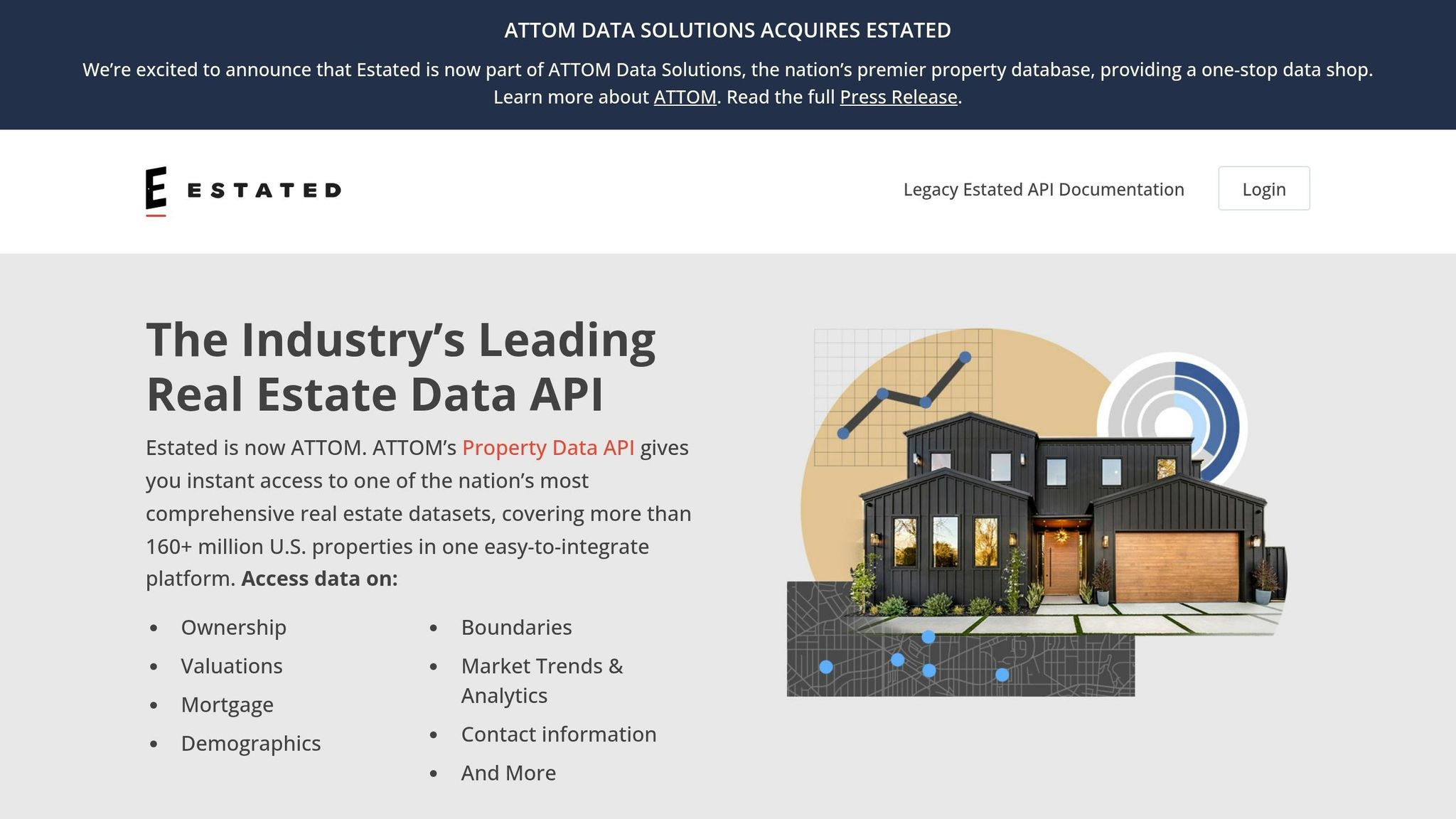
Estated is owned by ATTOM, and its docs are set to be deprecated in 2026. So this is best viewed as a transition API, not a long-term home base. In this comparison, Estated works more like a lighter lookup layer, with structured JSON and a clear sunset timeline that matters if you’re building for the next year or two.
Coverage and Data Model
Estated returns seven JSON objects: parcel, structure, taxes, assessments, market_assessments, valuation, owner, and deeds, covering land, building details, taxes, ownership, and transfer history.
AI-Ready Property Signals
These objects fit neatly into ranking and lead-scoring models. [valuation provides market value](https://batchdata.io/blog/avm), owner returns current ownership and vesting details, deeds gives past transfers and sales, and taxes plus assessments add the money side of the picture.
Integration and Scale
Because the API returns normalized JSON, it fits well into address resolution and AI search pipelines. Estated supports four lookup modes: Split (street, city, state), Parsed (detailed address components), Combined (a single address string), and FIPS + APN.
FIPS + APN is the best option when you need the most exact match. If a query returns more than one match, the API responds with PW02 and includes candidate APNs and FIPS codes so you can narrow it down.
Pricing and Usage Fit
Estated uses success-based billing. You’re only charged when the API returns a valid property record, meaning an HTTP 200 response with a data object. Requests that return error responses (4xx or 5xx) or warnings like PW01 (no property found) and PW02 (multiple properties found) are not billable.
That setup is handy when a team is still dialing in query logic. Existing API keys will keep working during the transition, while the long-term path shifts to ATTOM’s platform.
| Data Object | Signal Type |
|---|---|
valuation |
AVM and market value estimates |
owner |
Current ownership and vesting info |
deeds |
Historical sales and deed transfers |
taxes / assessments |
Tax history and county assessments |
market_assessments |
Market-based assessment data |
structure / parcel |
Physical characteristics and land data |
4. RentCast API
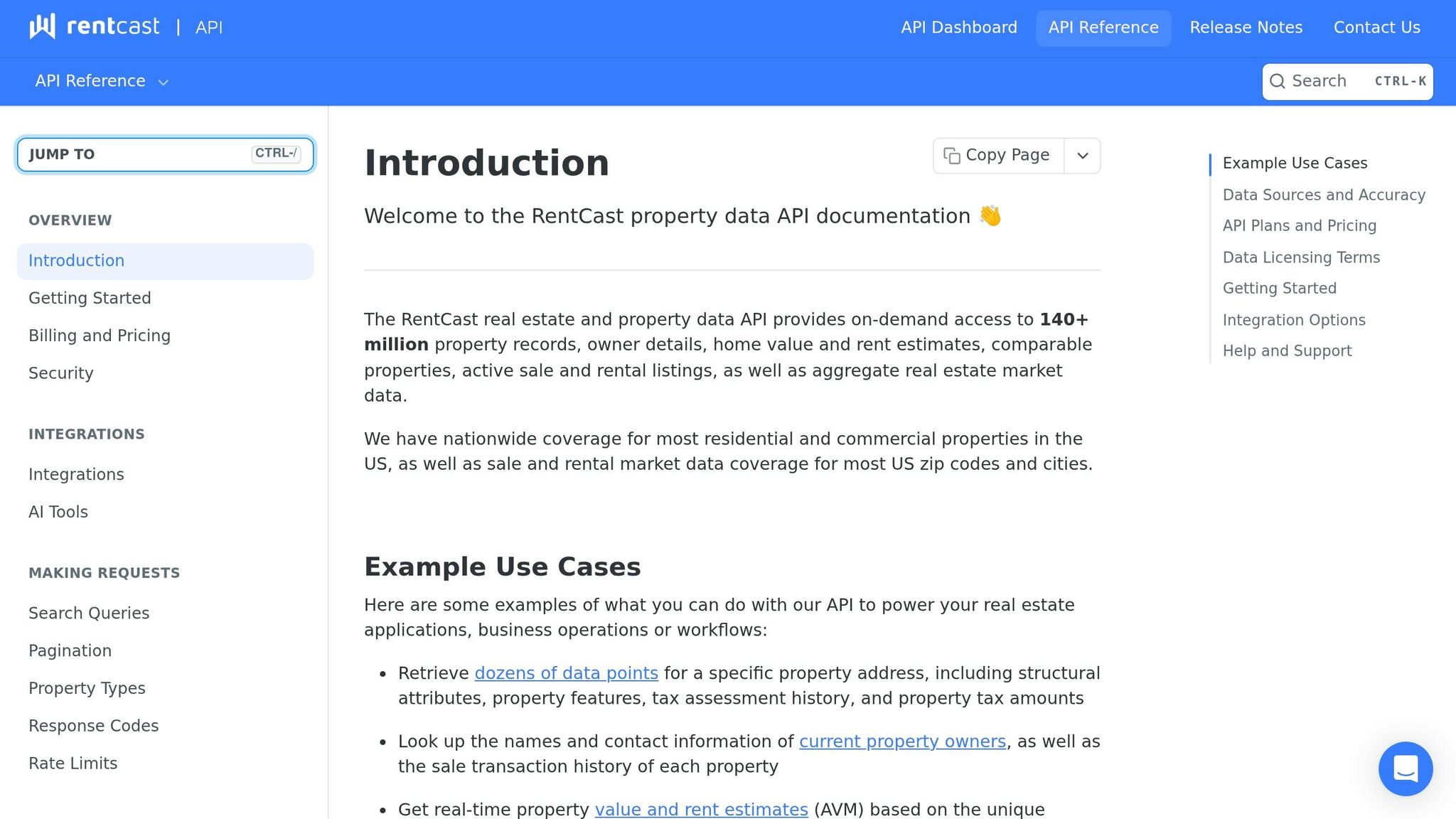
RentCast covers 140+ million property records across all 50 states, with 96% residential coverage for single-family homes, condos, townhomes, manufactured homes, and 2–4 unit multifamily properties, plus 90% coverage for 5+ unit multifamily properties like apartment buildings. It does not include office, retail, industrial, manufacturing, or farm properties.
U.S. Data Coverage
Listings update within 12–24 hours, while general property records refresh weekly. In plain terms, RentCast is a better fit for residential and multifamily search than for broad commercial property discovery.
AI-Ready Property Signals
For investor search, the main draw is its property valuation, and ownership data. RentCast provides AVMs for both property value and rent estimates. Each one comes with an estimate range, comparable properties, and comps correlation scores.
That matters when you’re trying to sort leads at scale. The ownerOccupied flag can help spot absentee owners, and taxAssessments history can help surface high-equity properties for lead scoring. For multifamily assets, there’s one detail you don’t want to miss: the value AVM is at the building level, while the rent AVM is at the unit level. Use the one that fits the asset type.
Those signals become much more useful when you can run them in bulk or plug them into an automated workflow. For larger projects, you might also integrate property data points via a RESTful API to handle high-volume requests.
Integration and Scale
Bulk queries return up to 500 records per request through limit and offset pagination. Searches can be scoped by city, state, ZIP code, or a latitude/longitude radius.
RentCast also offers an MCP server for AI editors and assistants. If you prefer no-code workflows, its Zapier integration connects RentCast with 6,000+ third-party apps, including Salesforce and Google Sheets.
Pricing and Usage Fit
Pricing comes down to one thing: how many requests you expect to make each month. The free tier includes 50 API requests per month. Paid plans use fixed monthly pricing, with overages charged above plan limits, and there’s no long-term contract. Enterprise pricing is custom.
| Plan | Monthly Requests | Contract |
|---|---|---|
| Free | 50 | None |
| Paid | Usage-based | No long-term contract |
| Enterprise | Custom | Custom |
5. HouseCanary API
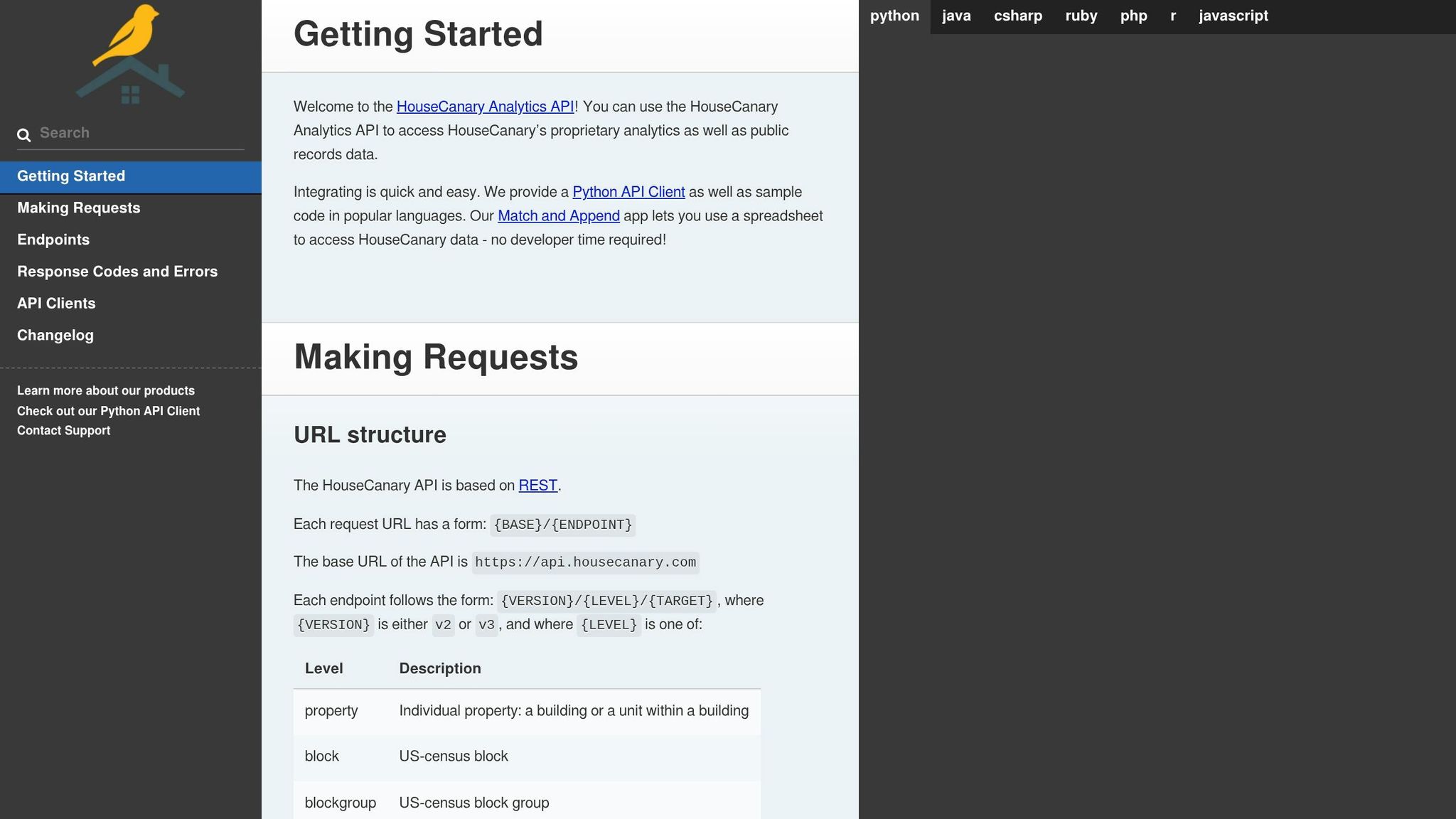
HouseCanary covers 136+ million properties across 19,000+ ZIP codes. It supports access at the property, block, ZIP code, metro division, MSA, and state level. That range makes it a strong option for valuation-led property search and market ranking.
U.S. Data Coverage
HouseCanary provides 122 million+ AVMs and 105 million+ rental valuations, with a 2.7% MAPE. It checks AVM accuracy against MLS listings and public record benchmarks every 2 days.
AI-Ready Property Signals
Coverage matters. But on its own, coverage is just a big map. The useful part is what you can do with that data.
HouseCanary adds forecasting and ranking signals, including 36-month value forecasts, 1-, 2-, and 3-year HPI forecasts, RPI forecasts, Market Grade, Market Action, Value by 6 Conditions, and Value Within Block. These signals can help teams rank properties, price deals, and spot market movement faster.
Market Grade gives a ZIP code a letter score from A to F based on how it compares with its MSA, while Market Action tracks supply and demand dynamics. Value by 6 Conditions estimates a property’s value across six physical condition levels, from C1 to C6. Value Within Block shows where a property’s price sits compared with nearby homes on the same block.
Integration and Scale
The API is REST-based and uses HTTP Basic Authentication. On the batch side, POST supports up to 100 items per call. The component_mget endpoint can also return multiple data points for one address in a single request.
Rate limits for self-serve accounts are:
- Analytics API: 250 components per minute
- Value and Rental Reports: 10 requests per minute
- Enterprise: custom limits
If your team needs bulk delivery instead of request-by-request API calls, HouseCanary also supports AWS and Snowflake delivery. There’s a Python SDK, plus sample code for Java, C#, Ruby, R, and Node.js. Developers can also integrate property APIs with n8n to automate workflows without heavy coding.
Pricing and Usage Fit
HouseCanary offers self-serve and enterprise tiers. Premium fields such as Land Value, LTV Details, and Value Forecasts cost extra and are available on both tiers.
One detail that can save money at scale: requests that return 429 (Rate Limit Hit), 400 (Bad Request), 401 (Authentication Failure), or 204 (No Content) are not charged.
Best fit: automated underwriting, portfolio risk monitoring, and valuation-led forecasting.
These strengths make HouseCanary a strong choice for valuation-heavy search. The next section looks at coverage, AI signals, integration, and cost across the APIs.
| Endpoint Category | Self-Serve Rate Limit | Enterprise Rate Limit |
|---|---|---|
| Analytics API | 250 components/min | Custom |
| Value Report | 10 requests/min | Custom |
| Rental Report | 10 requests/min | Custom |
| Value Analysis | 10 requests/min | Custom |
6. Zillow Bridge Interactive API
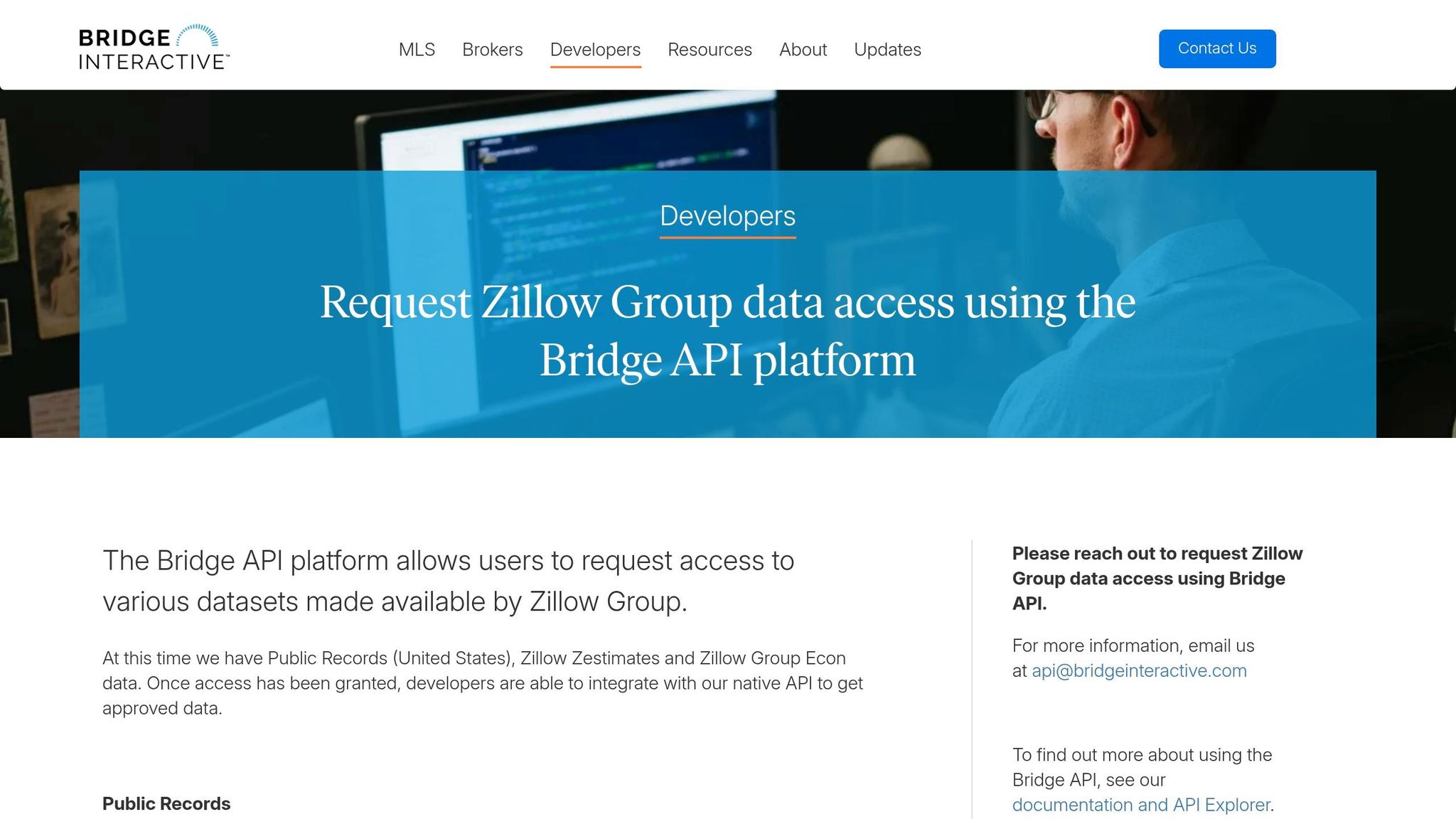
Zillow Bridge Interactive is the enterprise follow-up to Zillow’s retired public API. It gives approved users access to MLS listings, Zillow Public Records, Zestimates, and Zillow Economic Research metrics.
U.S. Data Coverage
Bridge covers about 148 million U.S. properties. That includes tax assessments, transaction history, and public records. For teams building search, ranking, or lead-scoring systems across the country, that kind of scale matters.
AI-Ready Property Signals
Bridge delivers a deep set of property signals, including Zestimates, Rent Zestimates, price history, tax history, listing status, school ratings, comps, and Zillow Economic Research metrics.
Those signals are useful for a few common jobs:
- Ranking and prioritizing leads
- Surfacing comps for agents and buyers
- Feeding AVM workflows with pricing and market data
The Economic Research metrics also add market-trend context, which can help with forecasting and model inputs.
Integration and Scale
The API uses the RESO Web API (Platinum Certified) standard with a RESTful / OData interface. In plain English, that means teams can work with a normalized data layer instead of stitching together a mess of mismatched fields.
Bridge also supports data replication, so teams can keep the dataset inside their own infrastructure. And if building OData queries sounds like a chore, the API Explorer gives teams a starting point instead of a blank screen.
Bridge is built for scale, but setup isn’t instant. It usually takes weeks to months, and access is limited to MLS members, licensed brokers, or Zillow partners. That’s a big deal when you’re comparing APIs on coverage, AI signals, integration work, and cost.
Pricing and Usage Fit
Access requires MLS affiliation, a broker license, or an enterprise partnership. Pricing starts at about $500/month, and MLS data costs are negotiated directly with each MLS provider.
Best fit: licensed brokers, MLS operators, and large proptech platforms with partnership access.
That puts Bridge in the same comparison set as other enterprise real estate APIs in this guide.
| Feature | Bridge Interactive Details |
|---|---|
| U.S. Property Coverage | ~148 million properties |
| Key AI Signals | Zestimates, Rent Zestimates, Price History, Tax History, School Ratings, Comparables |
| Data Standard | RESO Web API (Platinum Certified) |
| Integration Type | RESTful API / OData |
| Setup Time | Weeks to months |
| Starting Price | ~$500/month |
| Access Requirements | MLS affiliation, broker license, or enterprise partnership |
How the APIs Compare on Data, AI Signals, Integration, and Cost
Here’s how these APIs compare on the things that matter most when you’re building an AI-driven property search product.
| Criterion | What to Look For | Why It Matters for AI Search | Best Fit |
|---|---|---|---|
| U.S. Data Coverage | Nationwide coverage; off-market records; tax assessments; ownership history | Gaps in parcel or ownership data can cause misidentification and ranking errors | Zillow Bridge Interactive API, ATTOM, BatchData |
| AI-Ready Signals | AVMs, distress flags, equity data, flat, normalized JSON | Richer signals improve ranking, recommendations, and underwriting accuracy | BatchData, Zillow Bridge Interactive API |
| Integration & Scale | REST/JSON support, rate limits, webhook delivery, latency | Determines whether the API can handle production traffic without constant polling | BatchData, Zillow Bridge Interactive API |
| Pricing & Usage Fit | Entry cost, per-call cost, BatchData offers flexible pricing based on your use case and volume. Contact sales for current pricing. | High per-call costs can make AI agents expensive at scale | RentCast, Zillow Bridge Interactive API, BatchData, ATTOM |
The biggest gaps come down to data freshness, signal depth, integration work, and cost.
U.S. Data Coverage
Data quality and freshness shape how well AI models can match, rank, and score properties. If ownership or distress data is stale or incomplete, search accuracy drops fast. Models working from old records can misidentify owners, miss equity shifts, and surface leads that no longer fit.
BatchData pulls from 3,200+ county assessor and recorder offices with daily updates. Some older providers may refresh monthly or quarterly instead, which can leave real holes in the data used for ranking and alert logic.
AI-Ready Signals
For investor-focused search, the most useful signals are financial distress flags, equity levels, pre-foreclosure status, and ownership structure. Those signals help an AI system do more than just find properties. They help it sort for intent, risk, and deal potential.
BatchData surfaces investor-focused property and ownership signals and adds entity resolution to identify true owners behind corporate-held properties. On the consumer app side, Zillow Bridge Interactive API returns Zestimates and rent estimates along with listing and tax history in a single REST round trip.
Integration and Scale
Integration work is often the part that slows teams down. On paper, two APIs can look similar. In practice, one may take far less effort to run in production.
BatchData’s Smart Search uses a push/webhook setup, so properties are delivered as soon as they match your criteria instead of forcing repeated polling. That cuts infrastructure cost and lowers data latency. Zillow Bridge Interactive API also helps here with flat, normalized JSON responses, which means less parsing work when agents need to handle large record volumes cleanly.
Pricing and Usage Fit
Cost can change the whole math of an AI product, especially once usage climbs. A low entry point is nice, but per-call pricing starts to matter once agents are making lots of requests.
BatchData’s BatchData offers flexible pricing based on your use case and volume. Contact sales for current pricing. fits high-volume production platforms. RentCast’s free tier and ATTOM’s $95/month starting point are the easiest entry options for teams testing a use case before moving up in scale.
These trade-offs set up the practical pros and cons below.
Pros and Cons
Each API has one standout strength and one clear downside. The table below gives you the quick read: where each one shines, where it can get in the way, and the workflow it fits best.
| API Name | Pros | Cons | Best For |
|---|---|---|---|
| BatchData | 700+ property attributes; integrated skip tracing with event-driven push model via webhooks | Nested JSON can be token-heavy for small LLMs | Investor lead gen and outreach |
| ATTOM | 9,000+ attributes per property; official MCP server; institutional-grade distress and foreclosure records | Responses can exceed smaller LLM context windows | Institutional analysis and risk modeling |
| RentCast | Free tier (50 calls/month); low-cost entry at $0.002–$0.01 per call | Rental and valuation focus only; 75+ fields per property | Rental valuation workflows |
| HouseCanary | 36-month value forecasts; Market Grade and condition-based valuation signals | Legacy HTTP Basic Auth; $0.30–$0.50 per call | Valuation-led underwriting |
| Zillow Bridge Interactive API | Official Zillow access with Zestimates and MLS listings | Requires MLS affiliation or enterprise partnership | MLS-integrated property search |
Some trade-offs are pretty simple. If you want broad property data and built-in outreach support, BatchData stands out. If you need deep records for distress, foreclosure, or risk work, ATTOM gives you a lot more fields, but that depth can also make responses harder to fit into smaller LLM context limits.
RentCast is the low-cost option, which makes it a good starting point for rental-focused use cases. The catch is that it stays in a narrower lane. HouseCanary leans hard into valuation work, especially if forecast data matters, though its auth setup and per-call pricing may feel a bit old-school or pricey depending on your stack. And Zillow Bridge Interactive API is the clear choice if official Zillow and MLS-connected data are non-negotiable, but access is much more restricted.
The conclusion below distills these trade-offs into a final recommendation.
Conclusion
Pick the API based on your workflow. BatchData is the best fit for investor deal sourcing because its push-based alerts surface matches as soon as your criteria are met. After that, the right pick comes down to what matters most in your process: underwriting depth, rental screening, or valuation forecasting.
ATTOM works well for underwriting and portfolio analytics when you need lien, tax, and environmental risk data, though its responses can be large enough to strain smaller LLM contexts. RentCast is a good match for low-volume rental workflows and a low-cost pilot. HouseCanary makes sense for valuation-led workflows that need price forecasting.
For AI-driven property search, focus on data depth, delivery speed, and workflow fit instead of raw field count. AI search tends to work best when the data has clean schemas, clear specs, and push-based delivery.
FAQs
How do I choose the right property API for my workflow?
Choose a property API based on how your team works: real-time lookups for interactive apps, or high-volume batch processing for large-scale analysis.
For U.S. property data, focus on a few things that matter most:
- Broad U.S. coverage
- Deep property details
- Support for complex multi-location queries
- Integration options that fit your stack, like REST/JSON and asynchronous endpoints
Providers like BatchData can help cover those needs.
Which API is best for off-market lead generation?
For off-market lead generation, BatchData Smart Search API is the best pick.
Unlike one-off searches, it keeps scanning the national database and sends new matching properties straight to your CRM or marketing platform in real time through webhooks.
You can tighten that lead list even more with the Skip Tracing and Contact Enrichment API. That helps you identify the people behind LLCs and trusts and reach the actual decision-makers.
What should I check before integrating a property data API?
Check whether the provider gives you enough depth in the data, updates it often enough for your use case, and keeps the schema consistent across regions and source types.
On the implementation side, look for a sandbox or interactive docs, REST/JSON endpoints, auth details like bearer tokens, and SDK support for your preferred programming language.