






































SEO Title: How to Get Solar Leads With Data-Driven Targeting
Meta Description: Learn how to get solar leads with a data-first playbook covering targeting, channels, outbound, nurturing, and ROI.
Meta Keywords: how to get solar leads, solar lead generation, solar marketing, solar outbound, property data targeting, solar lead nurturing, solar lead ROI, BatchData
Most solar companies don't have a lead problem. They have a targeting problem. In residential solar, the average lead-to-close rate sits at 8% to 12%, while top performers reach 15% or higher with better lead sources, fast response, and tighter sales execution, according to AgentZap's solar lead statistics.
If you're serious about how to get solar leads, stop thinking in terms of "more traffic" and start thinking in terms of better homeowner selection, better routing, and faster follow-up. Broad PPC, generic zip code mailers, and recycled bought leads still work sometimes. They also waste a lot of budget when your audience definition is sloppy.
Here’s the short version:
- Use property-level signals, not broad demographics. Equity, ownership status, permits, and property condition tell you more than age bands and household income.
- Run a channel mix on purpose. Paid gets you speed. Organic compounds. Data-driven outbound gives you control.
- Build outreach around context. A homeowner responds better when your message fits the property.
- Treat speed-to-lead as a revenue lever. The first company to respond wins most deals.
- Measure closed revenue by segment. CPL alone hides bad channels and bad lists.
How Do You Define Your Ideal Solar Customer?
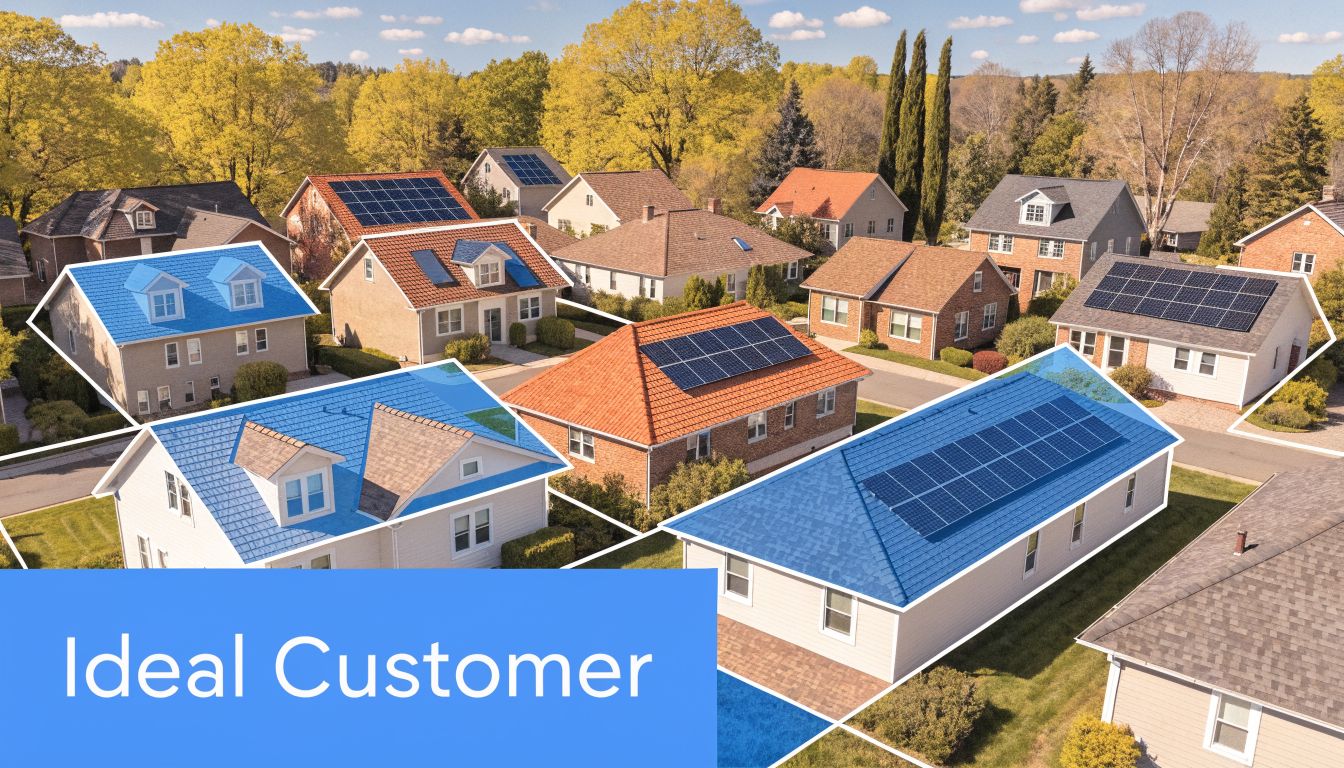
Your ideal solar customer is not a persona. It's a property-and-owner record with clear purchase signals.
Most solar teams still target the old way. They pick affluent neighborhoods, throw a radius around a city, then push door-to-door, direct mail, or paid ads into that area. That method is easy to explain. It's also blunt. You end up paying to reach renters, low-equity owners, homes with poor solar fit, and households with no financial reason to act now.
The better model is data-first. You build a list from observable property and ownership signals, then market to that list.
Why zip codes are a bad targeting model
Zip codes hide too much variation. One block can contain the exact homeowner you want and five you don't.
A useful solar target model starts with the property itself:
- Owner occupancy: Owner-occupied homes usually beat absentee-owned properties for residential solar outreach.
- Home equity: High-equity homeowners often have more financing flexibility and stronger motivation to invest in the property.
- Property type: Single-family homes are usually a cleaner operational fit than more complex structures.
- Physical solar viability: Roof size, pitch, shading, and obstructions affect whether the lead is even worth your sales team's time.
- Intent signals: Recent permits, remodeling activity, listing history, mortgage changes, or distress signals can indicate motivation and timing.
Practical rule: If your targeting method can't explain why this specific property should buy now, it isn't a targeting method. It's list rental with nicer branding.
One reason this matters is conversion. An underserved strategy is using property data platforms for hyper-targeted outreach, and a 2025 NREL report noted 28% higher conversion from equity-qualified leads, as summarized in this analysis of data-led solar prospecting.
What a high-propensity solar audience actually looks like
A usable audience model usually combines financial fit, physical fit, and timing.
Here’s a practical framework:
Start with ownership
- Owner-occupied
- Single-family residence
- Clean ownership record for direct outreach
Layer in financial capacity
- Strong equity position
- No obvious signs the homeowner can't take on a long-cycle home improvement decision
- Mortgage and lien context if available
Check property suitability
- Roof geometry that likely supports installation
- Lot and structure conditions that suggest usable sun exposure
- Home size as a rough proxy for energy demand
Add timing signals
- Recent home improvement permits
- Refinance or valuation changes
- Distress or pre-foreclosure indicators where relevant to your market and offer
That last point is where most generic guides fall apart. They talk about "homeowners interested in saving money." That's too broad to be useful. Better operators care about whether the owner is reachable, qualified, and likely to move this year.
For a broader tactical overview, this ultimate guide to solar leads generation is useful background. The gap is that broad channel advice becomes much stronger once it's anchored to property-level targeting instead of geography alone.
How to build the list
The process is simple in concept.
Use a property data platform to pull a list of homes that match your operating footprint and your install criteria. Filter by occupancy, home type, equity, ownership duration, permit activity, and any other signals you trust. Then validate which segments produce appointments and closed jobs.
Geospatial analysis sharpens this further. Terrain, parcel characteristics, neighborhood patterns, and valuation context all affect whether a lead should enter your campaign at all. This is why teams doing serious location intelligence increasingly use methods like the ones outlined in geospatial analysis for automated valuation models.
The point is simple. Your ideal solar customer isn't "a homeowner in a nice area." It's a living list that updates as property conditions and owner signals change.
Which Lead Generation Channels Actually Work in 2026?
Teams that rely on one channel usually pay for it twice. First in inflated acquisition cost, then in pipeline volatility when that channel gets crowded.
For solar in 2026, three channels still matter: paid media for speed, organic content for compounding demand, and data-driven outbound for control. They do different jobs. The mistake is forcing one channel to solve every growth problem.
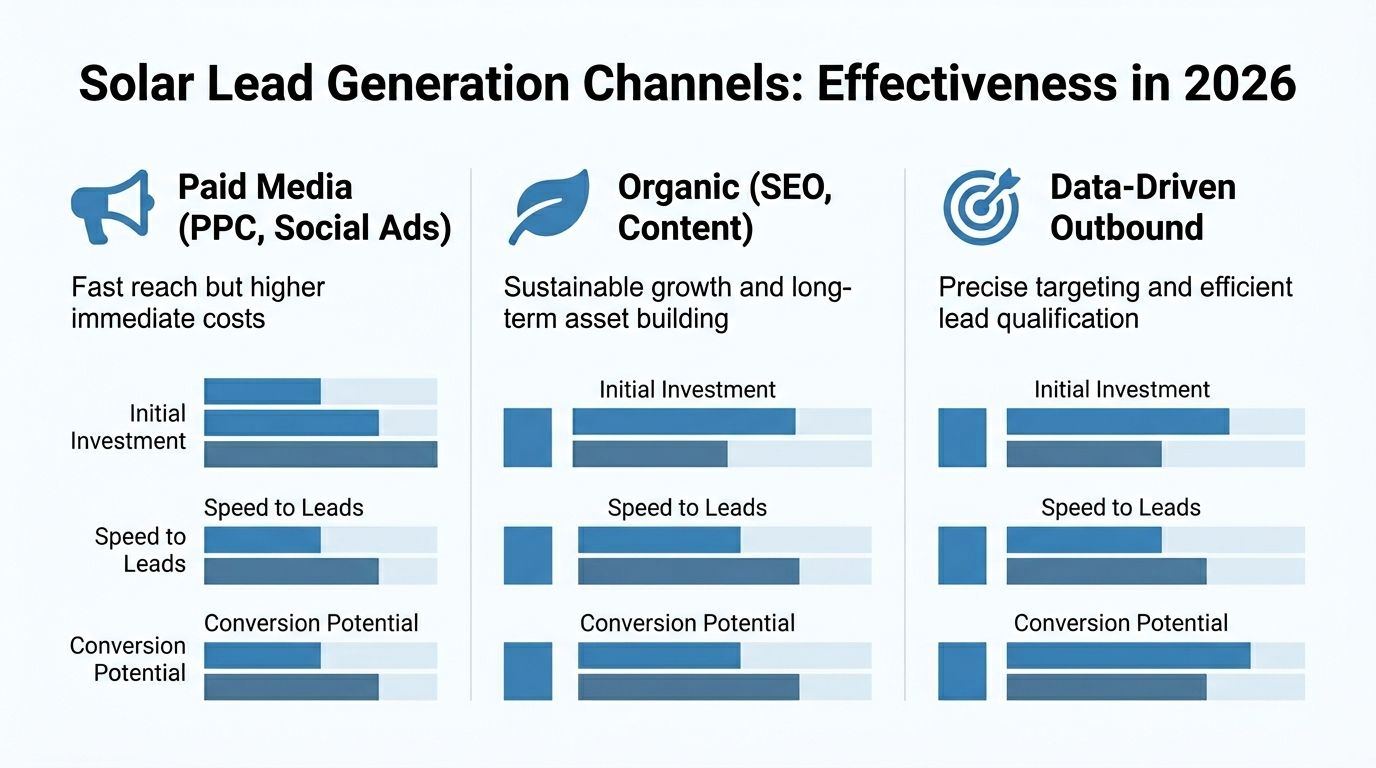
The better question is not which channel is best. It is which channel matches your current constraint. Need appointments this month? Paid can do that. Need lower acquisition cost six months from now? Organic helps. Need a way to reach qualified homeowners before every local installer starts bidding on the same clicks? Property data gives you that path.
Solar lead generation channel comparison
| Channel | Typical CPL | Lead Quality | Scalability | Speed to Results |
|---|---|---|---|---|
| Paid media and purchased leads | Higher than owned channels in many markets, with hybrid benchmarks discussed by Phantom Digital | Mixed. Strong on bottom-funnel search, weaker on broad audience targeting and reseller leads | High if budget is available | Fast |
| Organic content and SEO | Often lower over time than paid and third-party lead sources | Higher quality once content ranks and matches buyer intent | High, but slower to build | Slow at first, then compounding |
| Data-driven outbound | Varies by list quality, contact coverage, and channel mix | High when the list is built from property and ownership signals | High if data hygiene and sales ops are disciplined | Medium |
Paid media works fast, but it exposes sloppy execution
Paid search and paid social can fill the calendar quickly. They are useful when a new market needs volume, when setter capacity is underused, or when you need immediate feedback on offer and messaging.
They also waste money faster than any other channel.
The usual failure points are operational, not philosophical:
- Broad keyword buying: spend goes to researchers, renters, and homeowners outside your install criteria
- Weak landing pages: traffic clicks, bounces, and leaves no usable intent signal
- Slow speed to lead: the inquiry is real, but the contact attempt is late
- Poor CRM routing: reps cherry-pick or leads sit unworked
- Dependence on aggregators: you buy the same consumer multiple installers are calling
Paid is rented demand. Use it, but do not build the whole company around it.
Organic content lowers acquisition cost, but it needs time
Organic works best when the business already knows the questions real buyers ask before they book an appointment. Good content pulls in financing searches, roof replacement questions, local incentive research, utility rate concerns, and installation timing queries. It also gives sales a warmer conversation because the prospect has already done some homework.
The trade-off is simple. Organic rarely fixes a short-term pipeline gap. It builds an owned inbound engine that gets stronger if you keep publishing the right pages and supporting them with internal links, local proof, and clean conversion paths.
A practical overview of multi-channel demand generation is covered in this guide on how to get more leads. For solar, I would add one correction: content works better when it is paired with property intelligence, because traffic volume alone does not tell you which homes you should prioritize.
Data-driven outbound is the channel with the most upside
In this context, strong operators separate from everyone buying the same clicks.
Outbound works when it starts with property data, not a random list broker. BatchData lets you build homeowner audiences from ownership status, parcel details, equity signals, location, and other filters that matter to installability and sales efficiency. That changes outreach economics. You stop marketing to a ZIP code and start working a ranked set of properties.
That matters more in crowded states where installer density drives up ad costs. If you operate in California, the county-level patterns in our Investor Pulse reports for California are the kind of context worth layering into your territory planning before you launch outbound.
Property-led outbound gives you three advantages:
- Earlier access to intent: you can target homeowners based on property and ownership signals before they start clicking ads
- Better channel fit: direct mail, phone, and email all perform better when the list is selected for a reason
- More control: your pipeline is less exposed to auction pricing, aggregator quality swings, and platform volatility
I would not frame outbound as a replacement for inbound. It is the channel that lets you create your own market coverage where paid is expensive and SEO is still ramping.
Use the channel mix like this:
- Choose paid media when you need near-term volume and can manage follow-up tightly
- Choose organic when you want stronger economics over time and can wait for the asset to build
- Choose data-driven outbound when you want precision, territory control, and a way to reach high-intent homeowners before competitors see them
The strongest solar lead engine uses all three, but not equally at every stage. Paid captures current demand. Organic builds future demand. Property data, especially through BatchData, helps you bypass saturated channels and reach the right homeowners first.
How Can You Execute a Data-Driven Outbound Campaign?
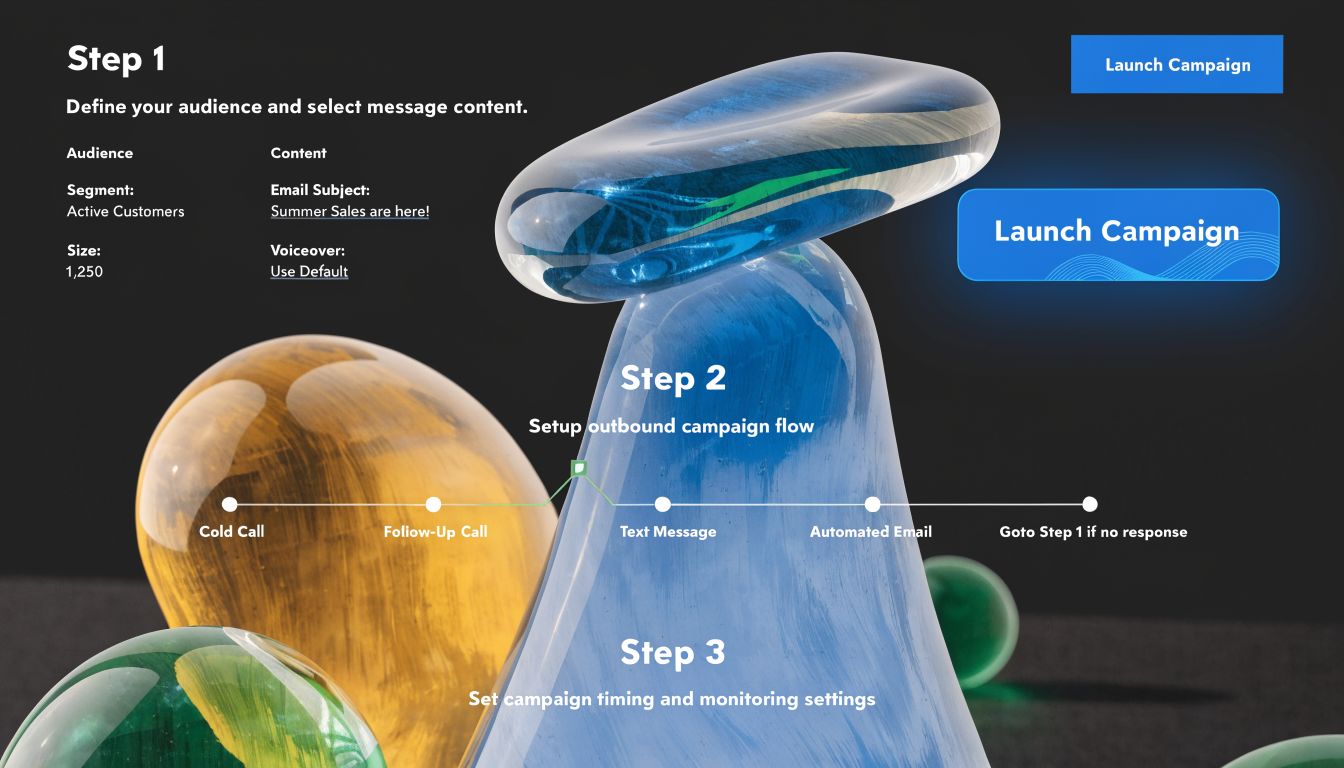
A strong outbound campaign starts with a tight list, clean contact data, compliant outreach, and a sales process that gives reps context before the first touch.
Most outbound fails before the first call. The list is sloppy, the messaging is generic, and the reps don't know why the homeowner is on the list. That turns outbound into interruption instead of relevance.
Build the list before you build the message
Start with property filters, not creative.
A practical outbound list for solar usually includes:
- Owner-occupied homes
- Single-family residences
- A defined service area or utility footprint
- Meaningful home equity
- Signals of likely solar viability
- Recent events that imply homeowner attention or urgency
Then enrich the list with reachable contact data. If you're calling or emailing, you need verified records, confidence indicators, and suppression steps built into your workflow. If you're mailing, you still need segment logic so the message fits the record.
Good outreach depends on context. A homeowner should feel that your company understands something real about their property, not that you dumped a script onto a random street.
Use segments that sales can actually work
Do not hand one giant list to the call center.
Break it into segments such as:
| Segment | Why it matters | Message angle |
|---|---|---|
| High equity owner-occupied homes | Strong financial fit | Payment stability and long-term home value framing |
| Homes with recent permit activity | Indicates home improvement motion | Add solar while the homeowner is already making decisions |
| Pre-foreclosure or distress-adjacent records | Timing and cost pressure may be present | Utility cost stability and financing conversation, handled carefully |
The point of segmentation is operational. Your setter should know the likely reason the homeowner made the list.
Write outreach that sounds informed
Most solar outbound scripts are awful because they sound mass-produced.
Better opening lines use context without sounding creepy. Keep them plain.
Cold call opening
We work with homeowners in your area who are evaluating whether their property is a good fit for solar. I’m calling because your home matches the kind of profile we usually review for owner-occupied installations. Would it be unreasonable to ask a couple of quick questions?
Email opening
Subject: Quick question about your home and solar fit
We’re reviewing homes in your area that may be good candidates for residential solar. If you’ve considered lowering long-term utility exposure or improving the property's energy profile, I can tell you whether it’s worth a conversation.
Direct mail angle
Your property may be a stronger solar candidate than the average home in your area. If you'd like a quick fit check, request a review.
That last step matters. You are not trying to close from the first touch. You are trying to earn the next step.
A lot of general lead-generation advice still applies here. This practical guide on how to get more leads is useful because it reinforces a truth many outbound teams miss: lead volume is worthless if the workflow around it is weak.
Run outreach with compliance and routing discipline
At this stage, many teams get careless.
Before launch:
- Scrub contact records against the proper suppression and compliance lists for your outreach method.
- Deduplicate by property and owner so multiple reps don't collide on the same household.
- Assign call windows and follow-up ownership inside the CRM.
- Define segment-specific cadences rather than one universal sequence.
Later in the cycle, portfolio-level market monitoring becomes useful. State-level shifts in ownership pressure, distress patterns, and market conditions can help you decide when to refresh lists or change messaging. Our Investor Pulse reports are useful for that kind of campaign timing.
Here’s a useful walkthrough before you operationalize the sales handoff:
Tighten the sales handoff
Outbound doesn't end when someone replies. It ends when sales takes control cleanly.
A structured sales process matters here. To avoid the classic one-legger problem, ask "Who else is involved in this decision?" early. And deals close 53% faster when next steps are clearly outlined in the initial calls, as cited in SolCertain's breakdown of solar sales process discipline.
That means your setter or closer should leave the first real conversation with:
- A defined next meeting
- The right decision-makers identified
- A clear explanation of what happens next
- Notes tied to the property record, not trapped in a rep's memory
Good outbound is not clever copy. It's clean targeting plus disciplined execution.
How Do You Optimize Lead Capture and Nurturing?
Companies that contact a lead first win a disproportionate share of deals. In solar, that advantage is large enough to shape the entire operating model. The first company to contact a lead wins 78% of sales, according to AgentZap's solar benchmark review.
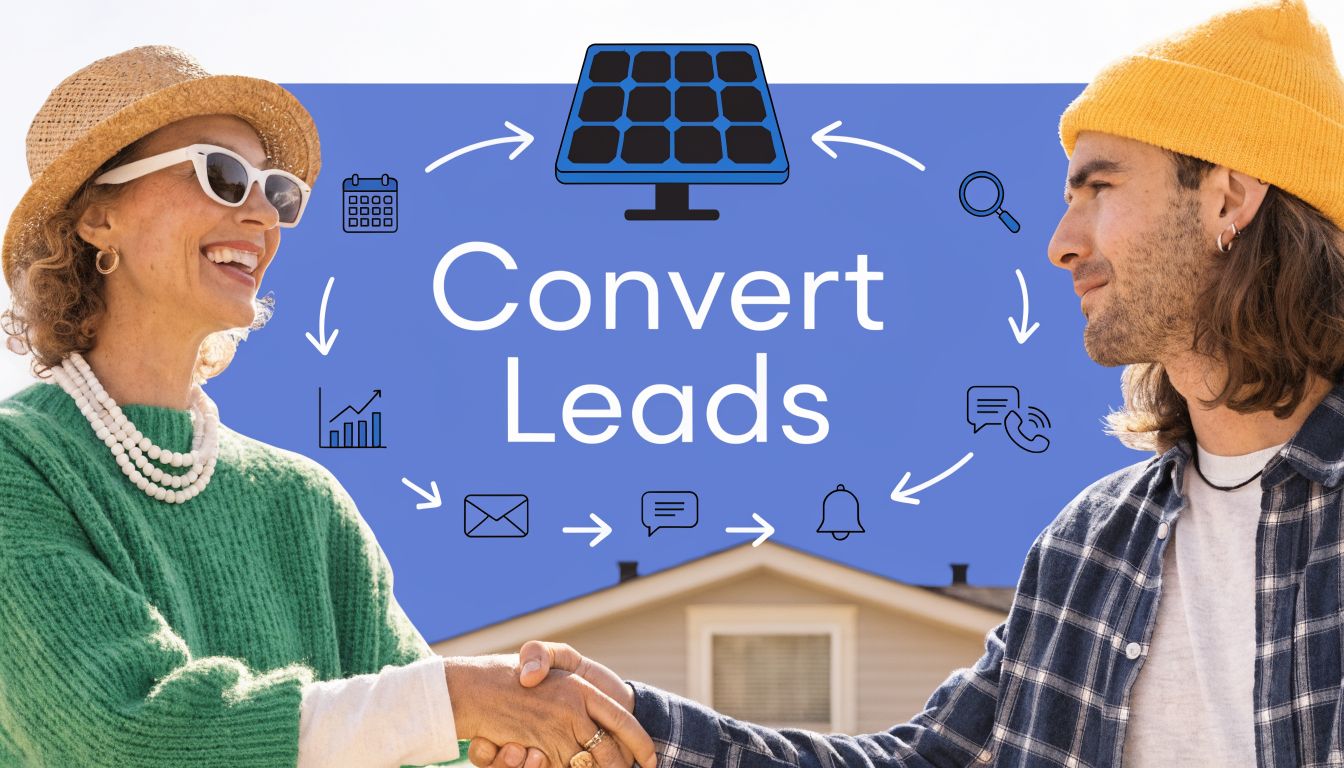
That means lead capture is not a web form problem. It's a speed, routing, and qualification problem.
Capture fewer fields, enrich the record later
A lot of solar teams still build forms for the sales manager instead of the homeowner. They ask for roof age, electric bill, financing preference, utility provider, and timeline before the prospect has any reason to trust them.
That hurts conversion.
The form should collect the minimum needed to start qualification and trigger the right follow-up:
- Name and contact details
- Property address
- Homeownership confirmation
- A simple intent signal, such as quote request, bill savings review, or eligibility check
The address does the heavy lifting. Once you have it, you can append property data through BatchData, check parcel and ownership details, flag likely owner-occupied homes, and route the lead based on real property context instead of asking the homeowner to fill out your CRM for you.
This is one of the cleanest advantages in solar. Saturated channels push everyone into the same inbox and the same auction. Property data lets you qualify in the background.
Use the address to personalize the first touch
A generic autoresponder is better than silence, but not by much.
If the lead includes a valid property address, the first response should reflect that record. Reference the property, the service area, and the next step. If your team uses BatchData well, the rep can open the record with ownership info, mailing match, and other property signals already attached. That shortens qualification and makes the outreach feel relevant instead of scripted.
For operators planning campaigns around broader homeowner trends, data like our Investor Pulse reports can also help you decide which markets deserve tighter follow-up standards and faster routing.
Build response logic before you buy more traffic
Lead quality usually gets blamed first. In practice, a lot of the waste comes from weak intake ops.
Set up the workflow in this order:
- Instant confirmation by SMS or email
- Automatic CRM assignment based on geography, channel, or lead type
- Fast first-call attempt
- A scheduled follow-up sequence if the first call misses
- Status tags that reflect buying stage, not just contact status
A lead marked "new" or "contacted" tells sales almost nothing. Better stages are "researching," "quoted," "needs spouse on call," "financing questions," or "timing delayed." Those labels create usable next actions.
I care less about fancy nurturing software than I do about whether the rep knows exactly what to do next.
Nurture based on timing and friction
Homeowners stall for predictable reasons. They want a second opinion. They need another decision-maker. They are waiting on a roof repair. They like solar but freeze when financing enters the conversation.
Your nurture should answer the actual blocker.
| Lead state | Likely friction | Useful follow-up |
|---|---|---|
| Early research | Low trust, low urgency | Plain-language education, process overview, savings explainer |
| Comparing bids | Vendor confusion | Clear differentiators, timeline clarity, proof of install process |
| Delayed project | Timing or budget | Light check-ins, financing updates, seasonal reminders |
| Went dark after consult | Unresolved objection | Short recap, direct objection handling, specific next step |
Good nurturing feels like organized sales memory. Bad nurturing feels like software sending emails because the workflow said day 6.
Keep the handoff clean inside the CRM
A lot of conversion loss happens after the form fill and before the actual sales conversation. Reps call without context. Notes live in text messages. Nobody can tell whether the homeowner is unqualified, undecided, or unreachable.
Fix that with strict CRM rules:
- Every lead record needs an owner
- Every call outcome needs a disposition
- Every active lead needs a next task
- Every property record should hold the notes
If a rep leaves, the lead should still be workable. If marketing changes channels, sales should still be able to compare outcomes by segment. That only happens when the lead record is tied to the property and updated with discipline.
Good lead capture gets more leads into the system. Good nurturing gets more revenue out of the leads you already paid for.
How Should You Measure ROI and Scale Your Efforts?
A solar lead source is only valuable if it produces installs at a margin you want to keep.
That sounds obvious, but teams still overmanage cost per lead and undermanage payback. I care more about cost per sit, cost per close, gross profit per install, and time-to-close by property segment. If a channel brings in cheap form fills from weak-fit homeowners, it is not efficient. It is just cheap at the top of the funnel.
Start with a simple scorecard for every channel, list, and campaign segment:
- Lead volume
- Contact rate
- Consult or site visit rate
- Proposal rate
- Lead-to-close rate
- Customer acquisition cost
- Gross revenue and gross margin by deal
- Sales cycle length
- Rep hours required per closed install
That last metric gets ignored too often. Two channels can produce the same acquisition cost on paper and still perform very differently if one burns twice as much rep time.
Tie performance back to the property record
Generic attribution becomes inadequate for solar because you are not just buying clicks; you are targeting homes with specific physical and financial traits.
Track outcomes against the property record, not only the marketing source. With BatchData, that means comparing close rates across attributes like owner occupancy, estimated home value, mortgage age, length of ownership, recent listing activity, and solar suitability signals in your own model. Over time, you will see patterns that matter more than channel labels.
Example:
- A PPC lead from a long-tenure owner in a high-power-cost area may close well
- A direct mail lead from absentee owners may book calls and still die in underwriting
- A cold outbound list built from the right owner-occupied homes can outperform broader inbound traffic on margin
That is the advantage of a data-first system. You are not asking, "Did Facebook beat Google?" You are asking, "Which property profiles produce profitable installs fastest, and which channels reach those profiles efficiently?"
Use a practical attribution model
You do not need a complicated stack.
Use first-touch, last-touch, and property segment in the same report. First-touch shows what created demand. Last-touch shows what captured it. The segment tells you whether the lead was worth chasing in the first place. If you only look at one layer, you will misread performance and fund the wrong channels.
Sales feedback belongs in this model too. Lost reasons should be structured, not buried in notes. Roof condition, low utility bill, financing decline, no decision-maker present, HOA friction, and timing issues should all be tracked in fixed fields. That gives marketing something useful to act on during the next list build.
Scale by tightening the list before raising spend
The fastest way to waste money is to scale a channel before you know which subset of homes is carrying the economics.
Expand in this order:
- Increase volume inside your best-performing property segment
- Test adjacent segments with one variable changed
- Add budget to the channel that reaches those segments at acceptable CAC
- Cut segments that create activity without installs
If owner-occupied homes built between certain years, with higher estimated equity and no recent refinance, are producing better payback, pull more of those records first. If conversion falls when you broaden geography or loosen filters, that is your warning that scale is reducing quality.
Broader market reports also help with expansion planning. I use signals like transaction activity, investor concentration, and regional housing shifts from our Investor Pulse reports to pressure-test where a list strategy is likely to hold up.
Know when to cut, not just when to spend more
Scaling is not adding budget everywhere that looks promising for two weeks.
Set clear thresholds. If a segment misses your target close rate after enough lead volume to judge it fairly, cut it. If a campaign needs constant manual rescue from reps, fix the targeting before you send more. If a channel only works with aggressive discounting, the acquisition math is weaker than it looks.
The goal is a repeatable lead engine. Better property data, cleaner attribution, disciplined segment testing, and fast feedback from sales are what make that possible.
Frequently Asked Questions About Solar Leads
Should you buy solar leads or build your own pipeline?
Build your own pipeline if you want control over margin, speed, and lead quality.
Bought leads can help when a market opens fast or your setters have open capacity, but they come with hard limits. You do not control when the lead was generated, how many competitors saw it first, or how well the original form qualified the homeowner. That is why purchased volume often looks fine on a CPL report and weak on installs.
The economics also get worse as competition rises. Boberdoo's solar lead generation stats show exclusive leads command a meaningful premium over shared leads. That premium only makes sense if your speed-to-lead, call discipline, and close process are already tight.
For many organizations, the better long-term play is to build a house list from property data, then target owner-occupied homes with the right equity, roof age proxy, home value, and location fit before those homeowners ever fill out a marketplace form. BatchData is useful here because it gives you the raw records and ownership detail to build that audience yourself instead of renting access to it from lead sellers.
What lead sources usually convert best?
The best source is the one that produces installs at acceptable CAC in your target segment.
Referral volume is usually high quality but hard to scale on demand. Search leads can work, but they get expensive in saturated markets and often attract homeowners who are comparing five bids at once. Door-to-door still works in some zip codes, especially where rep density is low and utility rates are painful, but labor management is harder than operators admit.
Property-data outbound deserves more attention than it gets. If you can pull likely solar-fit households by ownership type, estimated equity, purchase timing, lien profile, and geography, you can reach homeowners earlier in the decision cycle. That often means less competition and a cleaner sales conversation.
How do you measure ROI beyond basic CPL?
Start with contribution to revenue, not lead volume.
Track cost per qualified appointment, cost per issued proposal, cost per signed deal, cost per install, and gross margin after commissions and incentives. Then look at the hidden labor load. A cheap lead source that burns rep time with bad contact data, low ownership match, or poor property fit is not cheap.
I also look at time-to-contact, appointment show rate, proposal rate, pull-through to install, and cancellation rate by source. Those numbers tell you which channels create real pipeline and which ones create admin work.
If you run outbound, measure list quality at the segment level. For example, compare owner-occupied single-family homes with higher estimated equity against broader homeowner lists. In practice, narrower targeting often wins because reps spend more time talking to plausible buyers and less time chasing noise.
What should you say when a homeowner objects about roof fit or cost?
Keep the conversation tied to the property and the bill.
If the objection is roof fit, do not argue from memory or guesswork. Say that solar fit depends on the home's layout, orientation, shade, roof condition, and utility usage, then offer a quick review. A homeowner will keep talking if the next step feels simple.
If the objection is cost, anchor the discussion in monthly economics and hold period. Compare current utility spend, expected rate increases, available financing, and how long the homeowner expects to stay in the property. A household with strong credit, high summer bills, and meaningful home equity needs a different conversation than a price-shopping lead with weak usage.
Short scripts beat long rebuttals.
Is door-to-door still worth it?
Yes, in the right pockets.
It works best when you have tight turf selection, strong rep management, and neighborhoods that match your install profile. It breaks down when teams blanket broad areas with no property filtering and hope effort makes up for weak targeting.
A better approach is to use property data first, then send reps only into blocks where ownership, home type, tenure, and value suggest a real shot at conversion. The same list can support calling, direct mail, and field outreach, which makes channel testing easier and reduces wasted knocks.
What is the fastest way to find high-intent solar prospects before competitors do?
Use property-triggered prospecting instead of waiting for inbound demand.
New homeowners, households with strong equity, homes in high-rate utility territories, and owners showing financing capacity are often better outbound targets than generic interest audiences. With BatchData, teams can pull from 155M+ U.S. property records, layer in ownership and valuation signals, and prioritize records for outreach based on who is most likely to buy.
That is the core advantage of a data-first solar lead engine. You stop bidding for the same homeowner everyone else is chasing and start building demand from records your competitors have not worked yet.